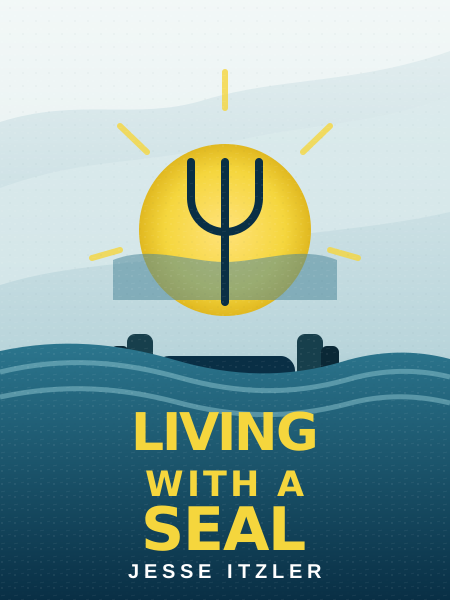
Living with a SEAL
Jesse Itzler · 2015
Editorial rating
- Evidence
- 3/10
- Actionability
- 6/10
- Originality
- 7/10
The thesis
Most people live on autopilot at 40% capacity. Discomfort reveals your actual limits. Entrepreneur Jesse Itzler hired a Navy SEAL (David Goggins) to live with him for 31 days and break him out of comfort - through brutal workouts, mental toughness, and zero excuses.
Who this is for
Successful people who feel like they're coasting, anyone stuck in routines that feel too comfortable, and those curious what happens when you inject chaos into your privileged life for a month.
My favorite quote
When you think you're done, you're only at forty percent of what your body is capable of doing. That's just the limit that we put on ourselves.
Why it matters
This reframes exhaustion as a choice, not a biological limit. Your brain quits before your body does.
Do this
Next workout, when you want to quit, do 10 more reps. Test the 40% rule yourself.
Start here
The 40% Rule: When your mind says stop, you're at 40% of actual capacity. This is the only concept you need. The rest is entertainment. SEAL (David Goggins) doesn't teach technique - he teaches that your limits are self-imposed. Discomfort is the price of finding your real ceiling.
Critical summary
Jesse Itzler - entrepreneur (co-founded Marquis Jet, sold Zico to Coca-Cola), part-owner of Atlanta Hawks, married to Spanx founder Sara Blakely - felt stuck on cruise control. Solution: Hire the guy he saw run a 100-mile ultramarathon solo in 24 hours (breaking both feet, pissing blood) to move into his house for a month.
The SEAL is David Goggins, though the book never names him. Goggins: only person to graduate Navy SEAL training, Army Ranger School, and Air Force Tactical Air Controller training. Holds world record for pull-ups in 24 hours (4,030). Ultramarathon legend. Completely insane work ethic.
What it gets right
- The 40% rule is genuine: Most people quit far before physical limits
- Getting comfortable with discomfort is transferable: Running in 14°F weather teaches you can handle client conflicts, tight deadlines, hard conversations
- External accountability works: Itzler would never do this alone. SEAL made it non-optional
- Simplicity beats complexity: SEAL's workouts are bodyweight basics - push-ups, pull-ups, running. No equipment excuses
What it misses
- Zero methodology: "Just do hard shit" isn't a training program. No periodization, recovery science, or progression
- Privilege blind spot: Itzler can afford to hire a live-in trainer, has a home gym, flexible schedule. "Just push harder" advice doesn't translate to single parent working two jobs
- Survivorship bias: Goggins is a genetic outlier who thrives on punishment. Normal humans need rest days
- Repetitive: Same "SEAL is intense, Jesse whines, SEAL pushes him harder" loop for 250 pages
- No long-term sustainability: 31 days of brutality ≠ lifestyle. What happens on day 32?
Evidence quality: Weak. This is one rich guy's n=1 experiment, zero science. Goggins' philosophy is rooted in military training (which has real methodology), but the book presents none of it - just war stories. The 40% concept is interesting but unsubstantiated. Think of it as motivational entertainment, not training advice.
Critics say: "Repetitive and a lot of whiny rich white guy stuff." Fair. Also: the lack of Goggins' name in the book is weird - everyone knows it's him, and he later wrote Can't Hurt Me (much better book).
Key concepts
The 40% Rule
Your brain quits at 40% of actual capacity. When you think you're done, you're barely started. Test this during next workout - go past "failure."
Comfortable = Complacent
If your life feels easy, you're not growing. Do one uncomfortable thing daily. Today: cold shower for 3 minutes.
"It doesn't have to be fun, it has to be effective"
Stop optimizing for enjoyment. Results come from doing hard things consistently. This week: do the task you've been avoiding.
No Excuses Culture
Temperature, soreness, tiredness - all excuses. Conditions don't matter. Today: run even if weather sucks.
"I don't stop when I'm tired, I stop when I'm done"
Reframe exhaustion as input, not stop sign. Finish what you start, period.
Core insights
-
Autopilot is the enemy
Most people cruise at 60% effort because 60% is enough to get by. Real growth requires deliberate discomfort.
-
External constraints work when internal discipline doesn't
Itzler needed SEAL because self-imposed rules are negotiable. Make commitments you can't back out of.
-
Mental toughness transfers across domains
Running 6 miles in freezing rain teaches you can handle board meetings, difficult conversations, and startup chaos.
-
Your comfort zone expands permanently
After 31 days, Itzler's baseline shifted. What was hard week 1 became normal week 4. Push boundaries and they stay pushed.
-
Most people will never know their limits
Goggins' point: who wants to die without discovering their collapse point? That's tragic.
Implementation steps
Today
- Do one thing that scares you or makes you uncomfortable (public speaking, cold call, difficult conversation)
- When you want to quit next workout, add 10 more reps/5 more minutes
This week
- Every day at 6 AM: 100 push-ups (break into sets if needed). No negotiation.
- Take one cold shower (start warm, finish 3 min cold)
- Run/workout in bad weather - don't wait for conditions to be perfect
This month
- Design your own 30-day challenge: one hard thing daily (100 push-ups, no sugar, write 500 words, etc.)
- Find accountability partner who won't let you quit
- Track capacity: when you think you're done, push 25% farther. Log how far you actually had left.
Ongoing
- Default to discomfort: when choosing between easy and hard, pick hard
- Audit your excuses: what are you not doing because of "conditions"?
- Expand comfort zone quarterly: pick new scary thing every 3 months
Suggested 30-day practice plan
An editorial application plan created by Monolithic Vault - an interpretation of the book's ideas, not part of the original book.
- Day 1
Define your hard thing (100 push-ups daily, run every morning, etc.). Commit publicly.
- Day 7
Debrief: What excuses surfaced? Which were real constraints vs. mental?
- Day 14
Add second challenge (cold showers, no complaining, extra reps when tired)
- Day 21
Reflect: What's easier now than Day 1? Comfort zone expanded?
- Day 30
Test the 40% rule - pick a workout, go to "failure," then push 60% farther. Where was your real limit?
Free PDF summary
Take this analysis with you: a designed two-page field-notes sheet with the thesis, my favorite quote, the key concepts and core insights, and the full 30-day checklist. Print it or keep it - free, no signup.
Go deeper
If this analysis earned your attention, the full book goes further than any summary can. The original is always the primary source.