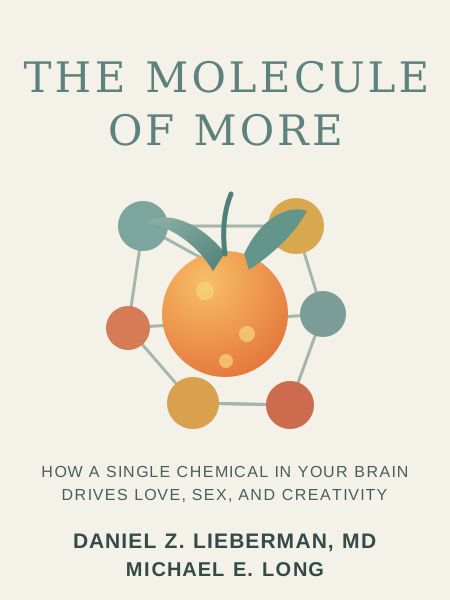
The Molecule of More
Daniel Z. Lieberman & Michael E. Long · 2018
Editorial rating
- Evidence
- 6/10
- Actionability
- 7/10
- Originality
- 8/10
The thesis
Dopamine drives pursuit, anticipation, and control more than satisfaction, so a life organized only around the next reward produces achievement without enough enjoyment.
Who this is for
Ambitious professionals, compulsive scrollers, serial project starters, and anyone who keeps reaching the goal only to become restless before the celebration is over.
My favorite quote
Dopamine isn't the pleasure molecule, after all. It's the anticipation molecule.
Why it matters
Wanting and enjoying are different systems, and confusing them explains why progress can feel exciting while possession quickly feels flat.
Do this
Delay one nonessential purchase for 24 hours and record whether the urge falls once anticipation is interrupted.
Start here
Separate wanting from liking. Before pursuing a goal, purchase, or stimulation, ask whether you expect to enjoy the actual experience or mainly enjoy moving toward it.
Critical summary
Daniel Z. Lieberman, a psychiatrist, and Michael E. Long, a writer trained in physics, use dopamine as a lens for explaining why people chase novelty, ambition, romance, status, ideas, and control. Their central distinction is between dopaminergic systems aimed at what lies beyond immediate reach and a loose group of Here and Now chemicals associated with sensory experience, attachment, and satisfaction. They further divide dopamine into a desire circuit that creates wanting and a control circuit that supports planning, persistence, and abstraction. Reward prediction error explains why surprise energizes pursuit while predictable rewards lose their pull. The same model clarifies why early romance feels electric and why stable attachment requires a shift toward present experience. From there, the authors extend the model into love, addiction, creativity, mental illness, politics, migration, and technological progress.
What it gets right
- Corrects the popular claim that dopamine is simply a chemical dose of pleasure
- Makes the distinction between wanting and liking memorable enough to notice in daily behavior
- Shows how anticipation can motivate useful achievement while quietly sabotaging contentment
What it overstates or misses
- Compresses complex neural systems into a two-camp story that sounds cleaner than the underlying biology
- Treats serotonin, oxytocin, endorphins, and related systems as one Here and Now bloc despite major differences
- Political and personality claims often travel farther than the evidence can comfortably support
The strongest sections rest on established neuroscience around incentive salience, reward prediction, addiction, and executive control. The weaker sections use dopamine as an all-purpose explanation, moving from plausible mechanism to cultural story without always marking the change in certainty. The book is best read as a useful model rather than a complete map of motivation. It gives readers a sharp question for cravings and goals: do I want the thing, or do I want the chase? The verdict: memorable neuroscience with a reductionism tax.
Key concepts
Desire Dopamine
Novel possibilities trigger wanting and pursuit; pause before acting when the imagined reward feels more vivid than the real experience.
Control Dopamine
Frontal circuits support planning, abstraction, and persistence; convert excitement into a written sequence of concrete steps.
Reward Prediction Error
Dopamine reacts strongly when reality beats expectation and falls when rewards become predictable; design progress with meaningful feedback, not constant novelty.
Wanting Versus Liking
Desire can rise without increasing enjoyment; rate expected pleasure separately from urge strength before consuming or buying.
Here and Now Experience
Sensation, connection, and embodied attention counter endless future orientation; schedule activities whose value exists during the activity itself.
Core insights
-
Acquisition Is Not Satisfaction
The system that gets you moving is poorly designed to tell you when enough has arrived, so define stopping rules in advance.
-
Novelty Loses Value Quickly
Surprise drives attention, but repetition normalizes rewards; do not interpret fading excitement as proof that the choice was wrong.
-
Ambition Needs Embodiment
Abstract goals produce momentum, while craft, exercise, touch, food, and conversation make achievement emotionally inhabitable.
-
Craving Makes Promises
A strong urge predicts pursuit, not pleasure; test small doses before committing money, time, or identity.
-
Balance Beats Suppression
Dopamine is not the enemy because creativity and progress depend on it; the problem is letting future-oriented pursuit crowd out present experience.
Implementation steps
Today
- Label three urges as wanting, liking, or both before acting on them.
- Spend ten uninterrupted minutes on a sensory activity with no goal, score, or screen.
This week
- Add a 24-hour delay to one category of impulsive purchase or digital consumption.
- End each workday by naming one completed result before planning the next target.
This month
- Audit recurring goals and remove one pursuit that creates anticipation but little lasting value.
- Pair every major achievement project with a weekly embodied practice such as cooking, craft, sport, or shared meals.
Ongoing
- Use written stopping rules for shopping, gaming, scrolling, work, and other activities that lack natural limits.
- Protect time for relationships and physical experiences that cannot be optimized into future rewards.
Suggested 30-day practice plan
An editorial application plan created by Monolithic Vault - an interpretation of the book's ideas, not part of the original book.
- Day 1
Track five moments of wanting and estimate the pleasure each action actually delivers.
- Day 3
Introduce a 24-hour waiting rule for one recurring temptation.
- Day 7
Review which pursuits created satisfaction and which only created momentum.
- Day 14
Replace one novelty loop with a present-focused activity performed twice this week.
- Day 21
Set explicit enough-points for one financial, career, or consumption goal.
- Day 30
Build a personal balance plan covering ambition, recovery, relationships, and embodied enjoyment.
Free PDF summary
Take this analysis with you: a designed two-page field-notes sheet with the thesis, my favorite quote, the key concepts and core insights, and the full 30-day checklist. Print it or keep it - free, no signup.
Go deeper
If this analysis earned your attention, the full book goes further than any summary can. The original is always the primary source.