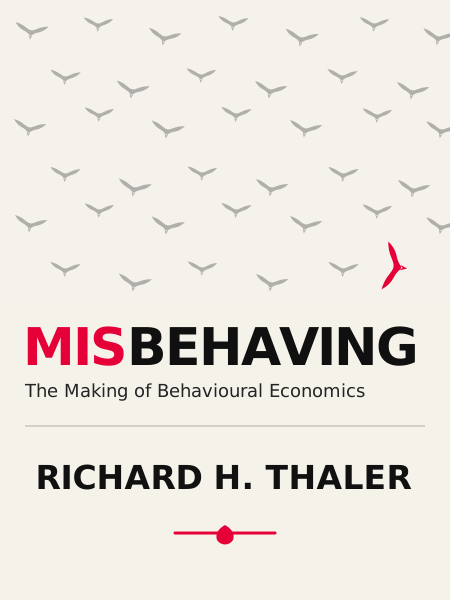
Misbehaving
Richard H. Thaler · 2015
Editorial rating
- Evidence
- 10/10
- Actionability
- 8/10
- Originality
- 9/10
The thesis
Traditional economics assumes humans are "Econs" - perfectly rational calculating machines. In reality, we are "Humans" who misbehave. We overvalue what we own, we struggle with self-control, and we care about "fairness" more than the bottom line. By understanding these "supposedly irrelevant factors" (SIFs), we can make better decisions.
Who this is for
Marketers, policy makers, and anyone wondering why they make "irrational" decisions with their money.
My favorite quote
The core of behavioral economics is that people are not Econs. They are Humans.
Why it matters
It validates the complexity of human nature against rigid mathematical models.
Do this
Identify one "mental account" you have (e.g., "vacation money"). Notice how you treat those dollars differently even though they are identical to your rent money.
Start here
The Endowment Effect: We value things more just because we own them. This prevents us from selling stocks at a loss or getting rid of junk. To combat this, ask: "If I didn't own this today, how much would I pay to get it?" If the answer is less than the current market price, sell/discard it.
Critical summary
Richard Thaler, Nobel laureate and father of behavioral economics, tells the story of how he fought the economic establishment to prove that people are predictably irrational.
Key Insights
- Mental Accounting: We categorize money into different "buckets," which leads to irrational behavior (like carrying credit card debt while having a savings account).
- Transaction Utility: We buy things because they are "on sale," even if we don't need them, just to feel the "utility" of the deal.
Key concepts
Nudges
Small changes in the "choice architecture" that lead to big changes in behavior.
Sunk Costs
Our tendency to continue an endeavor once an investment in money, effort, or time has been made.
Fairness
Why people will pay $10 for a beer at a luxury hotel but only $2 at a grocery store.
Implementation steps
Today
- Audit Your Sunk Costs: Find one project or subscription you are keeping only because you've "already spent so much."
This week
- Track your spending for 7 days and identify your mental accounts.
This month
- Set up automatic savings to combat self-control issues.
Ongoing
- Question "on sale" purchases before buying.
Suggested 30-day practice plan
An editorial application plan created by Monolithic Vault - an interpretation of the book's ideas, not part of the original book.
- Day 1
Audit your sunk costs (Habit Scorecard).
- Day 7
Review mental accounting patterns.
- Day 14
Implement one "nudge" in your environment.
- Day 21
Check progress on automatic savings.
- Day 30
Reflect on behavioral changes made.
Free PDF summary
Take this analysis with you: a designed two-page field-notes sheet with the thesis, my favorite quote, the key concepts and core insights, and the full 30-day checklist. Print it or keep it - free, no signup.
Go deeper
If this analysis earned your attention, the full book goes further than any summary can. The original is always the primary source.