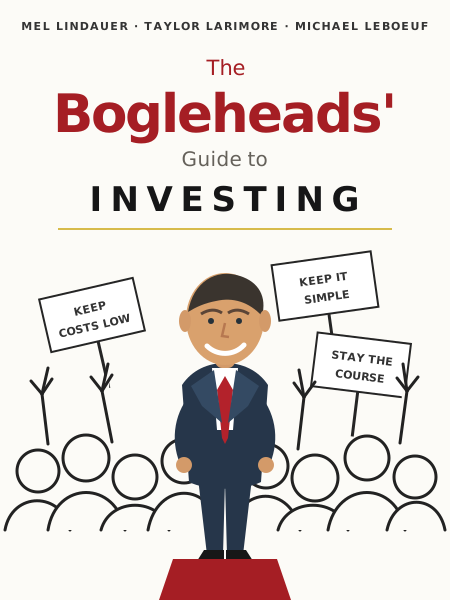
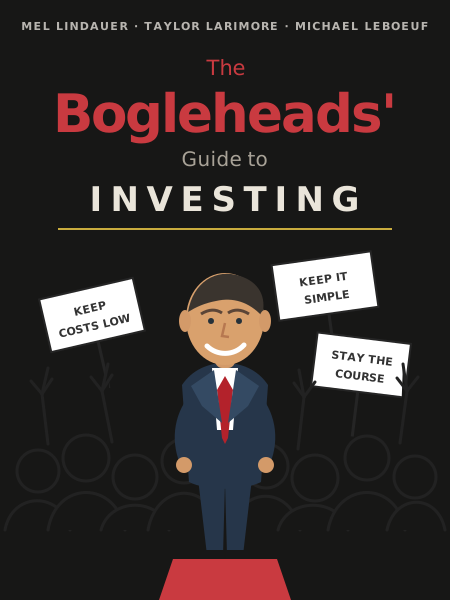
The Bogleheads' Guide to Investing
Taylor Larimore, Mel Lindauer, Michael LeBoeuf · 2006
Editorial rating
- Evidence
- 8/10
- Actionability
- 9/10
- Originality
- 5/10
The thesis
Invest like Jack Bogle: buy low-cost index funds, diversify broadly, minimize taxes and fees, stay the course through volatility. The Bogleheads - a community of investors who follow Vanguard founder John Bogle's philosophy - have distilled decades of collective wisdom into a practical guide that makes professional-grade investing accessible to everyone.
Who this is for
Beginning investors who want a comprehensive guide from experienced practitioners, anyone tired of conflicting advice and ready for a proven approach, and investors who want to "set it and forget it" without sacrificing returns.
My favorite quote
Investing can be simple, but it's certainly not simplistic.
Why it matters
This captures the book's essence. The Bogleheads' approach is elegantly simple - three funds can do the job - but the reasoning behind it draws on decades of research and hard-won experience.
Do this
Evaluate your current portfolio complexity. Could you achieve the same results with fewer, simpler holdings?
Start here
The Three-Fund Portfolio: Own three low-cost index funds - U.S. total stock market, international stock market, and total bond market. That's it. This simple structure captures global equity returns, provides diversification, and keeps costs minimal. Rebalance annually. Everything else is noise.
Critical summary
Written by three experienced Bogleheads - Taylor Larimore ("The King"), Mel Lindauer ("The Prince"), and Michael LeBoeuf - this book translates the investment philosophy of Vanguard founder John Bogle into a step-by-step guide for individual investors.
The book covers everything: stocks and bonds basics, mutual funds vs. ETFs, asset allocation, tax-advantaged accounts, retirement planning, estate planning. It's comprehensive - perhaps too comprehensive for some readers, who may find the detail overwhelming. But for those who want one book that covers everything, this is it.
What it gets right
- Comprehensive coverage from basics to advanced topics
- Written by practitioners with no hidden agenda (they don't sell products)
- Practical advice on taxes, account types, and rebalancing
- Strong community backing - the Bogleheads forum provides ongoing support
What it misses
- Heavily U.S.-focused; less useful for international investors
- Can feel dry despite attempts at humor
- Some material overlaps with Bogle's own books (which some prefer)
- Critics note the "three-fund portfolio" oversimplifies for some situations (concentrated stock positions, alternative investments)
Evidence is strong: academic research, historical returns, and the track record of index investing. The philosophy has been tested through multiple market cycles.
Key concepts
Index Investing
Owning the whole market rather than picking stocks. Guarantees market returns minus tiny fees.
Expense Ratio
The annual cost of a fund. Lower is better - always. The best predictor of future returns.
Asset Allocation
How you divide stocks, bonds, and other assets. The most important decision you'll make.
Tax-Efficient Placement
Putting tax-inefficient investments (bonds, REITs) in tax-advantaged accounts; tax-efficient investments (stock index funds) in taxable accounts.
Rebalancing
Periodically returning to your target allocation. Forces buying low and selling high.
Stay the Course
The Bogleheads mantra. Don't panic sell during downturns; don't chase during bull markets.
Core insights
-
Costs destroy wealth
Over 30 years, a 1% fee difference compounds to massive lost wealth. Minimize expenses ruthlessly.
-
Tax drag is a hidden cost
Taxes can cost you more than fees. Use tax-advantaged accounts wisely and minimize turnover.
-
International diversification matters
20-40% of equity in international stocks reduces risk without sacrificing returns.
-
Don't depend on the kindness of strangers
Avoid products where someone else's behavior affects your returns (variable annuities, actively managed funds).
-
Rebalance, but not obsessively
Annual or threshold-based rebalancing captures most of the benefit without excessive trading.
Implementation steps
Today
- List all investment accounts and their expense ratios
- Determine your current asset allocation (stocks vs. bonds, domestic vs. international)
This week
- Research your 401(k) options - find the lowest-cost index funds available
- Calculate your target allocation based on risk tolerance and time horizon
This month
- Implement the three-fund portfolio (or closest approximation in your 401(k))
- Set up automatic contributions to tax-advantaged accounts
Ongoing
- Rebalance annually (or when allocations drift 5%+ from target)
- Increase contributions with each raise; aim for 15-20% savings rate
Suggested 30-day practice plan
An editorial application plan created by Monolithic Vault - an interpretation of the book's ideas, not part of the original book.
- Day 1
Inventory all accounts and calculate total investment costs
- Day 2
Determine your risk tolerance (how much could you watch drop 50% without selling?)
- Day 3
Set target allocation (e.g., 60% stocks, 40% bonds; 70% domestic, 30% international)
- Day 7
Identify lowest-cost index funds in each account
- Day 14
Rebalance existing accounts to target allocation
- Day 21
Maximize tax-advantaged accounts (401k match, IRA)
- Day 30
Set calendar reminder to rebalance in one year
Free PDF summary
Take this analysis with you: a designed two-page field-notes sheet with the thesis, my favorite quote, the key concepts and core insights, and the full 30-day checklist. Print it or keep it - free, no signup.
Go deeper
If this analysis earned your attention, the full book goes further than any summary can. The original is always the primary source.