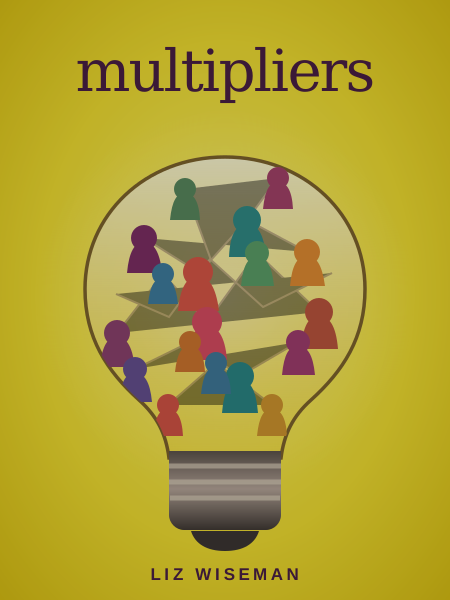
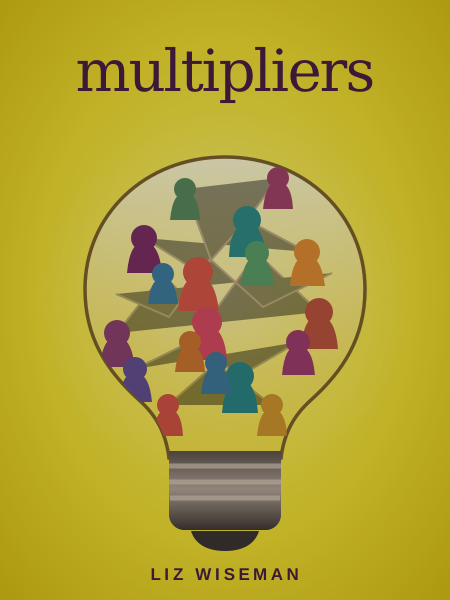
Multipliers
Liz Wiseman · 2010
Editorial rating
- Evidence
- 7/10
- Actionability
- 9/10
- Originality
- 8/10
The thesis
Some leaders amplify the intelligence around them and get 2x the capability from their teams. Others - Diminishers - shut people down and extract only half their potential. The difference isn't charisma or IQ but five specific, learnable disciplines that either multiply or diminish the people around you.
Who this is for
Leaders frustrated that their teams seem to underperform, managers who suspect they might be accidentally diminishing their people, and anyone who's worked for a boss who made them feel stupid.
My favorite quote
Multipliers invoke each person's unique intelligence and create an atmosphere of genius - innovation, productive effort, and collective intelligence.
Why it matters
Most leaders focus on being smart. Multipliers focus on making others smart. That's a fundamentally different game.
Do this
In your next meeting, deliberately hold back your opinion. Ask questions that help others think harder instead.
Start here
Play fewer chips: In meetings, imagine you have a limited number of "chips" to play (comments to make). This forces you to be selective, creates space for others, and prevents you from accidentally becoming the "genius in the room" who shuts everyone else down. Your restraint is a gift to your team's intelligence.
Critical summary
Wiseman, a former Oracle executive and leadership researcher, studied 150+ leaders across four continents to identify what distinguishes leaders who amplify intelligence (Multipliers) from those who diminish it.
What it gets right
- 5 discipline pairs (Talent Magnet vs. Empire Builder, etc.) are clear and memorable
- Research-based: Data from 150+ executives, not just anecdotes
- "Accidental Diminisher" concept is eye-opening - you may be diminishing without knowing
- Multipliers get 2x more from their teams - hard to ignore
- Practical experiments for each discipline
What it misses
- Some disciplines feel obvious once stated (attract talent, create debate)
- Less guidance for dealing with Diminisher bosses
- Assumes leaders have significant organizational authority
- Limited discussion of contexts where directive leadership is actually needed
- Can feel repetitive - 5 chapters of similar structure
Evidence is solid: Research with 150+ executives, quantified outcomes, and practical experiments tested in organizations.
Key concepts
Multiplier vs. Diminisher
Multipliers get 2x more capability from their teams. Diminishers get only half.
Talent Magnet vs. Empire Builder
Magnets attract talent and let it flow to where it's needed. Builders hoard talent until it stagnates.
Liberator vs. Tyrant
Liberators create space for best thinking. Tyrants create fear that suppresses ideas.
Challenger vs. Know-It-All
Challengers ask questions that stretch people. Know-It-Alls give answers that shrink people.
Debate Maker vs. Decision Maker
Debate Makers drive rigorous thinking. Decision Makers announce conclusions.
Investor vs. Micromanager
Investors give ownership and expect results. Micromanagers hover and undermine.
Core insights
-
Diminishing is often accidental
Well-meaning leaders diminish by being "helpful," sharing expertise, or moving fast. Awareness is the first step.
-
Your genius can be your limitation
The smarter you are, the more likely you're shutting down the intelligence around you.
-
Multipliers get discretionary effort
People give 100% to Multipliers. They give 50% (at best) to Diminishers - and find ways to "quit and stay."
-
Intensity ≠ tension
Multipliers create intense environments (high expectations) but not tense ones (fear of failure).
-
The question is the answer
Challengers ask questions that make people think harder, rather than giving answers that make people stop thinking.
-
Restraint is a discipline
The hardest part of being a Multiplier is NOT contributing - holding back so others can step up.
Implementation steps
Today
- Ask yourself: Am I the genius, or the genius maker?
- In your next meeting, hold back one opinion you were about to share. Ask a question instead.
This week
- Identify one person whose talent you might be underutilizing
- Create space for debate on a decision you were about to make unilaterally
This month
- Take the Accidental Diminisher quiz - which tendencies do you have?
- Give someone full ownership of a project (and resist the urge to micromanage)
Ongoing
- Default to questions before answers
- After meetings, ask yourself: Did I create space, or fill it?
Suggested 30-day practice plan
An editorial application plan created by Monolithic Vault - an interpretation of the book's ideas, not part of the original book.
- Day 1
List your Diminisher tendencies (be honest)
- Day 2
Identify one person you may be underutilizing - why?
- Day 3
In a meeting, play fewer chips - hold back, ask questions
- Day 7
Give someone ownership of a decision you normally make
- Day 14
Conduct a debate on a key issue before deciding
- Day 21
Get feedback: "Do I create space for your best thinking?"
- Day 30
Review: Where did you multiply? Where did you accidentally diminish?
Free PDF summary
Take this analysis with you: a designed two-page field-notes sheet with the thesis, my favorite quote, the key concepts and core insights, and the full 30-day checklist. Print it or keep it - free, no signup.
Go deeper
If this analysis earned your attention, the full book goes further than any summary can. The original is always the primary source.