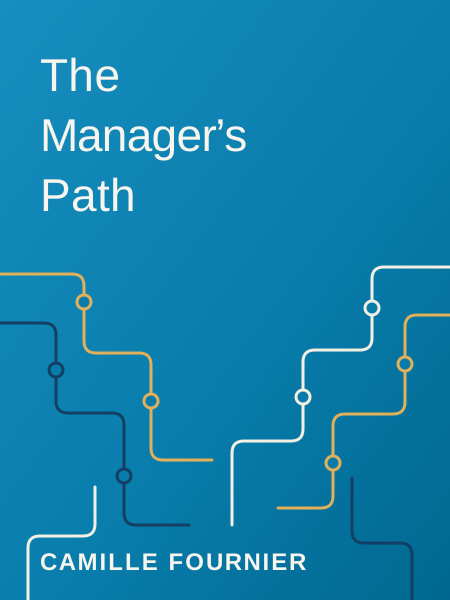
The Manager's Path
Camille Fournier · 2017
Editorial rating
- Evidence
- 7/10
- Actionability
- 10/10
- Originality
- 8/10
The thesis
Engineering management is a distinct skill set - not just a promotion for good engineers. Each level of the management ladder (mentor, tech lead, manager, director, VP, CTO) has different challenges and requires different competencies. Understanding what's expected at each stage prevents you from failing at the transition.
Who this is for
Engineers considering management, new tech leads unsure what they're supposed to do, engineering managers who feel like they're making it up as they go, and senior leaders who want a reference manual for developing their management teams.
My favorite quote
Management is not a promotion. Management is a career change.
Why it matters
Most engineers treat management as a reward for technical excellence. It's not. It's a different job requiring different skills.
Do this
If you're considering management, ask yourself: "Do I want to write less code and spend more time in meetings?" If yes, proceed. If no, explore the IC (individual contributor) track instead.
Start here
The 1-on-1 is your most important meeting: As a manager, your 1-on-1s with direct reports are where trust is built, problems surface early, and growth happens. Make them regular (weekly for new reports), let the employee drive the agenda, and never cancel them. If you're too busy for 1-on-1s, you're too busy to manage.
Critical summary
Fournier, former CTO of Rent the Runway, wrote this as a practical reference manual for engineering managers at every level. It's structured as a progression from IC to mentor to tech lead to manager to director to VP to CTO - each stage getting a chapter.
What it gets right
- Stage-by-stage progression is immediately useful - you can read the chapter for your level
- Practical, tactical advice (how to run 1-on-1s, how to give feedback, how to debug dysfunctional teams)
- Acknowledges management is a career change, not a promotion
- Tech-specific: addresses issues like staying technically relevant, managing tech debt, architecture decisions
- O'Reilly-style reference manual - meant to be returned to, not just read once
What it misses
- US/Silicon Valley-centric - some cultural assumptions don't translate
- Less depth on any single topic (breadth over depth by design)
- Limited on office politics and navigating organizational dysfunction
- Fewer war stories and concrete examples than some readers want
- Senior executives may find later chapters too basic
Evidence is Fournier's experience plus interviews with other engineering leaders. Practical wisdom, not academic research.
Key concepts
Tech Lead
A leadership role that is NOT management - you're still an IC but with coordination responsibilities. Requires learning to delegate.
Manager vs. Maker Schedule
Managers live in 30-minute blocks. Makers need long stretches. As a manager, protect your team's maker time.
Skip-Level 1-on-1s
Meet periodically with your reports' reports. You'll learn what's really happening.
Debugging Dysfunctional Teams
Approach team problems like debugging code: gather data, form hypotheses, test interventions.
Shield vs. Expose
Sometimes protect your team from organizational chaos. Sometimes expose them to it so they understand context.
Staying Technically Relevant
As you rise, you code less. But you must understand the architecture to make good decisions.
Core insights
-
Management is a career change
Different skills, different satisfactions. Some great engineers are miserable managers (and vice versa).
-
New managers often over-correct
They either micromanage (because they know how to do the work) or abdicate (to prove they're not micromanaging). Find the balance.
-
1-on-1s belong to the employee
They set the agenda. You listen, ask questions, and remove blockers.
-
Tech leads fail when they hoard interesting work
Your job is to make the team succeed, not to do all the fun stuff yourself.
-
Skip-levels reveal what's really happening
Your direct reports filter information. Their reports don't.
-
Managing managers is about coaching, not directing
You can't tell them what to do with each employee. You help them figure it out.
Implementation steps
Today
- If you're a new manager: Schedule weekly 1-on-1s with every direct report
- If you're a tech lead: List the interesting tasks you've been hoarding. Delegate one this week.
This week
- Ask each direct report: "What do you want to talk about in our 1-on-1s?"
- Identify one way you're either micromanaging or abdicating. Correct it.
This month
- Conduct one skip-level 1-on-1 (if you manage managers)
- Create a 30-60-90 day plan for any new hire
Ongoing
- Protect your team's maker schedule - batch interruptions, limit unnecessary meetings
- Stay technically relevant: review architecture decisions, read code occasionally
Suggested 30-day practice plan
An editorial application plan created by Monolithic Vault - an interpretation of the book's ideas, not part of the original book.
- Day 1
Audit your calendar. How much time are you spending on 1-on-1s?
- Day 2
Ask direct reports how they prefer to receive feedback
- Day 3
Identify one task you're hoarding. Delegate it.
- Day 7
Create a running doc for each direct report's career development
- Day 14
Conduct a skip-level meeting (or schedule one if you manage managers)
- Day 21
Review your team's technical decisions. Are you staying relevant?
- Day 30
Ask your team: "What's one thing I could do differently to be a better manager?"
Free PDF summary
Take this analysis with you: a designed two-page field-notes sheet with the thesis, my favorite quote, the key concepts and core insights, and the full 30-day checklist. Print it or keep it - free, no signup.
Go deeper
If this analysis earned your attention, the full book goes further than any summary can. The original is always the primary source.