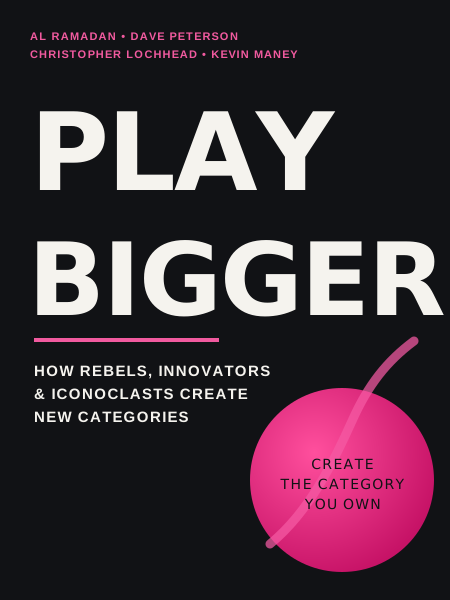
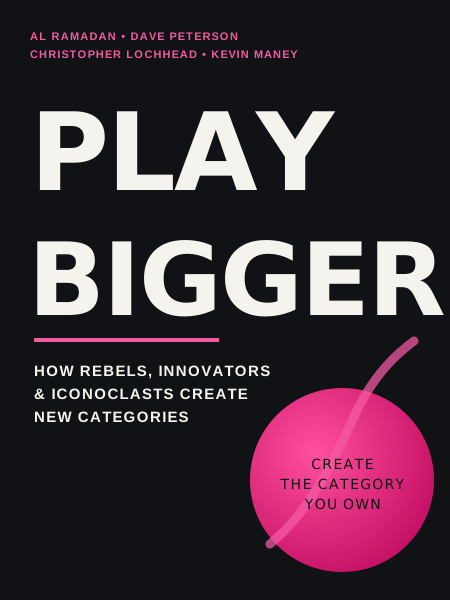
Play Bigger
Al Ramadan, Dave Peterson, Christopher Lochhead, Kevin Maney · 2016
Editorial rating
- Evidence
- 7/10
- Actionability
- 8/10
- Originality
- 8/10
The thesis
The strongest companies do not merely outperform rivals inside an existing market. They define a valuable problem, name the category around it, and condition customers to see their solution as the obvious standard.
Who this is for
Founders entering a crowded market, executives launching a genuinely new offer, and marketing leaders whose product is strong but still sounds interchangeable with every competitor.
My favorite quote
It's about winning the war for popular opinion, teaching the world to abandon the old and embrace the new.
Why it matters
Category leadership depends on changing how buyers frame the problem before asking them to compare products.
Do this
Rewrite your homepage headline so it names the costly old problem before describing your solution.
Start here
Build a sharp point of view before building another campaign. State what has changed, why the old approach now fails, what problem deserves a new name, and what future becomes possible once buyers adopt your category. That narrative aligns product, company, and market activity around one claim.
Critical summary
Al Ramadan, Dave Peterson, Christopher Lochhead, and Kevin Maney developed category design through their Silicon Valley advisory work, then packaged it as a deliberate alternative to competing feature by feature. Their argument is that legendary businesses coordinate three acts at once: designing a product, designing a company, and designing the category in which both make sense. The process starts by identifying an urgent problem and expressing a provocative point of view about why existing solutions fail. A category name and blueprint then define the new market, its participants, and the standards buyers should use. Finally, a concentrated Lightning Strike introduces the narrative, while repeated strikes build a flywheel that attracts customers, employees, partners, analysts, and capital. The intended result is a Category King whose name becomes mentally fused with the market itself.
What it gets right
- Makes problem framing a strategic responsibility instead of leaving positioning to a late marketing exercise
- Forces product, leadership, sales, and communications to tell one coherent story about why change is necessary
- Provides practical artifacts such as a point of view, category blueprint, and Lightning Strike rather than stopping at aspiration
What it overstates or misses
- Treats successful categories as more intentionally designed than messy market formation usually allows
- Leans heavily on winners, making survivor bias difficult to separate from genuine category-design skill
- Presents internal research on category value and IPO timing with more causal confidence than the evidence supports
The evidence combines the authors' consulting cases, technology-company histories, and an internal analysis claiming that category leaders capture most sector value. Those materials are useful for pattern recognition, but they do not prove that naming and promoting a category caused the eventual dominance; superior products, timing, distribution, capital, and network effects often did much of the work. The language can also feel self-promotional because the authors are selling the discipline they describe. The verdict: use it as a demanding positioning and alignment process, not as a recipe that manufactures monopoly.
Key concepts
Category Design
Deliberately define a market problem, its language, and its buying criteria so customers evaluate solutions on terms that favor your strengths.
Category King
The company buyers instinctively associate with a category; test whether prospects name you without being prompted.
Point of View
A narrative explaining what changed, why the old way fails, and what better future your category enables.
Category Blueprint
A map of the problem, ecosystem, use cases, category name, and standards needed to make the market understandable.
Lightning Strike
A concentrated event or campaign that forces the market to notice the new problem and repeat your category language.
Core insights
-
Market the problem first
Buyers rarely demand a new solution until someone makes the cost of the old approach vivid and urgent.
-
Different beats marginally better
Feature superiority invites comparison, while a credible new category changes the basis of comparison.
-
Language directs demand
Whoever supplies the accepted category name often shapes which attributes customers consider important.
-
Alignment is part of the product
A category claim collapses when sales, product, leadership, and communications describe four different futures.
-
Category work never finishes
Competitors, technology, and customer expectations keep moving, so the narrative requires repeated proof and reinforcement.
Implementation steps
Today
- Write one sentence naming the expensive problem your product solves without mentioning your product or company.
- List the three phrases competitors use most often and mark where your current message merely copies them.
This week
- Draft a one-page point of view covering the change, enemy, problem, category, promised future, and proof.
- Test the category language in five customer conversations and record which words they repeat without prompting.
This month
- Build a category blueprint showing buyers, partners, alternatives, standards, and the capabilities required to make the category credible.
- Design one modest Lightning Strike that gives customers a reason to discuss the problem, not merely your latest feature.
Ongoing
- Track whether prospects increasingly use your category language in calls, searches, requests, and procurement documents.
- Revisit the point of view whenever market conditions change or the category starts becoming vague and crowded.
Suggested 30-day practice plan
An editorial application plan created by Monolithic Vault - an interpretation of the book's ideas, not part of the original book.
- Day 1
Define the costly problem and identify the old approach your category intends to replace.
- Day 3
Interview three customers about how they currently describe the problem and available alternatives.
- Day 7
Draft the point of view and remove every claim that could appear unchanged on a competitor's website.
- Day 14
Build the category blueprint and identify the weakest missing proof, partner, capability, or standard.
- Day 21
Test the narrative with customers, salespeople, and one skeptical outsider, then revise the category name.
- Day 30
Run a focused Lightning Strike and measure whether the market repeats the problem and category language.
Free PDF summary
Take this analysis with you: a designed two-page field-notes sheet with the thesis, my favorite quote, the key concepts and core insights, and the full 30-day checklist. Print it or keep it - free, no signup.
Go deeper
If this analysis earned your attention, the full book goes further than any summary can. The original is always the primary source.