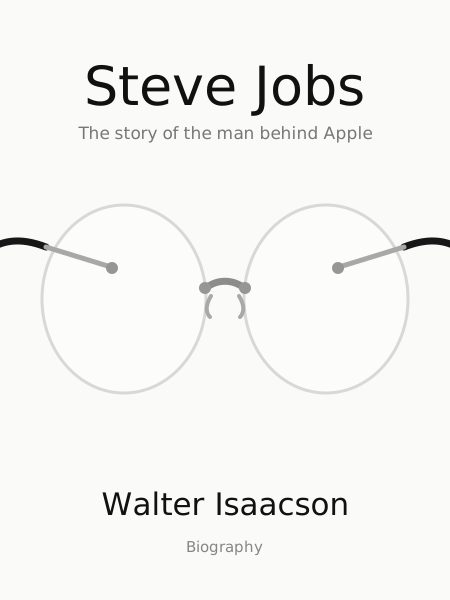

Steve Jobs
Walter Isaacson · 2011
Editorial rating
- Evidence
- 9/10
- Actionability
- 6/10
- Originality
- 8/10
The thesis
Breakthrough products emerge when one demanding vision unifies technology, design, business, and user experience. The same intensity that creates coherence can also damage people and distort judgment when nobody can challenge the leader.
Who this is for
Founders shaping a product category, executives managing creative talent, and product leaders deciding where uncompromising standards produce excellence and where they merely produce fear.
My favorite quote
Because the people who are crazy enough to think they can change the world are the ones who do.
Why it matters
Jobs treated audacious belief as an operating requirement, not a motivational slogan, and repeatedly organized teams around outcomes others considered impossible.
Do this
Identify one assumption limiting your current project and ask what you would attempt if that assumption were false.
Start here
Study Jobs as a system builder, not as a personality to imitate. His highest-leverage move was forcing hardware, software, services, design, marketing, and retail to serve one coherent experience. Copy the integration and standards, not the humiliation, volatility, or belief that cruelty proves seriousness.
Critical summary
Walter Isaacson interviewed Steve Jobs more than forty times across two years and spoke with over one hundred relatives, friends, colleagues, rivals, and competitors. Jobs requested the biography but surrendered editorial control, giving Isaacson unusual access to both achievement and damage. The narrative follows Jobs from adoption, counterculture, and the Apple garage through the Macintosh, exile, NeXT, Pixar, Apple's return, and the sequence of products that reshaped music, phones, tablets, retail, and digital publishing. Its central tension is that Jobs fused seemingly opposing qualities: artistic taste and technical curiosity, sweeping intuition and obsessive detail, long-range vision and brutal impatience. His end-to-end approach produced products in which hardware, software, packaging, stores, and services reinforced one another. His reality distortion field pushed teams past accepted constraints, while his binary judgments, control, and emotional aggression routinely hurt the people doing the work.
What it gets right
- Shows how product excellence came from hundreds of connected decisions rather than one dramatic invention
- Captures the strategic value of controlling the full user experience when fragmented ownership would create compromise
- Refuses to sanitize Jobs's abandonment, manipulation, medical denial, and repeated mistreatment of colleagues
What it overstates or misses
- Gives the singular founder so much narrative gravity that teams, institutions, suppliers, and market timing can look secondary
- Sometimes presents abusive behavior beside great outcomes without fully separating what enabled success from what merely accompanied it
- Stops before later accounts from close colleagues could complicate the portrait of Jobs's growth during his second Apple era
The reporting is extensive and unusually candid for an authorized biography, strengthened by competing recollections and Isaacson's willingness to print contradictions. Yet biography cannot establish which personality traits were causal, and participants reconstruct decisive moments after the outcome is known. The book is strongest as evidence about how Jobs worked and weaker as proof that others should work the same way. The verdict: copy his integrated product thinking and leave the management pathology behind.
Key concepts
End-to-End Integration
Control the critical layers of a product so design choices reinforce one another instead of being diluted across incompatible owners.
Reality Distortion Field
Treat accepted constraints as negotiable long enough to discover which limits are real, while protecting teams from impossible demands disguised as ambition.
A Players
Build small groups of exceptional people and set a high bar, but judge quality through output and collaboration rather than loyalty to one dominant personality.
Cannibalization
Replace your own successful product before a competitor does; ask which current revenue stream your next offering should make less necessary.
Technology and Liberal Arts
Combine engineering capability with taste, storytelling, and human behavior so the product feels understandable rather than merely impressive.
Core insights
-
Coherence is a competitive advantage
Customers experience the whole system, so optimizing isolated components can still produce a frustrating product.
-
Taste requires repeated judgment
Simplicity is not fewer features by default; it is the result of rejecting options until the essential structure becomes obvious.
-
Intensity is not permission
High standards can sharpen work, but humiliation and volatility create hidden costs in retention, candor, and decision quality.
-
Great products need direct leadership attention
Delegating every detail can fracture the experience, while selective deep dives reveal where the strategy is becoming real.
-
Narratives mobilize talent
Jobs made teams believe their work belonged to a larger cultural shift, which raised effort but also made dissent harder.
Implementation steps
Today
- Map the five parts of your product experience that customers encounter before, during, and after purchase.
- Write one assumption your team treats as fixed and identify the person who can confirm whether it is actually fixed.
This week
- Run a product review focused on the complete customer journey rather than separate departmental metrics.
- Remove one feature, handoff, or message that adds complexity without strengthening the core promise.
This month
- Create a single experience owner for a cross-functional customer journey that currently falls between teams.
- Establish a demanding review ritual where criticism targets the work, evidence, and customer outcome rather than the person.
Ongoing
- Revisit which successful product you may need to cannibalize before market conditions force the decision.
- Pair ambitious deadlines with explicit channels for technical dissent, workload concerns, and contrary evidence.
Suggested 30-day practice plan
An editorial application plan created by Monolithic Vault - an interpretation of the book's ideas, not part of the original book.
- Day 1
Document the full customer experience and mark every point where ownership or quality becomes fragmented.
- Day 3
Interview three users about the moments that feel confusing, inelegant, or disconnected.
- Day 7
Choose one experience problem and assign one accountable cross-functional owner.
- Day 14
Prototype a simpler integrated version and test whether customers notice the intended improvement.
- Day 21
Review the team's standards and remove one behavior that confuses intensity with disrespect.
- Day 30
Present a product doctrine covering integration, simplicity, review quality, cannibalization, and constructive dissent.
Free PDF summary
Take this analysis with you: a designed two-page field-notes sheet with the thesis, my favorite quote, the key concepts and core insights, and the full 30-day checklist. Print it or keep it - free, no signup.
Go deeper
If this analysis earned your attention, the full book goes further than any summary can. The original is always the primary source.