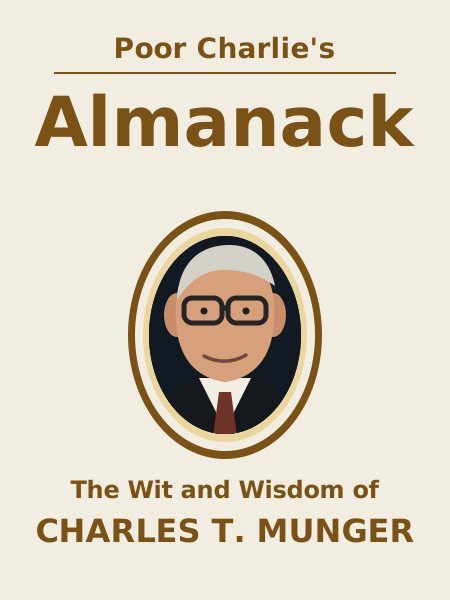
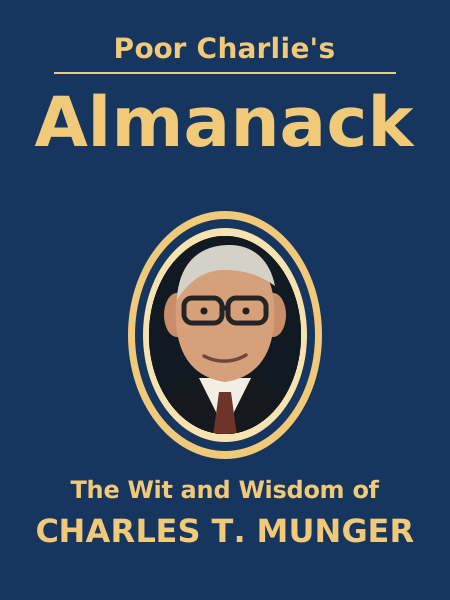
Poor Charlie's Almanack
Charlie Munger · 2005
Editorial rating
- Evidence
- 6/10
- Actionability
- 8/10
- Originality
- 9/10
The thesis
Good judgment comes less from exceptional intelligence than from building a latticework of durable ideas, checking incentives, and avoiding predictable stupidity.
Who this is for
Investors, executives, and advisers who face messy decisions where one spreadsheet, one discipline, or one confident expert cannot capture the whole system.
My favorite quote
Spend each day trying to be a little wiser than you were when you woke up.
Why it matters
Munger treats wisdom as accumulated daily work rather than a talent granted at birth.
Do this
Before bed, write down one belief you improved, rejected, or made more precise today.
Start here
Build a decision checklist from several disciplines, then use it before committing money, time, or reputation. Start with incentives, opportunity cost, base rates, second-order effects, and the possibility that several biases are reinforcing one another. That small lattice captures most of Munger's practical advantage.
Critical summary
Peter D. Kaufman assembled Charlie Munger's biography, investing principles, and eleven talks into a deliberately eccentric collection rather than a tidy argument. Munger's central method is the latticework of mental models: learn the few powerful ideas from mathematics, psychology, economics, engineering, biology, and history, then combine them when reality refuses to fit one professional lens. Incentives explain behavior, opportunity cost disciplines choice, inversion exposes routes to failure, and psychology identifies the tendencies that distort judgment. The models matter most in combination. Munger calls the resulting cascade a lollapalooza effect, where several forces push behavior much further than any single cause would predict.
What it gets right
- Treats multidisciplinary learning as a working decision system rather than decorative intellectual breadth.
- Makes error avoidance concrete through inversion, checklists, patience, and an explicit circle of competence.
- Connects business quality, managerial incentives, human bias, and long-term compounding instead of evaluating investments as isolated numbers.
What it overstates or misses
- Offers a philosophy of judgment, not a reproducible process for deciding which model deserves the most weight.
- Relies heavily on Munger's experience, aphorisms, and selected examples rather than systematic tests of the full framework.
- Repeats ideas across speeches and preserves examples, including praise for Jack Welch, that have aged less gracefully than the principles around them.
The evidence is strongest where Munger borrows established mechanisms such as incentives, conditioning, social proof, and compound growth, and weaker where his own success is treated as validation of the complete method. The book also demands more work than most summaries admit: collecting model names is easy, but developing enough fluency to apply them without hindsight is a long apprenticeship. Its loose structure can frustrate readers seeking a clean sequence, yet the repetition does make the central habits difficult to forget. The verdict: brilliant raw material for better judgment, but the reader must build the operating manual.
Key concepts
Latticework of Mental Models
Combine a small set of powerful ideas from several fields before judging a complex problem; add at least one model outside your own specialty.
Inversion
Ask what would guarantee failure, then remove those conditions before searching for clever ways to succeed.
Circle of Competence
Define what you can evaluate reliably and place unclear opportunities in the too-hard pile instead of forcing a verdict.
Psychology of Misjudgment
Check incentives, social proof, consistency, authority, envy, and other tendencies before accepting an appealing explanation.
Lollapalooza Effect
Look for several biases or forces acting in the same direction, because their combined impact can be nonlinear.
Core insights
-
Avoid Stupidity First
Removing obvious failure modes often produces more reliable gains than chasing rare flashes of brilliance.
-
Incentives Beat Intentions
Predict behavior from what the system rewards, not from mission statements or stated values.
-
Knowledge Must Be Usable
Facts become valuable only when attached to models that explain when and why they apply.
-
Patience Is an Active Skill
Preparation allows you to wait without drifting, then act decisively when a rare opportunity enters your competence.
-
Independent Thinking Needs Checks
Resisting the crowd is not enough; use evidence, disconfirming facts, and checklists so contrarianism does not become vanity.
Implementation steps
Today
- Write five models you already use and name the discipline each comes from.
- Invert one current decision by listing three ways it could fail badly.
This week
- Build a one-page checklist covering incentives, opportunity cost, base rates, second-order effects, and disconfirming evidence.
- Read for 15 minutes daily outside your main field and capture one model in your own words.
This month
- Review one important past decision through three different disciplines and identify what your original lens missed.
- Create a too-hard list for opportunities you cannot evaluate without pretending to know more than you do.
Ongoing
- Add models slowly, with one real example and one boundary condition for each.
- Record major decisions before outcomes arrive so luck cannot rewrite your reasoning afterward.
Suggested 30-day practice plan
An editorial application plan created by Monolithic Vault - an interpretation of the book's ideas, not part of the original book.
- Day 1
Create a decision journal and document one live choice, its assumptions, and its downside.
- Day 3
Build your first five-model checklist and apply it to the same choice.
- Day 7
Study one psychological tendency and find three recent examples in work or markets.
- Day 14
Invert a high-stakes decision and add safeguards against the two most damaging failure paths.
- Day 21
Ask a knowledgeable skeptic to attack your reasoning and record the strongest objection.
- Day 30
Review the journal, revise your checklist, and choose one model to study deeply next month.
Free PDF summary
Take this analysis with you: a designed two-page field-notes sheet with the thesis, my favorite quote, the key concepts and core insights, and the full 30-day checklist. Print it or keep it - free, no signup.
Go deeper
If this analysis earned your attention, the full book goes further than any summary can. The original is always the primary source.