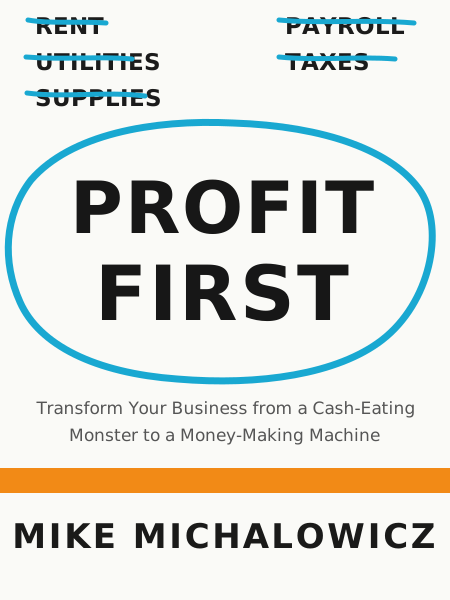
Profit First
Mike Michalowicz · 2014
Editorial rating
- Evidence
- 6/10
- Actionability
- 9/10
- Originality
- 7/10
The thesis
The traditional accounting formula (Sales - Expenses = Profit) is psychologically backwards. By flipping it to Sales - Profit = Expenses, you force your business to be profitable from day one. Take your profit first, then operate on what remains - your expenses will naturally shrink to fit available resources.
Who this is for
Small business owners living check-to-check despite growing revenue, entrepreneurs who consistently reinvest profits only to wonder where the money went, and anyone whose business feeds everyone except the owner.
My favorite quote
Most business owners try to grow their way out of their problems, hinging salvation on the next big sale or customer, but the result is simply a bigger monster.
Why it matters
Growth without profitability just creates a larger loss. Revenue is vanity, profit is sanity.
Do this
Today, transfer just 1% of your checking balance to a separate "Profit" account. You won't miss it, but you'll prove the system works.
Start here
Set up five bank accounts: Income (where deposits land), Profit (take 1-5% of every deposit here first), Owner's Compensation (your salary), Taxes (set aside 15-25%), and Operating Expenses (what's left). Transfer percentages on the 10th and 25th of each month. When operating expenses run low, you're forced to cut - not borrow or delay profit.
Critical summary
Mike Michalowicz, a serial entrepreneur who lost two businesses before learning these lessons, applies behavioral economics to small business accounting. His insight: Parkinson's Law (work expands to fill time available) applies to money too. If you have $10,000 in your account, you'll find ways to spend $10,000. By physically separating profit before you see it, you remove the temptation.
The system is essentially the "envelope method" from personal finance applied to business - allocate money to categories immediately, rather than trying to budget after the fact. Michalowicz adds rhythm (twice-monthly transfers) and friction (profit account at a different bank, harder to access) to make the system stick.
What it gets right
- Psychological framing brilliantly addresses how entrepreneurs actually behave with money
- The system is immediately implementable - you can start today
- Forced constraints drive operational efficiency ("necessity is the mother of invention")
- Celebrates small wins through quarterly "profit distributions"
What it misses
- Opening 5+ bank accounts with different access levels is cumbersome; many readers simplify
- The system can feel overly rigid for businesses with highly variable cash flow
- Dismisses traditional financial statements as "too confusing" - but P&L literacy remains important
- Target allocation percentages (TAPs) are generic; actual ratios vary significantly by industry
- Less useful for businesses requiring significant upfront investment before profitability
Evidence is largely anecdotal - Michalowicz's experience plus client case studies. But the behavioral science principles are sound, even if the specific implementation is customizable.
Key concepts
Parkinson's Law Applied to Money
Available resources are consumed. Reduce available operating resources to force efficiency.
Target Allocation Percentages (TAPs)
Predefined splits for Profit (5-20%), Owner's Comp (35-50%), Tax (15-25%), Operating Expenses (remainder). Adjust based on your business stage and industry.
Small Plates Theory
Just as smaller plates reduce food consumption, smaller operating accounts reduce expense consumption.
Profit Account Friction
Put your profit account at a different bank, ideally inconvenient to access. Remove temptation through friction.
The Instant Assessment
Calculate Real Revenue (revenue minus materials/subcontractors), then compare your current allocations to TAP benchmarks.
Quarterly Profit Distribution
Every quarter, distribute 50% of your profit account to yourself as a reward. Celebrate the system working.
Core insights
-
Profit is not an event
Profit doesn't happen at year-end; it happens with every transaction. Take it first, always.
-
Revenue growth doesn't solve profitability problems
A bigger unprofitable business is just a bigger problem. Fix profit first, then grow.
-
Your business should pay you first
Starving yourself to feed your business inverts the purpose of entrepreneurship.
-
Cutting expenses is easier than selling more
It's faster and more reliable to reduce costs than to increase revenue.
-
Separate accounts enforce behavior
Willpower fails; systems succeed. Remove money from sight to remove it from temptation.
Implementation steps
Today
- Open a new savings account labeled "Profit"
- Transfer 1% of your current business checking balance to it
- Commit to not touching this account for 90 days
This week
- Perform an "Instant Assessment" - calculate Real Revenue and current allocation percentages
- Research banks for your Profit account (choose one that's inconvenient to access)
- Set up automatic transfers on the 10th and 25th of each month
This month
- Open remaining accounts (Owner's Comp, Tax, Operating Expenses)
- Start with conservative TAPs (1% Profit, current Owner's Comp, 15% Tax)
- Identify your top 3 expenses and find one to cut by 10%
Ongoing
- Increase Profit percentage by 1% each quarter until you hit target
- Quarterly profit distribution: take 50% of Profit account as reward
- Review operating expenses monthly - if you're always running low, cut costs (don't raid other accounts)
Suggested 30-day practice plan
An editorial application plan created by Monolithic Vault - an interpretation of the book's ideas, not part of the original book.
- Day 1
Open a Profit account at a different bank; transfer 1% of current balance
- Day 2
Calculate your "Real Revenue" (revenue minus materials and subcontractors)
- Day 3
Document current allocation percentages across all expenses
- Day 7
Set up remaining accounts and automatic twice-monthly transfers
- Day 14
Identify three expenses that could be reduced or eliminated
- Day 21
Review first transfer cycle - did you survive on reduced operating funds?
- Day 30
Assess if you can increase Profit allocation by 1% next month
Free PDF summary
Take this analysis with you: a designed two-page field-notes sheet with the thesis, my favorite quote, the key concepts and core insights, and the full 30-day checklist. Print it or keep it - free, no signup.
Go deeper
If this analysis earned your attention, the full book goes further than any summary can. The original is always the primary source.