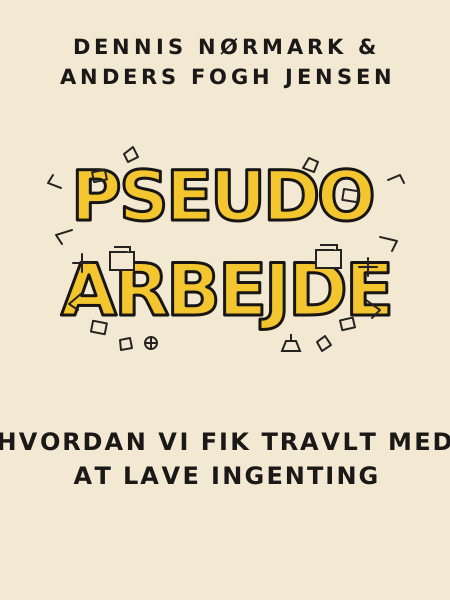
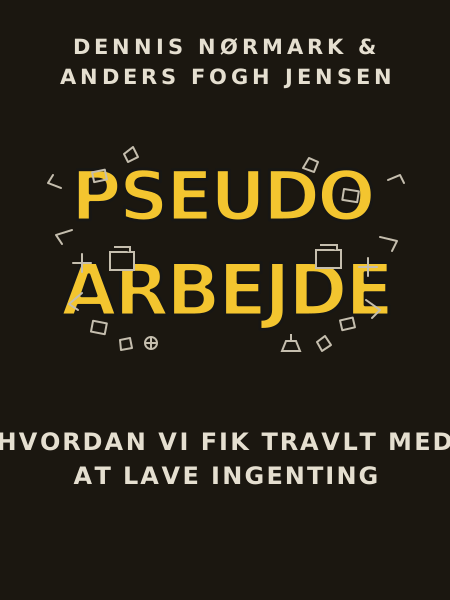
Pseudoarbejde
Dennis Nørmark & Anders Fogh Jensen · 2018
Editorial rating
- Evidence
- 5/10
- Actionability
- 7/10
- Originality
- 8/10
The thesis
Modern workplaces often reward visible activity rather than useful results, so employees become busy protecting systems, appearances, and positions instead of creating value. The cure begins by judging work by what would actually be lost if the task disappeared.
Who this is for
Managers drowning in reporting and recurring meetings, knowledge workers who cannot explain who benefits from half their tasks, and organizations that keep adding controls without removing anything old.
My favorite quote
Hvordan vi fik travlt med at lave ingenting
Why it matters
The subtitle captures the central paradox: a full calendar can conceal an alarming absence of useful work.
Do this
Choose one recurring task and ask what concrete harm would occur if nobody performed it for a month.
Start here
Use the disappearance test: if a task stopped for a month, who would notice, what value would vanish, and what risk would increase? When nobody can answer clearly, pause the activity instead of automatically improving its process.
Critical summary
Dennis Nørmark, an anthropologist, and Anders Fogh Jensen, a philosopher, begin with an old economic puzzle. Rising productivity was expected to shorten the working week dramatically, yet many people remain fully occupied while privately doubting that much of their work matters. Their answer is pseudo-work: activity that resembles necessary work, consumes time and organizational attention, but creates little or no value for customers, citizens, colleagues, or the stated mission. It includes reports nobody uses, meetings held because the calendar says so, documentation added without removing older requirements, symbolic projects, manufactured urgency, and tasks designed mainly to demonstrate that a role or department is busy. The authors connect these patterns to hourly employment, managerial control, unclear objectives, fear of spare capacity, status competition, and a culture where visible busyness is safer than admitting that the real work is finished. Interviews and workplace stories make the concept painfully recognizable, while the broader argument asks why productivity gains so rarely become free time.
What it gets right
- Gives employees memorable language for distinguishing real contribution from activity performed for appearance or institutional self-protection
- Shows how sensible controls accumulate into absurd systems because organizations add procedures far more easily than they remove them
- Treats wasted work as wasted life, not merely as an efficiency problem for managers and shareholders
What it overstates or misses
- Relies heavily on anecdotes and sweeping social interpretation rather than representative evidence about how much work is genuinely useless
- Sometimes treats value as obvious even though coordination, maintenance, compliance, care, and risk prevention often look unproductive until they fail
- Risks turning administrators, consultants, and public employees into convenient villains when incentives and political demands usually create the waste
The evidence is strongest as qualitative diagnosis and weakest when the authors imply a measurable economy-wide scale without measuring it convincingly. Later surveys and workplace research support the existence of widespread perceived uselessness, but they do not prove that every disliked task lacks value. The disappearance test is therefore more reliable than occupational stereotypes or heroic promises to abolish bureaucracy. The verdict: a brilliant name for a real problem, backed by more recognition than proof.
Key concepts
Pseudo-Work
Activity that consumes paid time and looks legitimate but produces no defensible value for the organization's users, mission, or necessary operations.
The Disappearance Test
Ask what specific loss would occur if a task stopped; vague discomfort is not enough to justify permanent work.
Performative Busyness
Displaying activity, urgency, and long hours to signal commitment when useful output is difficult to define or measure.
Organizational Sedimentation
New reports, controls, meetings, and initiatives accumulate because additions have sponsors while removals create political risk.
Productivity Dividend
Convert genuine efficiency gains into fewer tasks, shorter hours, or better service instead of filling the saved time with new activity.
Core insights
-
Busyness Is Often Defensive
People keep low-value tasks because an empty calendar can expose spare capacity, threaten status, or invite additional work.
-
Every Process Needs an Owner and a Beneficiary
A recurring activity without both is likely surviving through habit rather than necessity.
-
Invisible Work Still Needs a Case
Coordination and prevention may create value, but their defenders should explain the avoided cost or supported outcome.
-
Efficiency Without Subtraction Changes Nothing
Faster tools do not free time when organizations immediately replace eliminated work with fresh reporting and oversight.
-
Meaning Requires Consequence
Work feels worthwhile when employees can trace effort to a person helped, a risk reduced, or a result improved.
Implementation steps
Today
- List every recurring meeting and report you touched this week, then identify the direct beneficiary of each.
- Select one low-risk task and write the consequence you expect if it is skipped once.
This week
- Cancel or pause one recurring activity as a controlled experiment and record whether any meaningful problem appears.
- Require every meeting invitation to include a decision, owner, and reason the matter cannot be handled asynchronously.
This month
- Run a team audit that classifies work as customer value, necessary support, risk control, learning, or unexplained activity.
- Convert one verified productivity improvement into removed work or protected time rather than a higher volume target.
Ongoing
- Review new controls with a one-in, one-out rule so organizational sediment does not rebuild automatically.
- Reward employees for stopping unnecessary work, not only for launching visible initiatives and completing crowded task lists.
Suggested 30-day practice plan
An editorial application plan created by Monolithic Vault - an interpretation of the book's ideas, not part of the original book.
- Day 1
Track every task for one workday and mark the user, purpose, and expected consequence.
- Day 3
Apply the disappearance test to three recurring reports, meetings, or approval steps.
- Day 7
Pause one low-risk activity and ask affected colleagues to report any concrete loss.
- Day 14
Review the experiment and permanently remove, redesign, or defend the activity with evidence.
- Day 21
Audit one complete workflow for duplicated entry, waiting, approvals, and information nobody uses.
- Day 30
Establish a monthly subtraction review where the team removes at least one obsolete task before adding another.
Free PDF summary
Take this analysis with you: a designed two-page field-notes sheet with the thesis, my favorite quote, the key concepts and core insights, and the full 30-day checklist. Print it or keep it - free, no signup.
Go deeper
If this analysis earned your attention, the full book goes further than any summary can. The original is always the primary source.