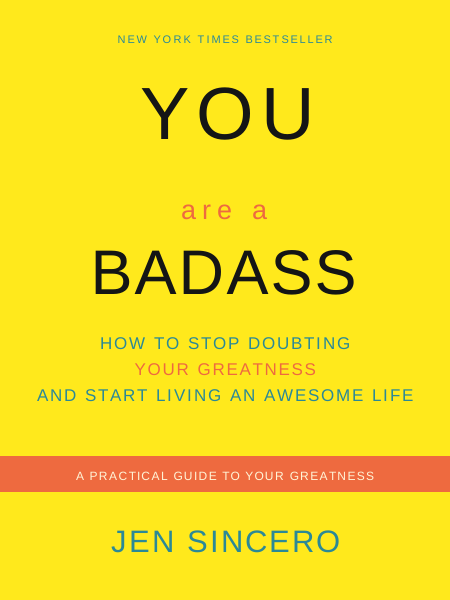
You Are a Badass
Jen Sincero · 2013
Editorial rating
- Evidence
- 2/10
- Actionability
- 6/10
- Originality
- 3/10
The thesis
You're already a badass - you've just buried it under layers of limiting beliefs, fear, and social conditioning. By connecting with "Source Energy," rewiring your subconscious, and acting despite fear, you can stop doubting your greatness and start living the awesome life that's been waiting for you.
Who this is for
People stuck in self-doubt who need a kick in the pants more than a careful analysis, anyone who's resistant to "woo-woo" self-help but might respond to humor and irreverence, and those who've read plenty of personal development but haven't taken action.
My favorite quote
You are responsible for what you say and do. You are not responsible for whether or not people freak out about it.
Why it matters
Most self-sabotage comes from managing others' reactions rather than expressing yourself. This separates your actions from their responses - you control one, not the other.
Do this
Identify one thing you've been avoiding saying or doing because of how someone might react. Do it anyway this week.
Start here
Your subconscious mind is running the show based on beliefs you absorbed as a child. Most of those beliefs are garbage ("I'm not good enough," "Money is hard to make"). To change your life, you must reprogram your subconscious through awareness, affirmations, and action - while connecting with what Sincero calls "Source Energy" (the universe, God, whatever works for you).
Critical summary
Jen Sincero writes self-help for people who roll their eyes at self-help. You Are a Badass packages Law of Attraction principles with humor, profanity, and personal anecdotes from her own broke-to-successful journey. The tone is "your blunt friend who won't let you wallow."
The book is more motivational speech than methodology. Sincero is funny, relatable, and skilled at making readers feel temporarily invincible. If you need permission to believe in yourself, this book grants it enthusiastically.
What it gets right
- Humor makes personal development accessible to people who'd never read traditional self-help
- Correctly identifies that subconscious beliefs drive behavior
- Emphasis on action over endless preparation
- "Big Snooze" as a label for the comfort-zone ego is memorable
What it gets badly wrong
- The Law of Attraction is pseudoscience. "Vibrating at a frequency" to attract wealth has zero empirical support
- Dismissive of structural barriers - poverty, discrimination, disability. "Just manifest it" ignores that the playing field isn't level
- No evidence presented for any claim. It's anecdotes and assertions dressed up as wisdom
- The advice to "have faith the Universe will provide" is indistinguishable from magical thinking
- Sincero acknowledges she was broke for years before success - survivorship bias means we don't hear from all the "positive thinkers" who stayed broke
- The tone can veer into toxic positivity: if you're not succeeding, you must not be believing hard enough
Read this for entertainment and permission, not as a methodology. The good parts are attitude shifts; the bad parts are pseudoscience.
Key concepts
Source Energy
The universal energy connecting everything - call it God, Universe, or whatever works for you. The point is connecting to something larger.
The Big Snooze
Your ego/comfort zone that resists change. It's the voice telling you to stay safe and not risk embarrassment.
Law of Attraction
Like attracts like - your frequency attracts matching experiences. Controversial but central to Sincero's framework.
Subconscious Mind
The autopilot running most of your behavior based on old programming. Change requires conscious reprogramming.
Limiting Beliefs
The stories you tell yourself about why you can't have what you want. Most were installed in childhood.
Acting "As If"
Behave as if you already have what you want. This allegedly shifts your frequency to attract it.
Core insights
-
Your thoughts create your reality
What you focus on expands. If you focus on scarcity, you see scarcity. Focus on possibility.
-
The Big Snooze will fight back
When you start making changes, your ego will throw up resistance - fear, "who do you think you are?", inconvenient obstacles. Expect it and push through.
-
Forgiveness is selfish (in a good way)
Holding resentment keeps you connected to pain. Forgive not for them, but to free yourself.
-
Comparison is violence against yourself
Comparing yourself to others is choosing to feel inadequate. Someone else's success doesn't limit yours.
-
Decide, don't wish
Wanting change and deciding to change are different. Decisions create action; wishes create fantasy.
Implementation steps
Today
- Write down 3 limiting beliefs you hold about yourself (e.g., "I'm not good with money")
- For each, write an alternative belief you'd prefer to hold
This week
- Catch yourself in negative self-talk and consciously reframe it
- Do one thing outside your comfort zone that you've been avoiding
This month
- Create a morning affirmation practice (5 minutes of reading positive statements about who you're becoming)
- Identify one area where you're playing small and take a bigger action
Ongoing
- Notice when the Big Snooze shows up and name it ("There's the Big Snooze trying to keep me safe")
- Practice gratitude daily - it shifts frequency from scarcity to abundance
Suggested 30-day practice plan
An editorial application plan created by Monolithic Vault - an interpretation of the book's ideas, not part of the original book.
- Day 1
List 10 things you love about yourself. (Harder than it sounds - do it anyway)
- Day 2
Write down your 5 most limiting beliefs about what you can achieve
- Day 3
Rewrite each limiting belief as an empowering alternative
- Day 7
Identify your biggest "Big Snooze" excuse and do the thing it's protecting you from
- Day 14
Create a simple daily affirmation routine (5 minutes, reading statements aloud)
- Day 21
Take one concrete action toward a goal you've been "someday-ing" for years
- Day 30
Write a letter to your future badass self describing who you've become
Free PDF summary
Take this analysis with you: a designed two-page field-notes sheet with the thesis, my favorite quote, the key concepts and core insights, and the full 30-day checklist. Print it or keep it - free, no signup.
Go deeper
If this analysis earned your attention, the full book goes further than any summary can. The original is always the primary source.