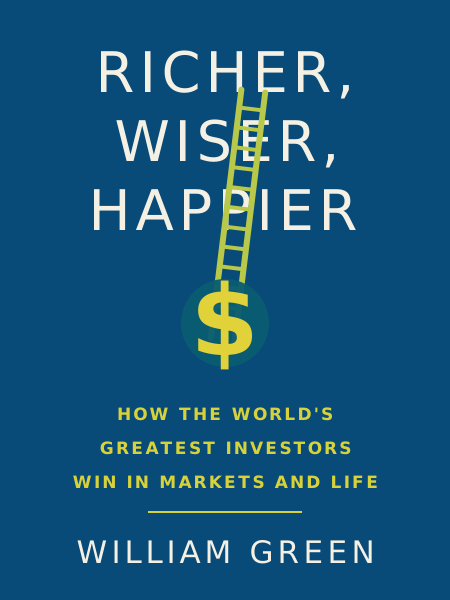
Richer, Wiser, Happier
William Green · 2021
Editorial rating
- Evidence
- 8/10
- Actionability
- 7/10
- Originality
- 7/10
The thesis
The world's greatest investors succeed not just because of analytical skill, but because of how they think, make decisions, handle adversity, and live their lives. Their talents extend far beyond finance - and by studying them, we can learn not only how to invest better but how to live better.
Who this is for
Investors who want life wisdom alongside financial wisdom, anyone curious about the minds behind legendary returns, and professionals seeking decision-making frameworks that apply beyond markets.
My favorite quote
I'm a shameless copycat. Everything in my life is cloned. I have no original ideas.
Why it matters
This demolishes the myth that success requires originality. The best investors - and people - find what works and copy it relentlessly. Cloning is strategy, not weakness.
Do this
Identify one successful person whose habits you could copy. Pick one specific behavior and adopt it this week.
Start here
Subtract rather than add. The greatest investors eliminate noise, complexity, and distraction rather than chasing more information, more trades, more activity. Simplify your portfolio, your process, and your life. As Charlie Munger says: "All I'm trying to be is non-idiotic."
Critical summary
William Green, a financial journalist who has interviewed legendary investors for 25 years, distills wisdom from more than forty super-investors including Charlie Munger, Howard Marks, Sir John Templeton, Joel Greenblatt, Mohnish Pabrai, and the elusive Nick Sleep.
Unlike typical investment books focused on technique, Green explores how these investors think. Their shared traits: fierce independence, comfort with being alone, willingness to look stupid in the short term, and a focus on avoiding mistakes rather than being brilliant.
The book is organized thematically - chapters on cloning, patience, dealing with adversity, simplicity - rather than as profiles. This structure lets patterns emerge across investors. The most memorable chapter covers Nick Sleep and Qais Zakaria of Nomad Partnership, whose "scale economics shared" framework (companies that pass cost savings to customers) produced exceptional returns.
What it gets right
- Access to investors who rarely give interviews (Nick Sleep especially)
- Focus on character and decision-making, not just stock picking
- Writing is engaging and storytelling is excellent
- Life lessons are as valuable as investment lessons
What it misses
- Some readers may want more tactical, actionable content
- Heavy value-investing focus - less relevant for other approaches
- The "billionaire wisdom" genre can feel aspirational rather than practical
- Survivorship bias - we only hear from winners
Evidence is journalistic - interviews and observation, not academic research. But 25 years of access to top performers provides unique insight.
Key concepts
Cloning
Systematically copying successful people's strategies, habits, and mental models. Originality is overrated.
Inner Scorecard
Judging yourself by your own standards, not others' opinions. Essential for contrarian decisions.
Scale Economics Shared
Nick Sleep's framework - companies that reinvest savings into lower prices, creating virtuous cycles (Amazon, Costco).
Second-Level Thinking
Asking not just "What will happen?" but "What do others think will happen, and how are they wrong?"
Simplicity as Strategy
Reducing complexity in portfolio, process, and life. Most activity destroys value.
Avoiding Stupidity
Munger's approach - focus on eliminating errors rather than being brilliant.
Core insights
-
Independence requires loneliness
Templeton invested from the Bahamas, Buffett from Omaha, Sleep from Edinburgh. Distance from the crowd is deliberate.
-
Pain tolerance is required
Every great investor has held positions through brutal drawdowns. Temperament beats IQ.
-
The best opportunities are counterintuitive
When everyone is selling, buy. When everyone is buying, be cautious. The obvious is rarely profitable.
-
Patience compounds
Templeton held stocks for years; Buffett for decades. Activity is the enemy of returns.
-
Character is destiny
Munger's "avoid people with bad values" applies to investments and life. Invest in quality people running quality businesses.
Implementation steps
Today
- Identify one source of noise you can eliminate (news, social media, market commentary)
- List 3 investors or thinkers whose habits you'd like to clone
This week
- Read the annual letters of one investor you admire (Buffett, Marks, Klarman)
- Practice explaining one investment in 2-3 sentences (if you can't, reconsider owning it)
This month
- Reduce portfolio complexity - can you achieve results with fewer positions?
- Create physical or digital distance from market noise
Ongoing
- Cultivate relationships with people who think long-term
- Default to inaction - most of the time, the best move is no move
- Review mistakes more than successes - avoiding stupidity beats chasing brilliance
Suggested 30-day practice plan
An editorial application plan created by Monolithic Vault - an interpretation of the book's ideas, not part of the original book.
- Day 1
Unsubscribe from 3 financial newsletters or notifications
- Day 2
Read one chapter from Buffett's or Munger's letters
- Day 3
Identify a successful person's morning routine and try it
- Day 7
List all your investments; can you explain why you own each in one sentence?
- Day 14
Read Nick Sleep's Nomad Partnership letters (available online)
- Day 21
Identify your biggest investing mistake; write down what you learned
- Day 30
Write your own "investment principles" document (1 page max)
Free PDF summary
Take this analysis with you: a designed two-page field-notes sheet with the thesis, my favorite quote, the key concepts and core insights, and the full 30-day checklist. Print it or keep it - free, no signup.
Go deeper
If this analysis earned your attention, the full book goes further than any summary can. The original is always the primary source.