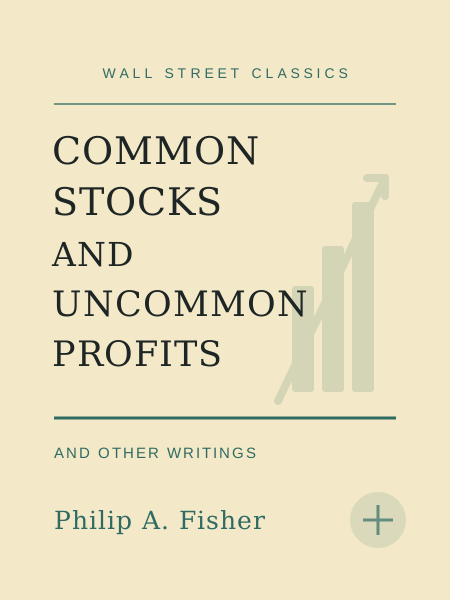
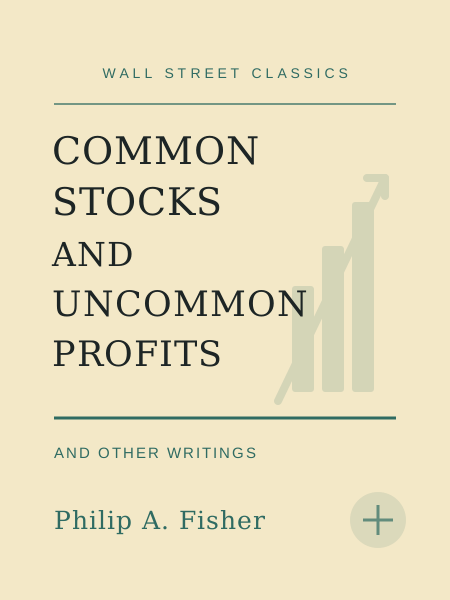
Common Stocks and Uncommon Profits
Philip Fisher · 1958
Editorial rating
- Evidence
- 7/10
- Actionability
- 8/10
- Originality
- 9/10
The thesis
The largest long-term returns come from owning a small number of exceptional growth companies whose markets, management, research, and culture can sustain expansion for years.
Who this is for
Fundamental stock pickers, equity analysts, and business owners who want to judge company quality beyond valuation multiples and quarterly earnings.
My favorite quote
The successful investor is usually an individual who is inherently interested in business problems.
Why it matters
Fisher makes stock selection a form of business investigation, not a contest in predicting price movements.
Do this
Pick one holding and write three operational questions that its financial statements cannot answer.
Start here
Use Fisher's scuttlebutt method before touching a valuation model. Speak with customers, suppliers, competitors, former employees, and industry specialists to learn whether the company has unusual products, honest management, strong sales execution, and room to reinvest. The goal is not gossip but a mosaic of facts that accounting reports reveal late or not at all.
Critical summary
Philip Fisher began as a securities analyst in 1928 and built his investment practice around companies capable of compounding sales and profits far beyond their industries. His method joins three parts. First, the scuttlebutt approach gathers information from a company's ecosystem rather than relying solely on management or published accounts. Second, fifteen points test the durability of growth through market potential, research and development, sales capability, margins, cost controls, labor and executive relations, management depth, candor, and integrity. Third, a long holding period allows exceptional businesses to convert those qualities into uncommon returns, while selling is reserved for a mistaken thesis, deteriorating fundamentals, or a clearly superior opportunity.
What it gets right
- Treats a stock as partial ownership of an operating business whose qualitative strengths eventually shape the numbers.
- Provides a demanding checklist that forces investors to examine growth runway, organizational capability, and management character together.
- Explains why concentration and long holding periods can be rational when research quality and business quality are genuinely high.
What it overstates or misses
- Gives little help with valuation, position sizing, or the price at which an excellent company becomes a poor investment.
- Assumes individual investors can obtain candid channel checks, access that is uneven and constrained by modern disclosure rules.
- Uses mid-century industrial examples and prose that can feel repetitive, leaving readers to translate the method into software and service businesses.
The evidence comes mainly from Fisher's long investment career, company cases, and the internal logic of his questions rather than controlled comparisons against alternative strategies. Later research on quality companies supports parts of his intuition, but it does not prove that every investor can identify those firms early or avoid paying too much. His framework is strongest as a research agenda and weakest as a complete portfolio system. It also invites confirmation bias unless the scuttlebutt process deliberately seeks disappointed customers, former employees, and competitors with reasons to challenge the thesis. The verdict: still the clearest classic on researching business quality, but incomplete without valuation and risk controls.
Key concepts
Scuttlebutt Method
Build a company mosaic by questioning customers, suppliers, competitors, former employees, and industry experts about strengths and weaknesses.
Fifteen Points
Test growth opportunity, innovation, sales, margins, people, controls, candor, and integrity before calling a company exceptional.
Fortunate Because Able
Prefer firms that create new growth through managerial capability rather than merely benefiting from a temporary external boom.
Almost Never Sell
Hold while the original thesis and future opportunity remain intact; price appreciation alone is not a reason to exit.
Limited Diversification
Own only as many companies as you can understand and monitor deeply, while still controlling company-specific risk.
Core insights
-
Research Beyond Reports
Financial statements describe results, while conversations across the value chain can reveal the causes before they appear in reported numbers.
-
Management Quality Is Operational
Judge leaders through research productivity, sales execution, cost discipline, succession depth, employee relations, and candor under pressure.
-
Growth Needs a Runway
A good current product is insufficient unless the company can develop additional demand after the first market matures.
-
Selling Interrupts Compounding
Frequent exits create taxes, timing errors, and replacement risk, so sell only when the business case changes materially.
-
Quality Does Not Cancel Price
Fisher underplays valuation, so pair his checklist with an explicit estimate of expected return and downside.
Implementation steps
Today
- Choose one company and score it provisionally against Fisher's fifteen points using only public information.
- Write five scuttlebutt questions that ask for observable behavior rather than opinions about the stock.
This week
- Read two earnings calls, three customer reviews, and one competitor filing for the same company.
- Add one piece of disconfirming evidence to your research notes each day.
This month
- Interview at least three informed people from different parts of the company's ecosystem and compare their accounts.
- Build a written investment thesis covering growth runway, management quality, valuation, risks, and explicit sell conditions.
Ongoing
- Recheck the thesis after material company events rather than after routine price movements.
- Limit new positions to businesses you can explain operationally without relying on market forecasts.
Suggested 30-day practice plan
An editorial application plan created by Monolithic Vault - an interpretation of the book's ideas, not part of the original book.
- Day 1
Select one company and create a research file organized around the fifteen points.
- Day 3
Map its customers, suppliers, competitors, products, and major growth drivers.
- Day 7
Complete the public-information review and mark every unanswered question.
- Day 14
Conduct the first scuttlebutt conversations and record facts separately from interpretations.
- Day 21
Write the strongest bear case, including valuation risk and evidence that management quality may be overstated.
- Day 30
Produce a one-page decision memo with a verdict, confidence level, position limit, and sell conditions.
Free PDF summary
Take this analysis with you: a designed two-page field-notes sheet with the thesis, my favorite quote, the key concepts and core insights, and the full 30-day checklist. Print it or keep it - free, no signup.
Go deeper
If this analysis earned your attention, the full book goes further than any summary can. The original is always the primary source.