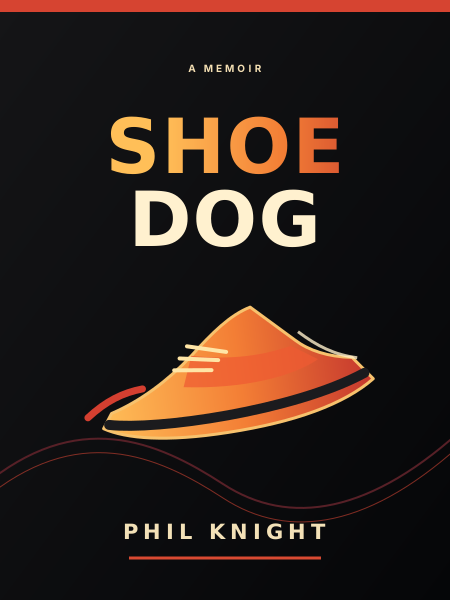
Shoe Dog
Phil Knight · 2016
Editorial rating
- Evidence
- 6/10
- Actionability
- 7/10
- Originality
- 8/10
The thesis
The path to building a global empire is defined by relentless uncertainty, near-bankruptcy, and "the play" - the joy of the game itself. Success isn't about a perfect business plan; it's about a "Crazy Idea" fueled by a team of misfits who refuse to lose. Victory is often found in the ability to outlast the competition's willingness to suffer.
Who this is for
Founders in the "messy middle," leaders struggling with cash flow and scaling pains, and anyone who feels like their business is a series of lucky escapes rather than a smooth trajectory.
My favorite quote
The coward never started and the weak died along the way. That leaves us, ladies and gentlemen. Us.
Why it matters
It captures the raw endurance required for long-term entrepreneurship.
Do this
Identify one "impossible" roadblock you are facing. Ask: "Am I quitting because it's hard, or because it's truly impossible?" If it's just hard, keep running.
Start here
Understand the Growth vs. Cash Gap. For the first decade of Nike (then Blue Ribbon Sports), the company was essentially broke. Every dollar made was immediately reinvested in more inventory. Phil Knight lived in a state of constant debt to the banks. The lesson: High-growth companies "eat" cash. If you want to scale, you must become comfortable with the "hair-raising" nature of high-leverage growth.
Critical summary
Shoe Dog is Phil Knight's memoir of the founding of Nike. It differs from most business books by focusing on the struggle rather than the victory. It details the early days of importing Japanese Onitsuka Tiger shoes, the betrayal of suppliers, the constant threat of bank foreclosures, and the team of "Buttfaces" (his core team) who made it happen.
What it gets right
- The reality of the "Cash Flow Crunch": You can have a best-selling product and still be one day from bankruptcy.
- The importance of "Partners": His relationship with Bill Bowerman (the innovator) provided the product soul that marketing alone couldn't create.
- The value of "The Misfits": Hiring people for their passion and loyalty over their pedigree.
What it misses
- Knight's background (Stanford MBA, CPA) gave him a financial literacy that many founders lack; his "risk" was calculated.
- It doesn't focus on the modern ethical complexities of global supply chains.
Key concepts
The Crazy Idea
The "Crazy Idea" is the spark, but the "Shoe Dog" (someone obsessed with the craft) is the engine.
The Buttfaces
His inner circle. A group of diverse people who could argue brutally but remained totally loyal to the mission.
Supply Chain Fragility
Nike was nearly killed multiple times by their own suppliers. Control over your source is survival.
The Play
Reframing work as a game or a mission. If you're just working for money, you'll quit during the hard years.
Core insights
-
Don't sell; compete
Knight never felt like a salesman. He felt like he was sharing something he believed in.
-
Growth is the only way to survive
In the shoe business, you're either growing or you're dying. Stagnation is death.
-
Banks are not your friends
They want safety; entrepreneurs want growth. Understand that this conflict is permanent.
-
Innovation comes from the edges
The "Waffle Iron" sole came from a track coach, not a laboratory.
-
Brand is the story people tell about you
Nike became Nike because of the athletes who wore it, not the commercials.
Implementation steps
Today
- Core Team Audit: Do you have "Buttfaces"? People who can tell you the brutal truth without ego?
- Vision Check: Are you chasing a goal or a "Crazy Idea"? Re-center on the "Why."
This week
- Cash Flow Review: Look at your "Float." Are you growing at a sustainable rate, or is your growth eating your survival cash?
- Innovate from the Fringe: Ask your frontline employees for one "crazy" improvement to the product.
Ongoing
- Outlast the Competition: Focus on being the last one standing.
Suggested 30-day practice plan
An editorial application plan created by Monolithic Vault - an interpretation of the book's ideas, not part of the original book.
- Day 1
Read the first 50 pages. Identify your "Crazy Idea."
- Day 10
Audit your supplier/partner dependencies.
- Day 20
Host a "Buttface" style meeting: brutal honesty allowed.
- Day 30
Review: Are we playing, or just working?
Free PDF summary
Take this analysis with you: a designed two-page field-notes sheet with the thesis, my favorite quote, the key concepts and core insights, and the full 30-day checklist. Print it or keep it - free, no signup.
Go deeper
If this analysis earned your attention, the full book goes further than any summary can. The original is always the primary source.