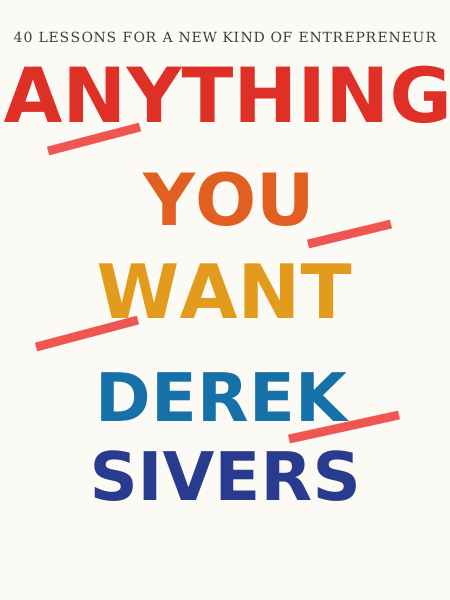
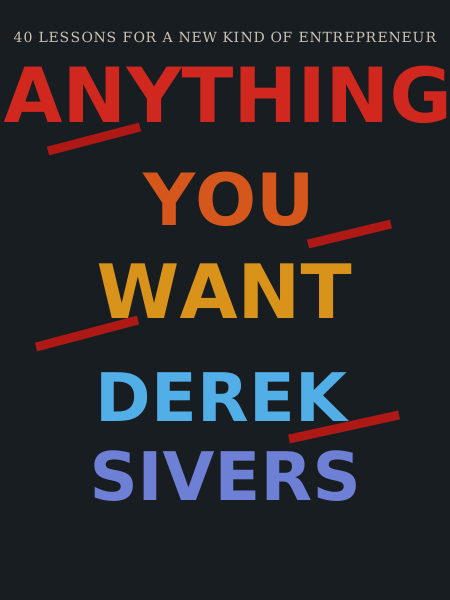
Anything You Want
Derek Sivers · 2011
Editorial rating
- Evidence
- 7/10
- Actionability
- 8/10
- Originality
- 9/10
The thesis
Business is not about maximizing profit - it's about making yourself happy while being useful to others. Start with what you need, not what investors want. Care about your customers more than yourself. And run your business like you don't need the money.
Who this is for
First-time founders who feel pressured to "think big," creative professionals considering monetizing their work, and burned-out entrepreneurs who've lost sight of why they started in the first place.
My favorite quote
Never do anything just for the money.
Why it matters
This isn't naive idealism - Sivers sold CD Baby for $22 million. It's strategic: when you optimize for money, you make short-term decisions that destroy long-term value and happiness.
Do this
List the three things you do in your business purely for money. For each, ask: "If this didn't pay, would I still do it?" If no, consider cutting it.
Start here
Start now, with what you have. Sivers built the first version of CD Baby over a weekend because he needed to sell his own CD. The business that made him $22 million started as a personal need, not a market opportunity. Don't wait for funding, permission, or the perfect idea. Start with something useful to you, then see if others want it too.
Critical summary
Derek Sivers wrote Anything You Want as a collection of lessons from accidentally building CD Baby into the largest seller of independent music online. It's more manifesto than manual - a series of short, punchy chapters that challenge conventional startup wisdom.
The book's philosophy is radically anti-growth: Sivers advocates staying small, rejecting outside investment, and prioritizing customer happiness over scaling. He shares stories of delighting customers with quirky confirmation emails, giving away millions to charity, and eventually selling a company he never intended to build.
What it gets right
- Refreshing counterpoint to "growth at all costs" startup culture
- Practical demonstration that profitable businesses don't require VC funding
- Emphasis on customer experience as competitive advantage
- Short, memorable format that practices what it preaches about efficiency
What it misses
- Survivorship bias: Sivers's approach worked for him, in his market, at his time
- Limited applicability to capital-intensive businesses or highly competitive markets
- Some advice (like casual hiring) could be disastrous in different contexts
- The "anti-business" framing can feel self-congratulatory
Evidence is entirely autobiographical. CD Baby was real and successful, but the lessons may not transfer to other contexts. Best read as permission to do things differently, not as a universal playbook.
Key concepts
Hell Yeah or No
If you're not saying "hell yeah" about an opportunity, say no. Applies to projects, hires, and partnerships.
Business as Personal Expression
Your business reflects who you are. Make decisions that match your values, not "what a business should do."
Customer Obsession
Sivers answered every customer email personally for years. This created loyalty no marketing budget could buy.
Revolution is Useful Idealism
Business success comes from genuinely caring about helping people, not from clever marketing or financial engineering.
Delegate or Die
At some point, you must trust others to make decisions. Teach your principles, then get out of the way.
The Anti-Plan
You don't need a business plan. Start helping people and let the business emerge from what works.
Core insights
-
Business success equals helping people
The more people you help, the more successful you'll be. Focus on usefulness, not revenue.
-
Never delegate understanding
Sivers made sure he understood every part of his business before hiring someone to do it. Otherwise, you can't evaluate their work.
-
Ideas are just multipliers of execution
An idea alone is worth nothing. A great idea times brilliant execution creates massive value.
-
You don't need money to start
CD Baby started with $500 and a weekend of coding. What can you build with what you have right now?
-
Know when to quit
Sivers sold CD Baby when he was no longer the right person to run it. Knowing when to exit is as important as knowing how to start.
Implementation steps
Today
- Write down why you started your business (or want to start one). Is that still true?
- Apply "Hell Yeah or No" to one pending decision
This week
- Answer one customer question that you've been delegating - what do you learn?
- Remove one activity from your business that exists only for the money
This month
- Create one "delightful surprise" for your customers (a quirky email, unexpected gift, personal note)
- Document one core process so well that someone else could do it
Ongoing
- Ask monthly: "Am I still the right person to run this?"
- Keep your business simple enough to explain in one sentence
Suggested 30-day practice plan
An editorial application plan created by Monolithic Vault - an interpretation of the book's ideas, not part of the original book.
- Day 1
Read Anything You Want (takes about an hour)
- Day 2
Apply "Hell Yeah or No" to your top 5 current projects
- Day 3
Write down your business in one sentence - what are you really doing?
- Day 7
Create one customer surprise; measure the response
- Day 14
Identify one thing only you can do; delegate everything else
- Day 21
Ask your best customers: "What would make this even more useful?"
- Day 30
Review: Does your business still reflect your values? What needs to change?
Free PDF summary
Take this analysis with you: a designed two-page field-notes sheet with the thesis, my favorite quote, the key concepts and core insights, and the full 30-day checklist. Print it or keep it - free, no signup.
Go deeper
If this analysis earned your attention, the full book goes further than any summary can. The original is always the primary source.