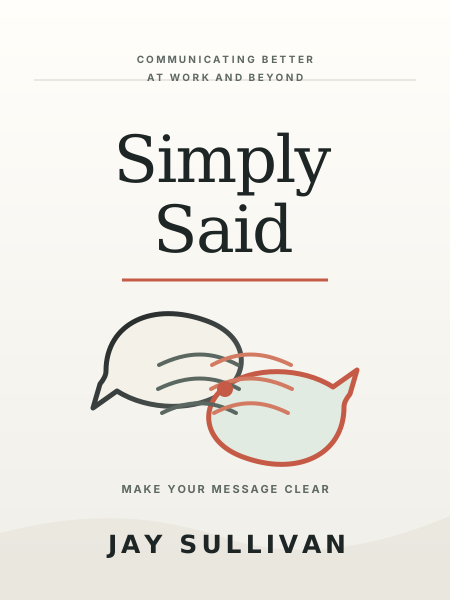
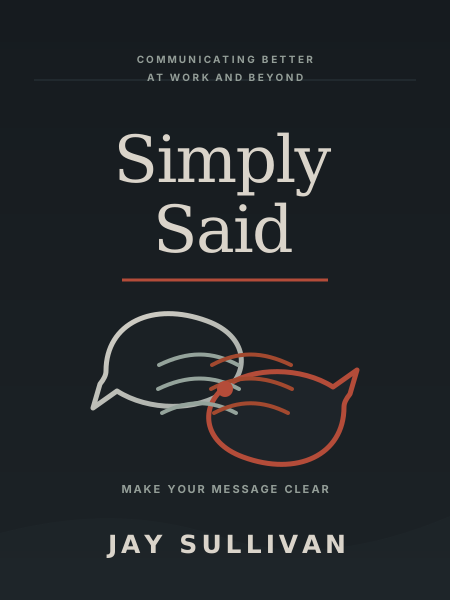
Simply Said
Jay Sullivan · 2016
Editorial rating
- Evidence
- 5/10
- Actionability
- 8/10
- Originality
- 4/10
The thesis
Effective communication isn't about expressing yourself clearly - it's about focusing on what your audience needs to hear. Shift from "What am I trying to convey?" to "What is someone hoping to get out of this?" and every interaction improves.
Who this is for
Professionals who write emails that get ignored, give presentations that don't land, or struggle to give feedback that actually changes behavior. Especially useful for consultants, lawyers, and anyone whose job requires persuading skeptical audiences.
My favorite quote
If you aren't clear about what you want them to know, there is no hope the message will get through.
Why it matters
Most communication failures start before you open your mouth. Clarity of purpose precedes clarity of expression.
Do this
Before your next email or meeting, write down the one thing you want the other person to remember. Make it ten words or fewer.
Start here
Lead with the message, not the background. State your main point in the first sentence, then support it. Most people bury their conclusion after extensive context, forcing audiences to figure out what matters. Invert: conclusion first, context second.
Critical summary
Sullivan, managing partner at communication consulting firm Exec|Comm, distills decades of corporate training into practical advice for presentations, emails, difficult conversations, and feedback. The book's central philosophy is simple: focus on others, not yourself.
This is a workmanlike handbook, not a transformative text. Sullivan systematically covers presentations (structure, delivery, visual aids), written communication (emails, documents, formatting), and interpersonal skills (feedback, difficult conversations, meetings). Each section provides concrete, immediately usable tips.
What it gets right
- The emphasis on audience focus is consistently applied across every context
- Advice is extremely practical: "keep subject lines under 7 words," "maintain eye contact with one person at a time"
- Treatment of feedback delivery is particularly strong - specific, behavior-focused, timely
What it misses
- Little new ground covered for anyone who's read a communication book before
- Repetitive - the "focus on others" theme appears in nearly every chapter without much evolution
- Touches many topics superficially rather than going deep on any
- Cultural assumptions may not translate globally
Evidence is primarily experiential - Sullivan's years of consulting - rather than research-based.
Key concepts
Audience-First Mindset
Ask "What do they need?" before "What do I want to say?" Reorient every communication.
The One Main Point
Every presentation or document should have exactly one takeaway, expressed in under ten words.
Message Before Context
Lead with your conclusion. Background comes after they know what matters.
Specific and Timely Feedback
Vague praise or criticism changes nothing. Name the behavior, give it immediately.
Eye Contact with Individuals
Don't scan the room - hold one person's gaze, complete a thought, move to the next.
Persuasive vs. Informative Documents
Different purposes require different structures. Know which you're writing.
Core insights
-
You're not as clear as you think
If your audience is confused, the problem is your communication, not their comprehension.
-
Being helpful is the only legitimate reason to speak
Every sentence should answer: "How does this serve them?"
-
Format signals importance
Headers, bullets, and white space aren't decoration - they help readers process quickly.
-
Questions beat statements for engagement
Drawing people into the conversation creates buy-in.
-
Speed and volume matter as much as words
Most speakers talk too fast and too quietly. Slow down, project, pause.
-
Feedback focuses on behavior, not character
"You arrived late three times" works. "You're unreliable" doesn't.
Implementation steps
Today
- Before your next email, write the main point as a single sentence. Put it first.
- Check your last five emails - are your subject lines under seven words?
This week
- In one presentation, hold eye contact with individuals rather than scanning
- Practice the pause: after key points, stop for 3-5 seconds
This month
- Give one piece of feedback using the formula: specific behavior + immediate timing + impact
- Restructure a document to lead with conclusions, follow with evidence
Ongoing
- Before every communication, ask: "What do they need from this?"
- Review emails before sending: Can the main point be understood in 5 seconds?
Suggested 30-day practice plan
An editorial application plan created by Monolithic Vault - an interpretation of the book's ideas, not part of the original book.
- Day 1
Write down the main point of your next three communications before creating them
- Day 2
Restructure one email to lead with the conclusion
- Day 3
Practice maintaining eye contact with one person at a time in a meeting
- Day 7
Give one piece of behavior-specific feedback
- Day 14
Review your sent emails - identify patterns in what works and what doesn't
- Day 21
Present something using the structure: message, support, message recap
- Day 30
Ask a colleague for feedback on your communication style - listen without defending
Free PDF summary
Take this analysis with you: a designed two-page field-notes sheet with the thesis, my favorite quote, the key concepts and core insights, and the full 30-day checklist. Print it or keep it - free, no signup.
Go deeper
If this analysis earned your attention, the full book goes further than any summary can. The original is always the primary source.