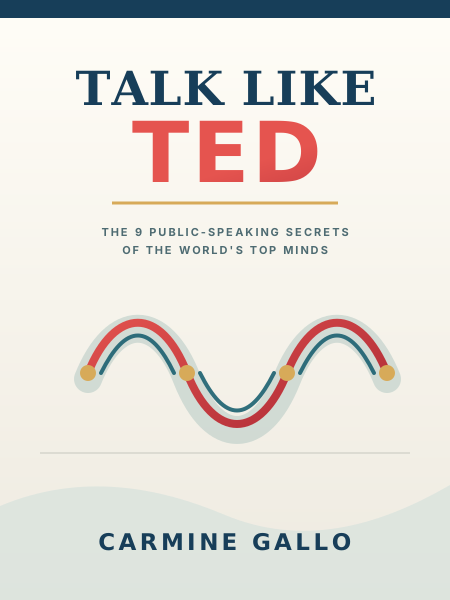
Talk Like TED
Carmine Gallo · 2014
Editorial rating
- Evidence
- 6/10
- Actionability
- 8/10
- Originality
- 5/10
The thesis
The best TED speakers share nine common techniques: they're passionate, they tell stories, they have conversations (not lectures), they teach something new, they create jaw-dropping moments, they use humor, they stick to 18 minutes, they appeal to multiple senses, and they stay authentic. Master these, and you can deliver presentations that inform, inspire, and go viral.
Who this is for
Anyone who presents ideas - consultants pitching clients, leaders rallying teams, entrepreneurs seeking funding, or professionals at conferences. Especially useful if your presentations are competent but forgettable.
My favorite quote
Ideas are the currency of the twenty-first century. The ability to persuade, to change hearts and minds, is perhaps the single greatest skill that will give you a competitive edge.
Why it matters
It reframes public speaking from a soft skill to a career-critical capability. In knowledge work, your ideas only matter if you can communicate them.
Do this
Watch one TED talk today. Note specifically: How did they open? What story did they tell? What was their "jaw-dropping moment"?
Start here
Create a "Holy Shit" moment - one emotionally charged event that your audience will remember and talk about. Bill Gates released mosquitoes into the audience. Jill Bolte Taylor brought a real human brain on stage. Your presentation needs one unforgettable moment that makes your key message stick. Without it, your talk is forgettable. With it, you have word-of-mouth.
Critical summary
Gallo, a communications coach who previously wrote about Steve Jobs' presentation style, analyzed 500+ TED talks to reverse-engineer what makes them work. He organizes his findings into three categories: Emotional (passion, stories, conversation), Novel (teach, wow moments, humor), and Memorable (18 minutes, sensory, authentic).
What it gets right
- The 18-minute rule is backed by cognitive research on attention and memory
- The emphasis on story structure is well-founded - stories activate more brain regions than facts
- Specific examples from actual TED talks make concepts concrete
- The "jaw-dropping moment" concept is genuinely useful for making presentations memorable
- Practical enough to implement immediately
What it misses or overstates
- Heavy on "what" great speakers do, lighter on "how" to actually develop these skills
- The examples are from world-class speakers - hard to know how to bridge from where you are
- Some advice is obvious ("be passionate," "tell stories") - the challenge is execution
- TED's format (18 minutes, receptive audience, high production values) doesn't match most real presentation contexts
- Survivorship bias - we only see the great talks; failures aren't analyzed
- Could have been shorter; some chapters pad rather than add
Evidence quality: Moderate. Gallo cites neuroscience research on attention spans and storytelling, which is solid. The TED talk analysis is observational, not experimental - it shows correlation between techniques and popularity, not causation. The advice aligns with presentation research, but the book is more practitioner guide than rigorous study.
Key concepts
The 18-Minute Rule
TED caps talks at 18 minutes because cognitive load increases with time. Creativity thrives under constraints - force yourself to be concise.
The "Holy Shit" Moment
An emotionally charged event that grabs attention and becomes the memorable hook. Plan it deliberately; don't hope it happens.
The Rule of Three
Human brains can process three pieces of information in short-term memory. Structure your presentation around three key points, not ten.
Story First, Data Second
Stories activate emotional brain regions; data doesn't. Lead with narrative, support with evidence.
Conversational, Not Lecturing
The best speakers talk with audiences, not at them. Rehearse enough that you can be spontaneous, not robotic.
Multisensory Experience
Engage multiple senses - visuals, demonstrations, props, even taste or smell if possible. More senses = stronger memory encoding.
Core insights
-
Passion is non-negotiable
If you don't care deeply about your topic, no technique will save you. Find the intersection of what you know and what moves you.
-
Your title should fit in a tweet
If you can't summarize your talk in 140 characters, you don't know what you're saying. Clarity before delivery.
-
Open with a story, not a summary
"Today I'll cover three topics..." is a surefire way to lose attention. Hook them with narrative first.
-
Novelty triggers dopamine
The brain pays attention to new information. Teach something genuinely surprising, or present familiar ideas in unexpected ways.
-
Humor lowers defenses
You don't need stand-up comedy. Self-deprecating humor, unexpected observations, or playful delivery builds rapport and makes audiences receptive.
Implementation steps
Today
- Write your next presentation's core message in one tweet-length sentence
- Identify one "holy shit" moment you could create - a demo, a story twist, a surprising statistic
This week
- Structure your next talk around exactly three key points
- Find or create one personal story that illustrates your main message
This month
- Video record yourself presenting. Watch without sound - how's your body language? Watch without video - how's your vocal variety?
- Practice one talk until you can deliver it conversationally, not from memory
Ongoing
- Study one TED talk per week, noting specific techniques you could adapt
- Seek feedback after every presentation: "What do you remember?" (Not: "Was it good?")
- Collect stories continuously - anecdotes are fuel for future presentations
Suggested 30-day practice plan
An editorial application plan created by Monolithic Vault - an interpretation of the book's ideas, not part of the original book.
- Day 1
Watch Ken Robinson's "Do Schools Kill Creativity?" Note: Opening story, humor, simple structure, conversational tone.
- Day 3
Write the one-sentence thesis for your next presentation. If it takes more than 15 words, simplify.
- Day 7
Develop your "holy shit" moment. What would make your audience gasp, laugh, or lean in?
- Day 10
Script your opening 90 seconds. You have 60 seconds to hook them or lose them.
- Day 14
Do a full run-through. Time it. Cut ruthlessly until it fits in 18 minutes (or your allotted time).
- Day 21
Record yourself. Analyze: Eye contact? Varied pace? Gestures? Filler words?
- Day 30
Deliver to a live audience. Ask afterward: "What's the one thing you remember?" That's your test.
Free PDF summary
Take this analysis with you: a designed two-page field-notes sheet with the thesis, my favorite quote, the key concepts and core insights, and the full 30-day checklist. Print it or keep it - free, no signup.
Go deeper
If this analysis earned your attention, the full book goes further than any summary can. The original is always the primary source.