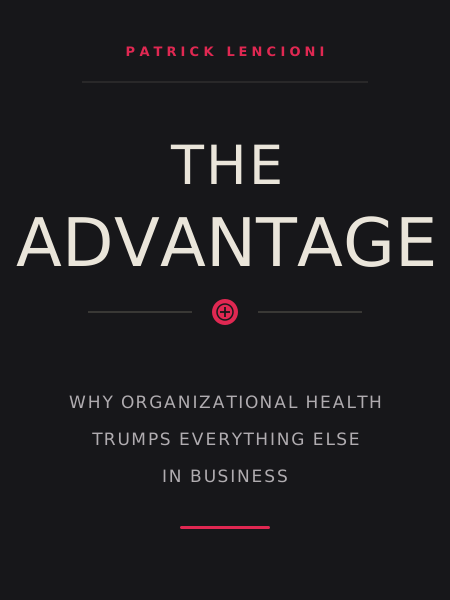
The Advantage
Patrick Lencioni · 2012
Editorial rating
- Evidence
- 6/10
- Actionability
- 9/10
- Originality
- 6/10
The thesis
The single greatest advantage any company can achieve is organizational health - not smarter strategy, better technology, or more talent. A healthy organization is whole, consistent, and free of politics, where everyone rows in the same direction. It sounds simple because it is. The hard part is the discipline to do it.
Who this is for
Executives frustrated by political dysfunction and misalignment, leaders who've tried strategy and talent upgrades without results, and anyone who senses their organization's biggest problems are internal, not external.
My favorite quote
If you could get all the people in an organization rowing in the same direction, you could dominate any industry, in any market, against any competition, at any time.
Why it matters
Alignment isn't a soft, feel-good concept - it's a competitive weapon. Most organizations waste enormous energy on internal friction.
Do this
Ask your leadership team the six critical questions. See how aligned (or misaligned) you really are.
Start here
Build organizational health through four disciplines: (1) Build a cohesive leadership team based on trust and productive conflict, (2) Create clarity by answering six critical questions, (3) Overcommunicate clarity until you're sick of hearing yourself, (4) Reinforce clarity through systems - hiring, performance, rewards. Start with the leadership team. If the top isn't aligned, nothing else matters.
Critical summary
Patrick Lencioni, author of The Five Dysfunctions of a Team, consolidates twenty years of consulting experience into a comprehensive framework for organizational health. His central argument: most organizations have plenty of intelligence and talent - what they lack is alignment, clarity, and political hygiene.
The book structures organizational health into four disciplines, each building on the previous. It's less about new ideas and more about disciplined execution of fundamentals.
What it gets right
- The six critical questions framework is immediately actionable
- Strong on overcommunication - most leaders radically underestimate how much repetition is needed
- Practical guidance on meeting rhythms (daily, weekly, monthly, quarterly)
- Clear connection between team health and organizational performance
What it misses
- Mostly synthesis of Lencioni's previous books - not much new if you've read his other work
- Evidence is primarily anecdotal (his consulting experience)
- Less applicable to highly distributed or remote organizations
- Doesn't address structural or market challenges - assumes the problem is always cultural
The book is practitioner-oriented, not academic. If you want research citations, look elsewhere. If you want a practical playbook, this delivers.
Key concepts
Organizational Health
Management, operations, strategy, and culture unified and working together. Build this before optimizing strategy.
The Six Critical Questions
Why do we exist? How do we behave? What do we do? How will we succeed? What's most important right now? Who must do what?
Cohesive Leadership Team
Built on trust, productive conflict, commitment, accountability, and results focus. Start here.
Overcommunication
Repeat core messages until you're sick of hearing yourself - then repeat more. Employees need to hear things 7+ times.
Thematic Goal
The single most important priority for a specific time period. Provides rallying focus.
Meeting Rhythm
Daily check-ins (5-10 min), weekly tactical (45-90 min), monthly strategic (2-4 hours), quarterly off-site.
Core insights
-
Smart organizations lose to healthy ones
Intelligence without alignment creates politics and dysfunction. Health is the greater lever.
-
Clarity requires answers, not slogans
Generic mission statements are useless. Answer the six questions with specificity.
-
Overcommunication is underrated
Leaders vastly underestimate the repetition needed. Keep saying it until you're bored - then say it again.
-
Cohesion starts at the top
A dysfunctional leadership team guarantees organizational dysfunction. Fix this first.
-
Meetings are the decision-making arena
Bad meetings create bad decisions. Structure different meeting types for different purposes.
-
Reinforcement closes the loop
Clarity without systems becomes noise. Hiring, rewards, and recognition must align with stated values.
Implementation steps
Today
- Answer the six critical questions yourself. Note where you're vague.
- Assess your leadership team's cohesion: Is there trust? Productive conflict? Commitment?
This week
- Gather your leadership team. Have each person answer the six questions independently. Compare answers.
- Identify your "thematic goal" - the one most important priority right now
This month
- Establish a meeting rhythm: daily check-ins, weekly tactical, monthly strategic
- Communicate clarity to the organization. Plan to repeat it 7+ times.
Ongoing
- Audit hiring, performance reviews, and rewards for alignment with stated values
- Quarterly off-sites to revisit and reinforce clarity
Suggested 30-day practice plan
An editorial application plan created by Monolithic Vault - an interpretation of the book's ideas, not part of the original book.
- Day 1
Read Disciplines 1 and 2 (cohesion and clarity)
- Day 2
Self-assess on the five behaviors of a cohesive team
- Day 3
Draft your answers to the six critical questions
- Day 7
Gather leadership team; compare answers to six questions
- Day 14
Establish new meeting rhythm (daily, weekly)
- Day 21
Communicate organizational clarity to broader team; plan repetition
- Day 30
Review one system (hiring or performance) for alignment with values
Free PDF summary
Take this analysis with you: a designed two-page field-notes sheet with the thesis, my favorite quote, the key concepts and core insights, and the full 30-day checklist. Print it or keep it - free, no signup.
Go deeper
If this analysis earned your attention, the full book goes further than any summary can. The original is always the primary source.