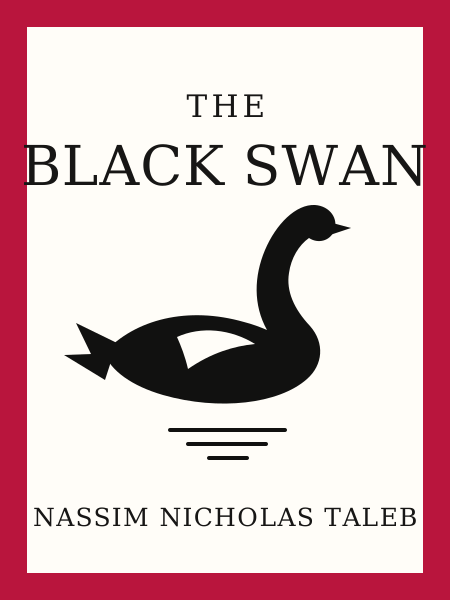
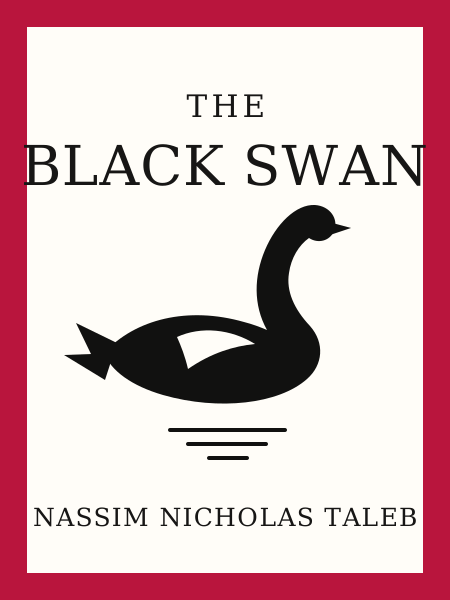
The Black Swan
Nassim Nicholas Taleb · 2007
Editorial rating
- Evidence
- 7/10
- Actionability
- 5/10
- Originality
- 9/10
The thesis
History is dominated by rare, unpredictable, high-impact events - Black Swans - that lie outside normal expectations. We systematically underestimate their frequency and impact, then rationalize them as predictable after the fact. The bell curve is a dangerous lie; plan for Extremistan, not Mediocristan.
Who this is for
Investors and risk managers who rely on models, strategists making long-term plans, and anyone whose career depends on predicting the future. Essential for those who need to understand why experts fail and how to prepare for the unpredictable.
My favorite quote
The inability to predict outliers implies the inability to predict the course of history.
Why it matters
We think history flows from trends we can observe. It actually lurches from rare events we never see coming.
Do this
Identify one assumption in your current plan that depends on "normal" conditions continuing. Stress-test it.
Start here
Distinguish between Mediocristan (where outliers don't matter - height, weight, individual calorie consumption) and Extremistan (where one observation can dominate - wealth, book sales, casualties in wars). Most financial and social domains are Extremistan, but we model them as Mediocristan using Gaussian bell curves. Stop predicting; start building robustness to negative Black Swans while exposing yourself to positive ones.
Critical summary
Nassim Nicholas Taleb, former Wall Street trader and probability scholar, wrote this book just before the 2008 financial crisis - which then became its most famous example. The core argument: rare, unpredictable events drive history and markets far more than we acknowledge, yet our models systematically ignore them.
Taleb introduces crucial concepts: Black Swans (rare, high-impact, retrospectively "predictable" events), Mediocristan vs. Extremistan (domains where outliers matter), the narrative fallacy (our compulsion to create stories that make random events seem inevitable), and the ludic fallacy (treating real-world uncertainty like casino games with known odds).
What it gets right
- Devastating critique of risk models that assume normal distributions
- Narrative fallacy and hindsight bias brilliantly explained
- Distinction between Mediocristan and Extremistan is genuinely useful
- Prescient about financial fragility (written before 2008 crash)
What it misses
- More diagnosis than prescription - you know Black Swans exist, now what?
- Taleb's personal attacks on academics and economists are gratuitous
- Writing can be repetitive and self-indulgent
- The advice to "just be robust" is vague without Antifragile's follow-up framework
- Some technical sections require statistical background
Evidence quality is mixed. The theoretical arguments about probability and rare events are sound. The critique of Gaussian models in finance is well-supported. But Taleb often overstates claims and dismisses counter-evidence. His subsequent success in 2008 lent credibility, but that's itself survivorship bias.
Key concepts
Black Swan
A rare event with extreme impact that was unpredictable beforehand but is rationalized as predictable after. Map where these could occur in your domain.
Mediocristan vs. Extremistan
Domains where averages matter vs. where extremes dominate. Know which world you're operating in.
Narrative Fallacy
Our compulsion to retrofit stories onto random events, making them seem inevitable. Resist the urge to explain everything.
Ludic Fallacy
Treating real-world uncertainty like games with known rules and probabilities. Reality doesn't come with a rulebook.
Silent Evidence
The data we don't see - the failures, the non-events - that would change our conclusions. Ask what's missing.
Confirmation Bias
Seeking evidence that confirms existing beliefs while ignoring disconfirming evidence. Actively seek disconfirmation.
Core insights
-
The improbable dominates reality
In Extremistan (most of finance, business, and history), a single event can overwhelm everything else. Plan accordingly.
-
Experts are worse at prediction than they admit
Professionals in forecasting-dependent fields (economics, political science) have terrible track records, but maintain confidence.
-
Hindsight blinds us
After events happen, we create narratives that make them seem inevitable. This creates false confidence in our ability to predict the next one.
-
Bell curves are dangerous when misapplied
Using Gaussian models in Extremistan domains (finance, technology adoption) catastrophically underestimates tail risk.
-
Focus on consequences, not probabilities
You can't predict Black Swans, but you can assess impact. Protect against catastrophic downsides regardless of probability.
-
Position for positive Black Swans
While avoiding negative Black Swans, expose yourself to domains where you could benefit from unexpected upsides.
Implementation steps
Today
- List your major assumptions that depend on "normal" conditions continuing
- Identify which domains you operate in: Mediocristan (averages matter) or Extremistan (extremes dominate)
This week
- Audit your risk models or plans for implicit Gaussian assumptions
- Identify where silent evidence might be distorting your conclusions
This month
- Stress-test your most important plans against extreme scenarios, not likely ones
- Map positive and negative Black Swan exposure in your career/business/portfolio
Ongoing
- Maintain skepticism toward expert predictions, especially precise ones
- Build optionality: positions that benefit from unexpected upside
Suggested 30-day practice plan
An editorial application plan created by Monolithic Vault - an interpretation of the book's ideas, not part of the original book.
- Day 1
Read Part One on antilibrary and empiricism
- Day 2
List where you assume normal distributions apply in your work
- Day 3
Identify three "narrative fallacies" in your organization's history
- Day 7
Map Mediocristan vs. Extremistan in your business - where do outliers dominate?
- Day 14
Audit a recent decision for confirmation bias - what evidence did you ignore?
- Day 21
Stress-test one major plan against a Black Swan scenario
- Day 30
Review your exposure - where are you vulnerable to negative Black Swans? Where could you gain from positive ones?
Free PDF summary
Take this analysis with you: a designed two-page field-notes sheet with the thesis, my favorite quote, the key concepts and core insights, and the full 30-day checklist. Print it or keep it - free, no signup.
Go deeper
If this analysis earned your attention, the full book goes further than any summary can. The original is always the primary source.