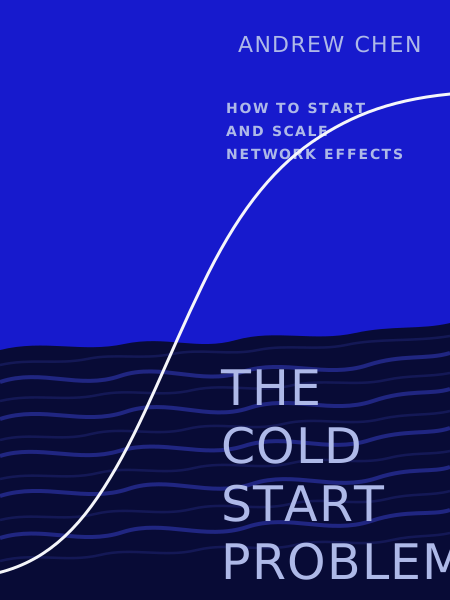
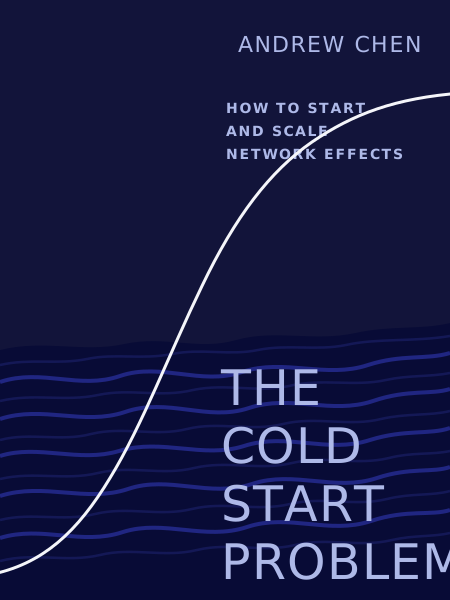
The Cold Start Problem
Andrew Chen · 2021
Editorial rating
- Evidence
- 8/10
- Actionability
- 9/10
- Originality
- 7/10
The thesis
Network effects are the most powerful competitive advantage in tech, but they start as a liability - new networks provide no value until enough users join. The "cold start problem" is this chicken-and-egg challenge. Solve it by building the smallest viable network first, then expand systematically.
Who this is for
Product managers building marketplace or social products, startup founders trying to bootstrap network effects, and anyone competing in winner-take-most markets where network density determines success.
My favorite quote
The first thousand users are the hardest to get, but they determine everything that follows.
Why it matters
Network effects compound, but only after you cross a threshold. The early users set the tone, density, and viability of everything that follows.
Do this
Define your "atomic network" - the smallest stable network that can self-sustain. Focus all early efforts there.
Start here
Build an Atomic Network first - the smallest, stable network from which all other networks can grow. For Tinder, it was a single college campus with enough attractive users of both genders. For Slack, it was a single team using it daily. For Uber, it was one city with enough drivers to achieve 5-minute pickup times. Don't try to boil the ocean. Find your atomic network, make it work, then replicate.
Critical summary
Andrew Chen, general partner at Andreessen Horowitz and former head of rider growth at Uber, spent years studying how networked products launch and scale. His central framework: network effects start negative (the "anti-network effect") and only turn positive after reaching critical mass. The book maps the entire lifecycle from cold start through escape velocity to the "ceiling" where growth stalls.
The Cold Start Theory has five stages: (1) Cold Start - bootstrapping the first network, (2) Tipping Point - network becomes self-sustaining, (3) Escape Velocity - growth accelerates through network effects, (4) Hitting the Ceiling - growth slows as market saturates, (5) The Moat - defending against competition.
What it gets right
- Practical frameworks from actual operator experience (Uber, Airbnb, Slack)
- "Atomic network" concept is immediately actionable
- Explains why aggregate metrics are meaningless - you must analyze individual networks
- Strong on tactics: invite-only, "come for the tool, stay for the network," hard side first
What it misses
- Dense at 400 pages - could be tighter
- Silicon Valley-centric; some tactics don't translate outside tech
- Less useful for B2B or non-platform businesses
- Examples skew toward massive successes; less on what went wrong
Evidence is primarily case-based - interviews with founders and Chen's own experience at Uber. Strong practical wisdom, less academic rigor than some strategy books.
Key concepts
Cold Start Problem
New networks have negative value - no users means no value for new users. Solve by bootstrapping an atomic network first.
Atomic Network
The smallest stable network that can self-sustain. Define yours precisely before launching.
Anti-Network Effects
At low density, network effects work against you - users churn because value is too low. Get past this quickly.
The Hard Side
The side of your network that's harder to attract but essential (drivers for Uber, creators for YouTube). Focus here first.
Come for the Tool, Stay for the Network
Launch with single-player utility, then layer on network features (Instagram, Dropbox).
Network Density
Quality of connections matters more than quantity. Dense, active networks beat large, sparse ones.
Core insights
-
Aggregate metrics are vanity metrics
Total users across a network tells you nothing. Analyze individual atomic networks - each needs to be healthy.
-
Start impossibly small
The atomic network should feel almost embarrassingly narrow. Slack started with one team, Tinder with one campus party.
-
Solve the hard side first
Every network has an easy side (riders) and a hard side (drivers). Attract the hard side first; the easy side follows.
-
"Flintstoning" before automating
Do things that don't scale to bootstrap the network. Reddit's founders created fake accounts to simulate activity.
-
Invite-only creates density
Limiting access forces density in early networks and creates social proof. LinkedIn and Clubhouse used this effectively.
-
Network effects are not winner-take-all
Multiple networks can coexist if they serve different atomic networks or geographies.
Implementation steps
Today
- Define your atomic network: What's the smallest group that would find your product valuable?
- Identify your "hard side" - who's essential but hardest to attract?
This week
- Map your current network density: Are users actually connecting, or just signing up?
- List 3 "Flintstoning" tactics you could use to simulate network value before you have scale
This month
- Build your first atomic network - focus all resources on making one small network work
- Instrument metrics at the network level, not just aggregate user counts
Ongoing
- Expand atomic network by atomic network, not by spraying marketing broadly
- Monitor network health: engagement, density, retention at the network level
Suggested 30-day practice plan
An editorial application plan created by Monolithic Vault - an interpretation of the book's ideas, not part of the original book.
- Day 1
Read Part I (Network Effects basics) and Part II (Cold Start)
- Day 2
Define your atomic network with specificity (geography, community, use case)
- Day 3
Identify your hard side and list 5 ways to attract them
- Day 7
Launch or intensify focus on one atomic network; cut distractions
- Day 14
Measure network density and engagement, not just signups
- Day 21
If atomic network is working, plan expansion to adjacent networks
- Day 30
Document playbook: what worked? What will you replicate?
Free PDF summary
Take this analysis with you: a designed two-page field-notes sheet with the thesis, my favorite quote, the key concepts and core insights, and the full 30-day checklist. Print it or keep it - free, no signup.
Go deeper
If this analysis earned your attention, the full book goes further than any summary can. The original is always the primary source.