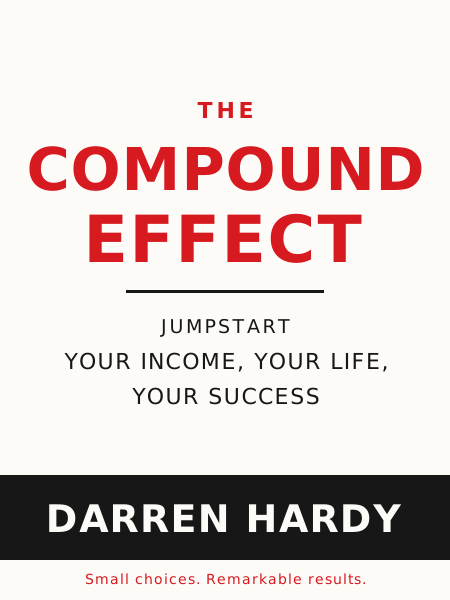
The Compound Effect
Darren Hardy · 2010
Editorial rating
- Evidence
- 5/10
- Actionability
- 7/10
- Originality
- 4/10
The thesis
Success isn't about massive actions or lucky breaks - it's about small, consistent choices that compound over time. A penny doubled daily for 31 days yields over $10 million. Similarly, tiny improvements in habits, relationships, and skills accumulate into extraordinary results. The catch: you won't see returns for months or years, so most people quit too early.
Who this is for
Professionals seeking sustainable success strategies over get-rich-quick schemes, anyone who has tried dramatic transformation and failed, people who intellectually understand habits but need motivational reinforcement, and readers who respond to no-nonsense "tough love" messaging.
My favorite quote
You will never change your life until you change something you do daily. The secret of your success is found in your daily routine.
Why it matters
This captures the book's central premise: outcomes are downstream of daily habits. Grand ambitions mean nothing without mundane execution.
Do this
Identify one small positive action you can do every day for the next 30 days. Make it so easy you can't fail. Start today.
Start here
Track every decision in your target area for one week. Awareness precedes change. Most people "sleepwalk" through choices, unaware of the small decisions eroding their goals. If you want to lose weight, track every calorie. Want to save money, track every dollar. Want better relationships, track every interaction. The tracking itself changes behavior before you make any deliberate changes.
Critical summary
Hardy, former publisher of SUCCESS Magazine, distills what he's learned from interviewing high achievers into a single principle: small consistent actions beat dramatic transformations. The math is compelling: cutting 125 calories daily (one soda) produces 12+ pounds of weight loss annually. Reading 10 pages daily yields 30-40 books per year.
The book covers choices, habits, momentum, influences, and acceleration. Hardy's style is motivational-speaker-direct, with personal anecdotes demonstrating each principle. He's clearly influenced by Jim Rohn and the success literature tradition.
What it gets right
- The compound math is genuinely persuasive - small daily differences yield massive long-term gaps
- Tracking as intervention: measuring behavior changes it before any other action
- The "Big Mo" (momentum) concept: once you're moving, continuing requires less effort
- Influence auditing: your results reflect the average of people you spend time with
- "Bookend" routines: how you start and end your day matters disproportionately
What it misses or overstates
- Heavy on self-congratulation and name-dropping; Hardy frequently references his own success and famous contacts
- The hypothetical examples (three friends diverging over 31 months) feel contrived
- Narrow definition of success: wealth, fitness, CEO status - little about meaning, relationships, creativity
- Some readers find the tone preachy and the "tough love" style condescending
- Much of this is Jim Rohn repackaged - if you've read classic success literature, little is new
- The evidence is mostly anecdotal; few references to research
- The penny-doubling example is mathematically correct but practically misleading (nothing compounds that cleanly)
This is motivation, not science. Useful if you need a kick to start; limited if you need nuanced guidance.
Key concepts
The Compound Effect
Small smart choices + consistency + time = radical difference. Works for good habits AND bad ones.
Tracking
You can't change what you don't measure. Track behavior in your target area before trying to change it.
The Big Mo (Momentum)
Once you're in motion, staying in motion is easier. The hardest part is starting; protect your momentum once you have it.
Bookend Routines
How you start and end each day disproportionately affects overall results. Design your mornings and evenings.
Influence Inventory
You become the average of the 5 people you spend most time with. Audit and upgrade your associations.
The Ripple Effect
Every action creates consequences beyond the immediate. Small choices ripple outward in ways you can't foresee.
Core insights
-
What's easy to do is also easy not to do
That's why most people don't do it. The compound effect rewards those who do the "easy" things consistently.
-
Choices are invisible until tracked
Most self-sabotage happens through unconscious decisions. Track everything in your problem area for one week.
-
100% commitment is easier than 98%
When something is absolute (I always X, I never Y), you don't waste energy deciding each time.
-
Momentum is fragile at the start
Once broken, it's hard to restart. Protect early momentum even at the cost of other priorities.
-
Your environment is stronger than your willpower
Design your surroundings to make good choices easy and bad choices hard.
Implementation steps
Today
- Choose ONE area to apply the compound effect (health, finances, relationships, skills)
- Define a tiny daily action in that area - so small you can't fail (10 pushups, $5 saved, 10 pages read)
- Start tracking: create a simple log (spreadsheet, journal, app)
This week
- Complete 7 days of tracking without trying to change behavior - just observe
- Identify your "Big 3" time-wasters revealed by tracking
- Audit your associations: list people who energize vs. drain you
This month
- Design bookend routines for morning and evening
- Eliminate or reduce one negative influence (person, media, environment)
- Add one positive influence (mentor, book, community)
Ongoing
- Continue your tiny daily action - don't break the chain
- Monthly review: what's compounding positively? What's compounding negatively?
- Protect your momentum; when you slip, restart immediately (don't wait for Monday)
Suggested 30-day practice plan
An editorial application plan created by Monolithic Vault - an interpretation of the book's ideas, not part of the original book.
- Day 1
Choose your focus area; define your tiny daily action; start tracking
- Day 2
Do your tiny action; log it. Notice the choices you make unconsciously.
- Day 3
Continue tracking; resist the urge to change anything yet
- Day 7
Review first week of tracking data. What patterns emerge? What's your baseline?
- Day 14
Design and implement morning bookend routine (first 30 minutes of day)
- Day 21
Audit your associations; make one upgrade (add positive, reduce negative)
- Day 30
Calculate your compound effect: 30 days × tiny action = what results? Project 365 days.
Free PDF summary
Take this analysis with you: a designed two-page field-notes sheet with the thesis, my favorite quote, the key concepts and core insights, and the full 30-day checklist. Print it or keep it - free, no signup.
Go deeper
If this analysis earned your attention, the full book goes further than any summary can. The original is always the primary source.