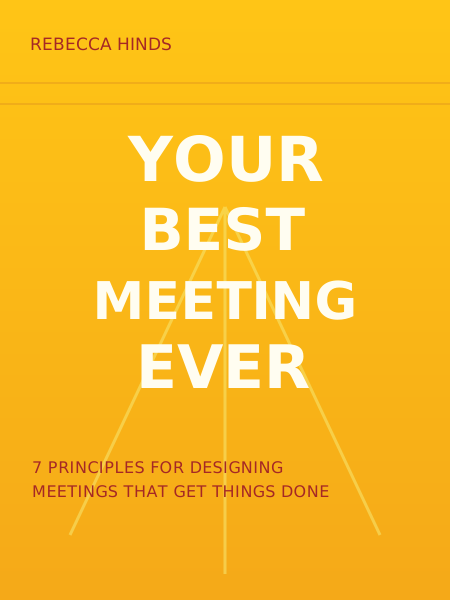
Your Best Meeting Ever
Rebecca Hinds · 2026
Editorial rating
- Evidence
- 6/10
- Actionability
- 9/10
- Originality
- 5/10
The thesis
Meetings are relics of a hierarchical, order-issuing work culture, and they should be designed like products, with users, purpose, and success criteria, not just scheduled by default.
Who this is for
Managers and project leads drowning in packed calendars, and consultants who need to facilitate client meetings that actually lead to decisions.
My favorite quote
Everyone wants better meetings, but no one seems to know how.
Why it matters
It captures why meeting frustration is universal but rarely solved systematically, it stays a shared complaint instead of becoming a design problem.
Do this
Pick one recurring meeting on your calendar tomorrow and ask: who is the "user," and what's the concrete output?
Start here
Treat meetings like products. Before scheduling one, define: who is the user (the attendees), what's the output (a decision, not information), and how will you measure whether it worked. If you can't answer those three, the meeting isn't ready to happen.
Critical summary
Hinds, former head of the Work Innovation Lab at Asana, draws on her Stanford research background to tackle one of knowledge work's most widely mocked, but rarely systematically solved, problems: bad meetings. The book's central metaphor is product design, meetings should have users, clear value, and ongoing iteration, just like a digital product. Central to the book is "Meeting Doomsday," a radical reset of an organization's meeting culture where all recurring meetings are deleted and must be re-scheduled with an explicit justification.
What the book does well: it's practically oriented, with concrete metrics, principles, and cases from Google, Salesforce, Pixar, and Dropbox. "Meeting Doomsday" is a bold, easy-to-grasp intervention that's simple to propose to a client without a long explanation. Blurbs from Reid Hoffman, Kim Scott, and Amy Edmondson suggest the book hits a real organizational pain point.
What falls short: the genre is already crowded, "Death by Meeting" (Lencioni), "The Surprising Science of Meetings" (Rogelberg, who himself reviews this book favorably), and parts of "Superteams" (Friedman, published the same spring) cover much of the same territory: fewer meetings, clearer purpose, better facilitation. The product-design metaphor is elegant but not fundamentally new, it reads more like an application of already established lean and UX principles to meeting culture than a genuine discovery. The book is so new (February 2026) that no independent critical reviews exist yet, only publisher- and author-adjacent sources plus early library listings. The evidence base is a mix of Hinds's own research at Asana and cases from large tech companies, which raises the question of how well it transfers to smaller Danish SMEs without Google's resources for meeting design.
Key concepts
Meetings as Products
Every meeting should have a defined user, an output, and a way to measure success, just like a product. Use it as a standard checklist before sending a meeting invite.
Meeting Doomsday
An organization-wide reset where all recurring meetings are deleted and must be re-scheduled with an explicit justification. Propose it to a client with a bloated meeting culture.
Meeting Minimalism
The principle that meetings should be a last resort, not the default response to a communication need. Test asynchronous communication as the first choice for a week.
Harmful vs. Useful Meeting Metrics
Some metrics (like number of meetings held) do more harm than good. Identify which meeting metrics you actually use, and whether they drive the right behavior.
Designing Delight into Meetings
Small, deliberate elements that make people want to show up, not just feel obligated. Relevant for a client's internal workshop facilitation.
Core insights
-
The meeting isn't the problem, the design is
Bad meetings are a symptom of a lack of deliberate design, not an unavoidable part of work life. Consequence: make meeting design a standard part of project kickoffs.
-
The default "let's have a meeting" is often wrong
Many questions can be resolved asynchronously. Challenge that reflex in client work.
-
Technology (including AI) should reduce, not increase, meeting load
Used wrong, AI tools just increase the volume of notes and follow-ups without reducing meeting time.
-
Hierarchy-driven meetings are a legacy, not a necessity
Many recurring status meetings exist because they always have, not because they create value today.
-
The genre is saturated, differentiate in practice, not theory
The real value for you lies in "Meeting Doomsday" as a concrete client intervention, not in the underlying theory, which already exists elsewhere.
Implementation steps
Today
- Review your calendar and identify one recurring meeting with no clear output.
- Cancel it, or redefine its purpose with a concrete decision requirement.
This week
- Test the "meetings as products" principle on a client meeting: define user, output, and success measure in advance.
- Replace one status meeting with an asynchronous update.
This month
- Propose a mini version of "Meeting Doomsday" in a client organization or internal team.
- Introduce a fixed meeting effectiveness metric and track it for four weeks.
Ongoing
- Make "who is the user, what's the output" a standard question before new recurring meetings are created.
Suggested 30-day practice plan
An editorial application plan created by Monolithic Vault - an interpretation of the book's ideas, not part of the original book.
- Day 1
Map all recurring meetings in your own calendar and note the purpose of each.
- Day 3
Cancel or redefine one meeting with no clear output.
- Day 7
Test the meetings-as-products principle on a client meeting.
- Day 14
Propose a mini Meeting Doomsday in one team.
- Day 21
Introduce a meeting metric and measure it for the first week.
- Day 30
Evaluate whether meeting time and perceived value have changed, and adjust the approach.
Free PDF summary
Take this analysis with you: a designed two-page field-notes sheet with the thesis, my favorite quote, the key concepts and core insights, and the full 30-day checklist. Print it or keep it - free, no signup.
Go deeper
If this analysis earned your attention, the full book goes further than any summary can. The original is always the primary source.