The Lean Startup
Eric Ries · 2011
Editorial rating
- Evidence
- 6/10
- Actionability
- 8/10
- Originality
- 7/10
The thesis
Startups fail not from building the wrong product well, but from building products nobody wants. The solution is rapid, iterative experimentation - build the smallest thing possible, measure customer response, learn, and pivot or persevere before burning through your runway.
Who this is for
First-time founders uncertain whether their idea has legs, product managers at established companies launching new initiatives, and anyone who needs to validate assumptions before committing significant resources.
My favorite quote
The only way to win is to learn faster than anyone else.
Why it matters
Speed of learning, not speed of building, determines startup survival. Most founders optimize for the wrong thing.
Do this
Write down your three riskiest assumptions about your current project. Design one experiment you could run this week to test the riskiest one.
Start here
Build a Minimum Viable Product (MVP) - the smallest version of your idea that lets you test your core hypothesis with real customers. Don't spend six months building; spend six days testing. The goal isn't a polished product - it's validated learning about what customers actually want.
Critical summary
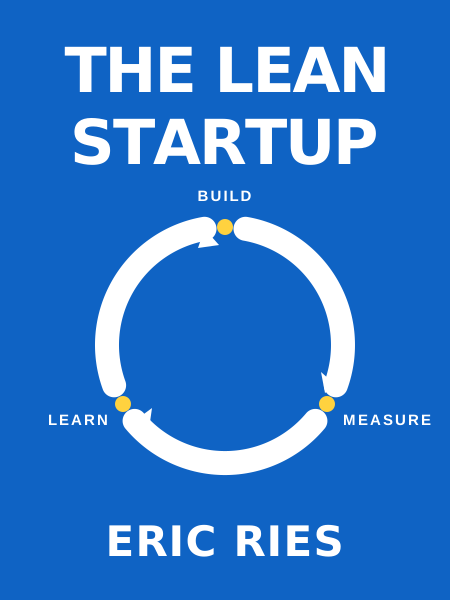
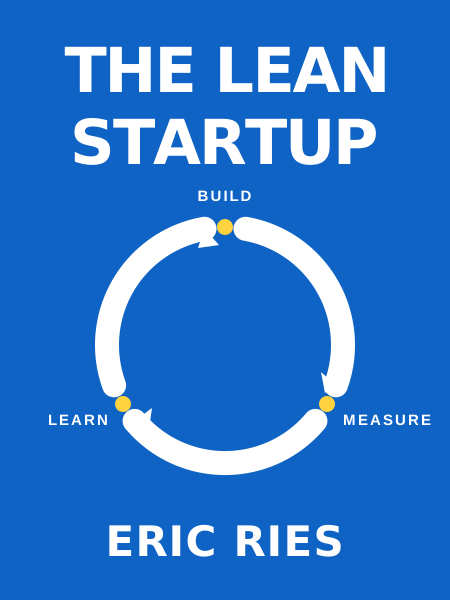
Eric Ries adapts Toyota's lean manufacturing principles to the chaos of startups. The central framework is the Build-Measure-Learn feedback loop: build an MVP, measure customer behavior with actionable metrics (not vanity metrics), learn whether to pivot or persevere, and repeat.
The book introduced vocabulary that's now ubiquitous - MVP, pivot, validated learning, innovation accounting. These concepts genuinely shifted how startups approach product development, moving from "build it and they will come" to "test before you invest."
What it gets right
- Rejection of stealth mode and big-bang launches as wasteful
- Distinction between vanity metrics (total signups) and actionable metrics (engagement rate)
- Pivot-or-persevere framework forces explicit decision points
What it misses
- The "just ship it" culture can produce low-quality MVPs that damage brand perception before you learn anything useful
- Ben Horowitz's critique is valid: "running lean" can become an end rather than a means - sometimes you need to run fat to dominate a market
- Hardware and deep-tech startups can't iterate as cheaply as software startups
- Examples lean heavily on software companies circa 2008-2011; many specific tactics are dated in 2025's AI-enabled world
- Innovation accounting remains vague and hard to implement
Evidence quality is primarily anecdotal - Ries's experience at IMVU and case studies from the early 2010s startup ecosystem. The methodology is sound in principle but lacks rigorous validation of outcomes.
Key concepts
Minimum Viable Product (MVP)
Smallest thing that tests your riskiest assumption. Launch a landing page before building the product.
Build-Measure-Learn Loop
Iterative cycle for systematic learning. After each sprint, ask: what did we learn?
Validated Learning
Progress measured by learning about customers, not features shipped. Track one metric that matters.
Pivot
Structured change in strategy while preserving learning. Schedule regular pivot-or-persevere meetings.
Innovation Accounting
Metrics for measuring startup progress. Define your leading indicators before launch.
Actionable vs. Vanity Metrics
Metrics that inform decisions vs. metrics that just look good. If a metric doesn't change your behavior, stop tracking it.
Core insights
-
Most startup effort is waste
You're building features nobody asked for, solving problems that don't exist. Ruthlessly cut everything that doesn't test your hypothesis.
-
Speed of iteration beats quality of iteration
Two crappy experiments per week teach more than one polished launch per month.
-
Customers don't know what they want
Don't ask them - observe their behavior. What people do matters more than what they say.
-
Pivots are strategy, not failure
The ability to pivot before running out of money is your actual runway. Runway = number of pivots remaining.
-
Small batches reveal problems faster
Ship daily if possible. Inventory (unreleased features) is liability, not asset.
Implementation steps
Today
- List your three riskiest assumptions about your current project or idea
- Identify one metric that would prove or disprove your core hypothesis
This week
- Design the smallest possible test for your riskiest assumption
- Set up basic analytics to track your actionable metric (not just pageviews)
This month
- Build and ship an MVP - even if it's just a landing page with an email signup
- Schedule a formal "pivot or persevere" meeting based on results
Ongoing
- Run at least one experiment per week
- Hold monthly pivot-or-persevere reviews with explicit go/no-go decisions
Suggested 30-day practice plan
An editorial application plan created by Monolithic Vault - an interpretation of the book's ideas, not part of the original book.
- Day 1
Write out your business model assumptions (customer, problem, solution, channel, revenue)
- Day 2
Rank assumptions by risk - which, if wrong, kills the business?
- Day 3
Design MVP to test your #1 assumption (could be landing page, video, manual service)
- Day 7
Launch MVP to first 10-50 potential customers
- Day 14
Review data - what did behavior tell you? Adjust hypothesis
- Day 21
Either iterate on MVP or pivot to new approach based on learning
- Day 30
Document validated learnings and decide: double down or kill the idea
Free PDF summary
Take this analysis with you: a designed two-page field-notes sheet with the thesis, my favorite quote, the key concepts and core insights, and the full 30-day checklist. Print it or keep it - free, no signup.
Go deeper
If this analysis earned your attention, the full book goes further than any summary can. The original is always the primary source.