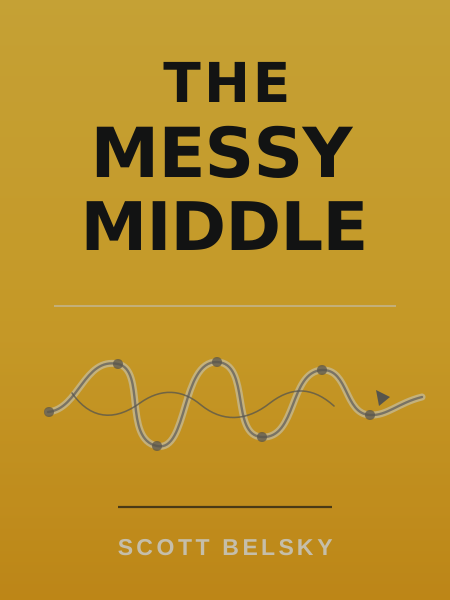
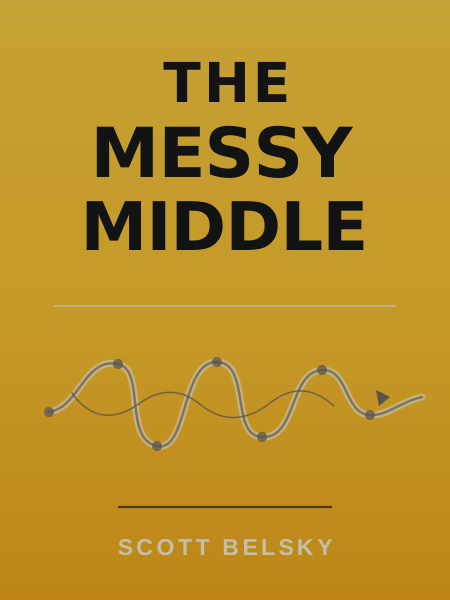
The Messy Middle
Scott Belsky · 2018
Editorial rating
- Evidence
- 6/10
- Actionability
- 8/10
- Originality
- 7/10
The thesis
The volatile middle stretch between starting something and completing it is where ventures are actually won or lost - yet it receives almost no attention compared to glamorous launches and triumphant exits. Success requires both enduring the valleys and optimizing the peaks.
Who this is for
Founders in year 2-5 of their startup journey who are past the excitement of launch but nowhere near exit, product managers leading major initiatives, and anyone navigating a multi-year creative project who needs tactical advice for the unglamorous middle years.
My favorite quote
We love talking about starts and finishes, even though the middle stretch is the most important and often the most ignored and misunderstood.
Why it matters
This cuts through the startup mythology that celebrates founders at launch and acquisition while ignoring the grueling years between.
Do this
Map where you are on your journey right now - are you optimizing (working on what's working) or enduring (surviving what's not)?
Start here
Recognize that the middle is volatile by design - it's a continuous sequence of ups and downs, not a linear path. Your job is to make each low less devastating than the last and each high more productive. Stop waiting for the chaos to end; instead, develop separate strategies for valleys (endurance) versus peaks (optimization).
Critical summary
Belsky draws on his experience founding Behance (acquired by Adobe for $150M), advising Uber, Pinterest, and Periscope, and serving as Adobe's Chief Product Officer to decode the middle phase of ventures.
The framework divides the messy middle into three activities: Endure (surviving the inevitable valleys through resolve and psychological management), Optimize (extracting maximum value from what's working), and Lead (navigating yourself and your team through volatility). The book contains 100+ mini-lessons organized as a handbook rather than narrative.
What it gets right
- Honest acknowledgment that the middle is fundamentally chaotic, not a problem to solve but a reality to navigate
- Practical psychological tactics: "short-circuit your reward system," "don't fetishize failure"
- Product insights like "kill your darlings" and "mystery is more important than hype" show real operator experience
- "Nothing should resonate more loudly than your own intuition" counterbalances data worship
What it misses
- Evidence is primarily anecdotal - Belsky's experience and interviews, no research methodology
- Handbook format means less depth on any single topic; reads like collected blog posts
- Some advice feels generic: "hire people who finish things," "don't let process replace intuition"
- Limited guidance on when to quit versus persist - the most agonizing middle question
- Heavy Silicon Valley bias; limited applicability to bootstrapped or lifestyle businesses
The book's strength is also its weakness: the breadth of 100+ lessons prevents depth. It's more compass than map - useful for orientation, less so for specific navigation.
Key concepts
Endure vs. Optimize
Two distinct modes - survival tactics for valleys versus extraction tactics for peaks. Know which mode you're in before taking action.
Short-Circuit the Reward System
Stop waiting for validation; internal milestones beat external ones. Set personal checkpoints to maintain momentum.
Mystery Over Hype
Features that intrigue users (even if rarely used) drive engagement more than marketed features. Add delightful discoveries.
Kill Your Darlings
Cut features/products you love but that aren't working. Emotional attachment is the enemy of progress.
The Volatility Premium
High volatility = high velocity. Embrace the chaos because it means you're actually moving.
Core insights
-
The finish line keeps moving
Don't organize your psychology around reaching an endpoint - sustained performance requires sustained motivation independent of outcomes.
-
Each low should be less low
Progress in the middle isn't linear growth but incrementally shallower valleys and higher peaks over time.
-
Data should inform, not lead
Overreliance on data creates products optimized for metrics rather than genuine user value.
-
Finishing is a skill
Hire for completion track record, not just capability. Many talented people never ship.
-
Identity isn't defined by work
Maintaining psychological stability through the middle requires separating self-worth from venture outcomes.
Implementation steps
Today
- Draw your current journey as a line graph with peaks and valleys - where are you right now?
- Identify whether you're in endure mode or optimize mode this week
This week
- List three things you're holding onto for emotional reasons that data says you should cut
- Define your next internal milestone that doesn't depend on external validation
This month
- Conduct a "darling audit" - features, processes, or people you're protecting for emotional rather than strategic reasons
- Create a "volatility tracker" to notice if your valleys are getting shallower over time
Ongoing
- Weekly classification: Am I enduring or optimizing this week?
- Quarterly review: Are my lows less severe and my highs more productive than last quarter?
Suggested 30-day practice plan
An editorial application plan created by Monolithic Vault - an interpretation of the book's ideas, not part of the original book.
- Day 1
Draw your journey graph and locate yourself on it
- Day 2
List three current challenges - classify each as endure or optimize
- Day 3
Identify one darling to kill this quarter
- Day 7
Review last month's valleys - were they truly catastrophic or did you survive?
- Day 14
Set three internal milestones that don't depend on customer/investor validation
- Day 21
Audit your reward system - what validation are you waiting for that you could provide yourself?
- Day 30
Compare your current volatility to 90 days ago - is the amplitude decreasing?
Free PDF summary
Take this analysis with you: a designed two-page field-notes sheet with the thesis, my favorite quote, the key concepts and core insights, and the full 30-day checklist. Print it or keep it - free, no signup.
Go deeper
If this analysis earned your attention, the full book goes further than any summary can. The original is always the primary source.