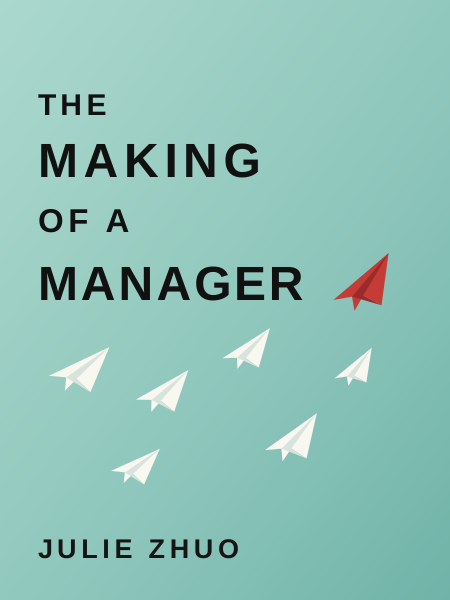
The Making of a Manager
Julie Zhuo · 2019
Editorial rating
- Evidence
- 7/10
- Actionability
- 9/10
- Originality
- 7/10
The thesis
Management is not about authority or having all the answers - it's about building trust with your team and helping them achieve outcomes that wouldn't be possible otherwise. Great managers are made through practice, reflection, and genuine care for their people.
Who this is for
First-time managers feeling overwhelmed by the transition from individual contributor, tech leads promoted into people management, and anyone who was suddenly handed a team without a playbook.
My favorite quote
Your job as a manager is not to dole out advice or 'save the day' - it's to empower your team to find the answers themselves.
Why it matters
New managers instinctively try to prove their value by solving problems. This reframes the role as building capability, not showcasing your own.
Do this
In your next 1:1, resist giving direct advice. Instead ask: "What options have you considered?" and "What do you think is the best path forward?"
Start here
Great management comes down to one thing: building trust. Zhuo identifies three core questions every team member asks about their manager: (1) Do you have my best interests at heart? (2) Can I be honest with you? (3) Do you have good judgment? If you can't answer yes to all three from your team's perspective, start there. Everything else - feedback, delegation, hiring - flows from trust.
Critical summary
Julie Zhuo rose from intern to VP of Design at Facebook in 14 years, and this book captures the lessons she wishes she'd known earlier. The framework centers on three pillars: Purpose (knowing why your team exists), People (hiring, developing, and supporting your team), and Process (establishing how work gets done).
What it gets right
Zhuo writes with unusual honesty about her own failures - botched feedback conversations, hiring mistakes, moments of self-doubt. This authenticity makes the advice feel earned rather than preachy. The book excels at capturing the emotional reality of new management: the identity crisis of no longer being "the doer," the awkwardness of giving feedback to former peers, the impostor syndrome.
Her tactical advice is granular and immediately applicable. She provides actual sentence structures for difficult conversations, specific questions for 1:1s, and concrete frameworks for hiring. The section on building trust is particularly strong, connecting abstract concepts to observable behaviors.
What it misses
The book is written from a Silicon Valley tech company perspective. Zhuo never critically examines Facebook's culture, the ethics of rapid growth, or whether "move fast" always serves teams well. The later chapters feel thinner than the opening - less insight, more general advice.
Some readers note the book could be shorter. After an exceptional first 100 pages, the density of original thinking decreases. And while the advice is excellent for first-time managers, experienced leaders may find familiar territory.
Evidence is primarily Zhuo's own experience supplemented by interviews with other tech leaders. Solid for a practitioner guide, though lacking academic research backing.
Key concepts
The Three P's (Purpose, People, Process)
Core framework for management responsibilities. Use to audit where you're spending time vs. where you're underinvesting.
Trust Battery
Mental model for relationship health with each report. Ask yourself: Is this person's battery charged or depleted with me?
Task-Relevant Maturity
Calibrate your management style (hands-on vs. hands-off) based on the person's experience with this specific task, not their seniority.
Skip-Level Meetings
Regular meetings with your reports' reports to understand team reality. Schedule one this quarter.
The Multiplier Effect
Your success is measured by what your team achieves together, not your individual contributions.
Core insights
-
Management is a skill, not a promotion reward
Being great at your job doesn't automatically make you a great manager. The skills are different. Approach management as a new discipline to learn.
-
Your calendar reveals your priorities
If you say people development matters but spend no time on 1:1s, you're lying to yourself. Block time for what you claim to value.
-
Feedback is a gift, but timing is everything
Don't wait for performance reviews. Give feedback within days of the event while context is fresh.
-
Hiring for potential > hiring for experience
In fast-growing teams, bet on learning trajectory and culture fit over credentials. A-players attract A-players.
-
The transition from "doer" to "enabler" is an identity shift
You'll feel less productive at first. Success now looks like your team's wins, not your personal output.
-
Hard conversations get harder the longer you wait
That feedback you've been avoiding? It won't age well. The kindest thing is honest, direct communication delivered early.
Implementation steps
Today
- Schedule 1:1s with every direct report if you don't have them (30-60 min weekly)
- Write down the "trust battery" level (0-100%) for each team member and why
This week
- Have one genuine feedback conversation using Zhuo's format: specific behavior + impact + what to do differently
- Ask one team member: "What could I do to better support you?"
This month
- Create a team vision document: Why does this team exist? What does success look like?
- Conduct a skip-level meeting to understand your team's reality without filters
Ongoing
- Review 1:1 notes weekly to identify patterns and follow through on commitments
- After every hire, document what worked and what you'd change in the process
Suggested 30-day practice plan
An editorial application plan created by Monolithic Vault - an interpretation of the book's ideas, not part of the original book.
- Day 1
Audit your current 1:1 schedule. Are you meeting with everyone weekly? Fix gaps.
- Day 2
Draft your team's purpose statement (1-2 sentences)
- Day 3
Identify one piece of feedback you've been avoiding. Deliver it this week.
- Day 7
Complete your first full round of 1:1s using Zhuo's question framework
- Day 14
Schedule your first skip-level meeting
- Day 21
Review: What's working in your 1:1s? What patterns are emerging? Adjust your approach.
- Day 30
Write a personal management philosophy document. What do you believe about how to lead?
Free PDF summary
Take this analysis with you: a designed two-page field-notes sheet with the thesis, my favorite quote, the key concepts and core insights, and the full 30-day checklist. Print it or keep it - free, no signup.
Go deeper
If this analysis earned your attention, the full book goes further than any summary can. The original is always the primary source.