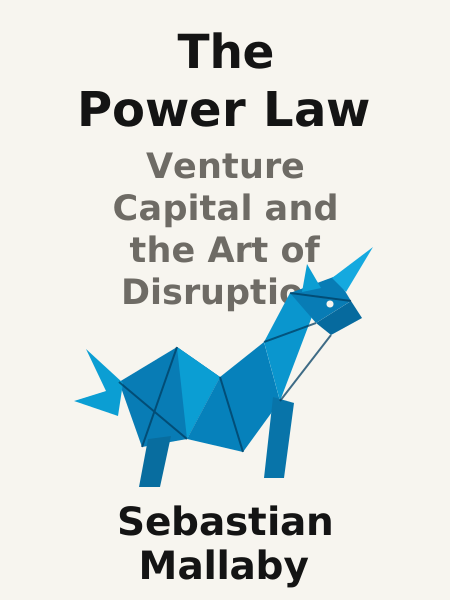
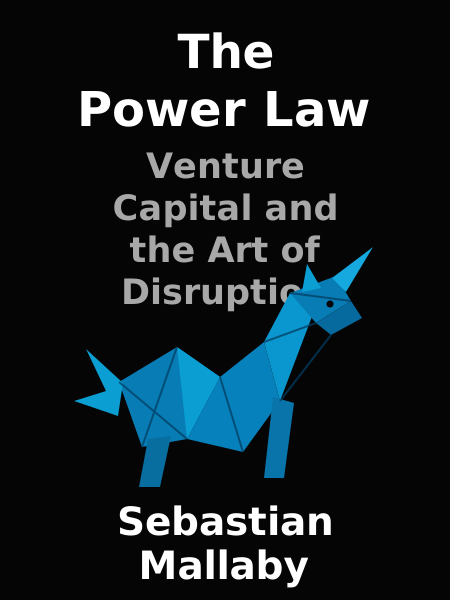
The Power Law
Sebastian Mallaby · 2022
Editorial rating
- Evidence
- 9/10
- Actionability
- 6/10
- Originality
- 8/10
The thesis
Venture capital is governed by extreme outcomes: a tiny number of investments create nearly all returns and much of the industry's influence. Success therefore depends on accessing unusual founders, tolerating frequent failure, and recognizing when early evidence justifies doubling down.
Who this is for
Founders choosing investors, professionals entering venture capital, limited partners evaluating fund strategy, and policymakers trying to understand how private financiers shape technology before public markets see it.
My favorite quote
Tail events are all they care about.
Why it matters
Venture portfolios cannot be managed like ordinary investments because one exceptional winner can outweigh a long list of total losses.
Do this
Review your current portfolio or project list and identify whether any bet has enough upside to materially change the whole result.
Start here
Understand the portfolio arithmetic before copying venture behavior. When one winner can return an entire fund, avoiding every failure becomes less important than securing access to exceptional opportunities and retaining enough ownership in the few that work. The logic rewards broad experimentation early and concentrated support after credible signs of breakout potential.
Critical summary
Sebastian Mallaby spent years interviewing venture capitalists, founders, and industry observers, then reconstructed the field from Georges Doriot and Arthur Rock through Kleiner Perkins, Sequoia, Accel, Benchmark, Founders Fund, SoftBank, and China's venture ecosystem. The central idea is statistical and institutional. Startup outcomes follow a power-law pattern in which a few extraordinary companies produce most returns, so venture investors cannot rely on conventional valuation or a high batting average. They compete through access, judgment, networks, staged financing, ownership, and the ability to help a promising company recruit, sell, govern, and raise again. Mallaby also argues that venture networks combine useful traits of corporations and markets: they assemble capital and talent around a company, then repeatedly expose it to price signals through new funding rounds. Different firms operationalize this differently, from Sequoia's disciplined partnership to Benchmark's concentrated funds, Founders Fund's founder autonomy, and SoftBank's overwhelming scale.
What it gets right
- Reconstructs famous investment decisions with enough detail to show how access, conviction, governance, and timing interact
- Explains why failure tolerance and follow-on concentration are rational responses to extreme portfolio distributions
- Treats venture firms as institutions with distinct operating models rather than a uniform pool of rich stock pickers
What it overstates or misses
- Gives winners and elite firms far more narrative space than failed funds, excluded founders, and ordinary venture outcomes
- Defends venture capital's social value more confidently than its record on governance, labor, privacy, diversity, and market power warrants
- Remains centered on Silicon Valley even when discussing the global diffusion of the model
The reporting base is unusually strong for an industry history, drawing on interviews, archives, transaction records, and candid accounts of both triumphs and failures. Yet access has a cost: insiders supply much of the evidence used to explain their own skill and importance, while causal counterfactuals remain impossible. The stories establish that top investors sometimes add real value, but not how much innovation would have occurred through other financing systems. The verdict: an excellent history of how venture capital thinks, paired with a defense of the industry that deserves more skepticism than Mallaby gives it.
Key concepts
Power Law
A distribution where a small number of outcomes dominate the total; design portfolios so one exceptional success can matter enormously.
Tail Event
A rare company whose return outweighs many failures, making access and ownership more important than a smooth average.
Venture Network
Relationships connecting founders, talent, customers, capital, and later investors; map who can unlock each scarce resource.
Staged Financing
Capital released through successive rounds that test progress, preserve options, and concentrate resources behind emerging winners.
Investment Model
A firm's chosen mix of ownership, fund size, involvement, specialization, and founder control, which determines which opportunities fit.
Core insights
-
Average thinking fails in skewed systems
When outcomes are extreme, optimizing the median can eliminate the few bets capable of transforming the portfolio.
-
Access precedes analysis
Investors cannot select exceptional companies unless trusted networks bring them into the room before consensus forms.
-
Failure tolerance needs concentration
Accepting many losses works only if the portfolio keeps meaningful exposure to winners instead of selling or diluting too early.
-
Capital changes company behavior
Fund size, governance, and follow-on pressure influence hiring, growth, risk, and whether founders pursue durable value or inflated milestones.
-
Networks are productive infrastructure
Introductions, reputation, recruiting, customer access, and later financing can turn isolated talent into a functioning innovation cluster.
Implementation steps
Today
- List your current investments or strategic projects and estimate the maximum plausible upside of each relative to the total portfolio.
- Mark which promising bet lacks access to a customer, expert, hire, partner, or source of follow-on capital.
This week
- Write explicit kill, continue, and double-down criteria for one uncertain initiative before new evidence arrives.
- Map ten relationships that could improve deal flow, recruiting, distribution, technical judgment, or financing quality.
This month
- Rebalance one portfolio so small experiments remain cheap while resources can concentrate rapidly behind strong evidence.
- Review governance rights and incentives to ensure capital supports honest learning rather than growth metrics designed for the next funding round.
Ongoing
- Track decisions by original thesis, evidence, ownership, follow-on choices, and realized outcomes instead of celebrating only visible winners.
- Study missed opportunities and failed investments with the same detail as successes to separate process quality from favorable outcomes.
Suggested 30-day practice plan
An editorial application plan created by Monolithic Vault - an interpretation of the book's ideas, not part of the original book.
- Day 1
Calculate how concentrated your expected returns are and identify the assumptions behind the largest potential outcome.
- Day 3
Define the evidence that would justify stopping, continuing, or doubling down on that bet.
- Day 7
Map the network required for talent, customers, expertise, governance, and future capital.
- Day 14
Review one past success and one failure using only information available when each decision was made.
- Day 21
Adjust resource allocation so weak bets stay cheap and promising bets can receive meaningful concentration.
- Day 30
Document a repeatable decision process for sourcing, evaluating, supporting, and exiting asymmetric opportunities.
Free PDF summary
Take this analysis with you: a designed two-page field-notes sheet with the thesis, my favorite quote, the key concepts and core insights, and the full 30-day checklist. Print it or keep it - free, no signup.
Go deeper
If this analysis earned your attention, the full book goes further than any summary can. The original is always the primary source.