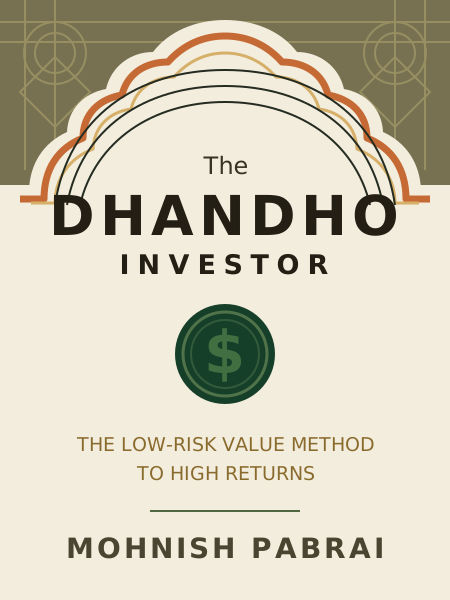
The Dhando Investor
Mohnish Pabrai · 2007
Editorial rating
- Evidence
- 7/10
- Actionability
- 8/10
- Originality
- 7/10
The thesis
"Dhandho" means endeavors that create wealth - specifically, low-risk bets with high upside potential. The Patel motel owners who arrived in America with nothing and now control $40 billion in assets didn't get there by taking wild risks. They found situations where the downside was minimal and the upside was enormous. Apply this framework to stocks: heads, I win; tails, I don't lose much.
Who this is for
Value investors seeking a concentrated, high-conviction approach, entrepreneurs who want to apply business thinking to stock picking, and anyone frustrated with diversification dogma who wants to bet big on their best ideas.
My favorite quote
Heads, I win; tails, I don't lose much!
Why it matters
This nine-word formula captures the essence of Dhandho. It's not about avoiding risk - it's about finding asymmetric bets where the math overwhelmingly favors you.
Do this
Before your next investment, quantify the worst case. If you can't survive it, pass. If you can, and the upside is 3x+, consider a meaningful position.
Start here
Find low-risk, high-uncertainty situations. Wall Street confuses uncertainty with risk. When a good business faces temporary problems, uncertainty spikes and the stock price crashes - but the underlying risk to the business may be low. That's your opportunity. Buy when fear creates bargains; wait for reality to reassert itself.
Critical summary
Mohnish Pabrai, a hedge fund manager with an exceptional track record, draws on the capital allocation strategies of Indian-American Patel motel owners to create an investment framework. The Patels arrived as refugees, bought distressed motels with minimal capital, ran them with family labor, and scaled up. Pabrai translates their low-risk, high-reward approach into stock selection principles.
The nine Dhandho principles include: invest in existing businesses, invest in simple businesses, invest in distressed businesses in distressed industries, invest with a large margin of safety, invest in low-risk high-uncertainty businesses, invest in copycat businesses, and make few bets, big bets, infrequent bets.
What it gets right
- Fresh cultural lens on value investing principles
- Memorable framework and examples
- The risk vs. uncertainty distinction is genuinely useful
- Kelly Formula application to position sizing is practical
What it misses
- Core ideas are extensions of Graham/Buffett - less original than presented
- Concentrated approach is psychologically difficult for most investors
- The Patel analogy, while charming, can feel stretched
- Limited discussion of when Dhandho fails (survivorship bias in examples)
Evidence is anecdotal - case studies from Pabrai's own investing and examples like the Patels. But the underlying logic is sound and grounded in value investing research.
Key concepts
Dhandho
Gujarati word meaning "endeavors that create wealth." Low-risk ventures with high-return potential.
Heads I Win, Tails I Don't Lose Much
The asymmetric bet. Only invest when downside is limited and upside is significant.
Low-Risk, High-Uncertainty
Wall Street conflates uncertainty with risk. Exploit this confusion by buying when uncertainty is high but actual business risk is low.
Few Bets, Big Bets, Infrequent Bets
Concentrate in your best ideas. Diversification is protection against ignorance.
Abhimanyu's Dilemma
Know your exit before you enter. Have a thesis for why the stock is undervalued and what will unlock value.
Kelly Formula
Bet size should reflect edge magnitude. Bigger edge = bigger position.
Core insights
-
Copy rather than innovate
The Patels didn't invent motels - they copied a proven model and executed better. Look for copycats, not pioneers.
-
Existing businesses over startups
You can analyze an existing business; a startup is a guess. Buy when there's track record to study.
-
Distress creates opportunity
The best bargains come from distressed businesses in distressed industries. Everyone else is selling.
-
The market votes short-term, weighs long-term
Graham's wisdom. Use temporary pessimism to buy at bargain prices.
-
Invest within your circle of competence
Simple businesses you understand. If you can't explain it, don't own it.
Implementation steps
Today
- List 5 simple businesses you genuinely understand
- For each, calculate: what's the worst that could happen? Could I survive it?
This week
- Screen for stocks down 50%+ in the past year with stable long-term fundamentals
- Identify which are experiencing uncertainty vs. genuine risk
This month
- Build a watchlist of 10-15 high-quality businesses to buy when distressed
- Calculate your Kelly bet size for your highest-conviction idea
Ongoing
- Maintain a "waiting for a fat pitch" mindset - don't swing at everything
- Review thesis quarterly: has uncertainty resolved? Is the bet still asymmetric?
Suggested 30-day practice plan
An editorial application plan created by Monolithic Vault - an interpretation of the book's ideas, not part of the original book.
- Day 1
Define your circle of competence (3-5 industries you know cold)
- Day 2
List 10 high-quality businesses in those industries
- Day 3
For each, determine: what price would create a "heads I win" scenario?
- Day 7
Study one company deeply - read 10-Ks, transcripts, understand unit economics
- Day 14
Rank your watchlist by conviction; calculate Kelly position sizes
- Day 21
Practice patience - if nothing is compelling, do nothing
- Day 30
If a fat pitch arrives, take a meaningful position (5-10% of portfolio)
Free PDF summary
Take this analysis with you: a designed two-page field-notes sheet with the thesis, my favorite quote, the key concepts and core insights, and the full 30-day checklist. Print it or keep it - free, no signup.
Go deeper
If this analysis earned your attention, the full book goes further than any summary can. The original is always the primary source.