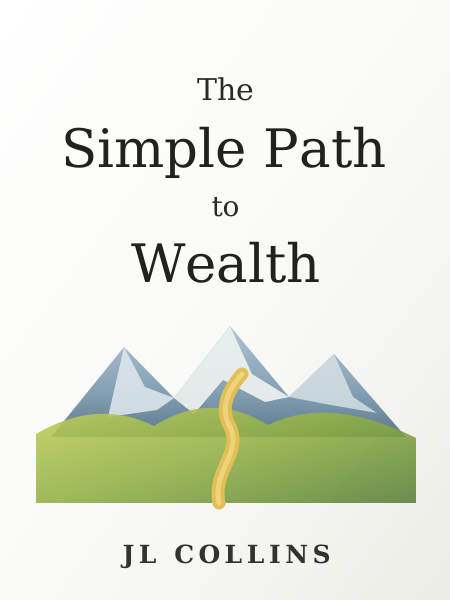
The Simple Path to Wealth
JL Collins · 2016
Editorial rating
- Evidence
- 8/10
- Actionability
- 10/10
- Originality
- 5/10
The thesis
Building wealth is simple, but not easy. Spend less than you earn, invest the surplus in low-cost index funds, avoid debt. That's it. The financial industry profits from making investing seem complicated; the truth is that passive index investing beats most active managers over time. Financial independence - having enough invested to live off 4% annually - is achievable for ordinary people who follow these principles consistently.
Who this is for
Young professionals who know they should invest but feel paralyzed by complexity, anyone paying advisory fees for underperformance, people seeking financial independence without gambling on stock picks, and those who want a simple, evidence-based investment strategy they can execute without ongoing attention.
My favorite quote
There are many things money can buy, but the most valuable of all is freedom. Freedom to do what you want and work for whom you respect.
Why it matters
This reframes wealth from status symbol to liberation tool. The goal isn't a bigger house - it's "F-You Money" that gives you options.
Do this
Calculate your "F-You Number" - 25 times your annual expenses. That's what you need invested to be financially independent.
Start here
Invest in VTSAX (or equivalent) and ignore everything else. Vanguard's Total Stock Market Index Fund gives you ownership of essentially every publicly traded US company at minimal cost (0.04% expense ratio). No stock picking, no market timing, no advisor fees. Buy regularly, hold forever. This single decision, consistently executed, outperforms most professional money managers over the long term.
Critical summary
Collins, a blogger turned author, wrote this book as a series of letters to his daughter who "just wasn't that interested" in investing. That origin shows - the book is conversational, accessible, and refreshingly free of jargon. It's become a foundational text in the FIRE (Financial Independence, Retire Early) movement.
The strategy is Bogle-style index investing stripped to essentials: total stock market index funds during accumulation, adding bonds as you approach withdrawal. Collins makes the case with clarity and conviction that passive investing is not just adequate but superior.
What it gets right
- The math is unassailable: after fees, most active funds underperform index funds. Collins cites decades of data.
- Behavioral coaching is excellent: the sections on staying the course during market crashes are worth the book price alone
- Actionable immediately: you can implement the strategy today with one fund
- Addresses psychological barriers to investing, not just mechanics
- "F-You Money" framing makes the goal visceral rather than abstract
What it misses or overstates
- US-centric: heavily weighted toward Vanguard US products. International readers need to adapt.
- Dismisses international diversification ("US companies are already global"), which is debatable and US-biased
- The 4% rule has faced criticism post-2008 - may be too aggressive in some scenarios
- Living on 50% of income is aspirational for many, especially in high cost-of-living areas
- Doesn't address insurance adequately - disability or death can wipe out a portfolio
- The simplicity, while a strength, means limited guidance for complex situations (inheritance, real estate, business ownership)
This is the best single-source introduction to passive investing for financial independence. Read it first, then seek specialized advice for edge cases.
Key concepts
F-You Money
Enough savings to give you leverage - to say no to bad jobs, bad bosses, bad situations. Not wealth for status; wealth for freedom.
VTSAX
Vanguard Total Stock Market Index Fund. Owns essentially every US public company. Low cost, maximum diversification, minimal effort.
The 4% Rule
You can withdraw 4% of your portfolio annually with high confidence it will last 30+ years. $1M invested = $40K/year.
Stock/Bond Allocation
100% stocks during accumulation for growth; add bonds (VBTLX) as you approach withdrawal for stability.
Expense Ratio
The annual fee a fund charges. Index funds: ~0.04%. Actively managed funds: 1%+. That difference compounds devastatingly.
Stay the Course
Markets crash. Don't sell. Historically, markets always recover. Panic selling is the wealth destroyer.
Core insights
-
Complexity is the enemy
The financial industry profits from making things complicated. The best strategy is simple enough to fit on an index card.
-
Fees compound against you
A 1% annual fee doesn't sound like much, but over 30 years it can consume 28% of your returns. Minimize fees ruthlessly.
-
Market timing is a fool's game
No one consistently predicts tops and bottoms. Time in the market beats timing the market.
-
Debt is the opposite of freedom
Every dollar of debt is a dollar you've obligated your future self to pay. Eliminate debt before investing heavily.
-
The market always goes up - eventually
Over long periods (10+ years), the stock market has always recovered and grown. Crashes are temporary; growth is permanent.
Implementation steps
Today
- Open a Vanguard account (or equivalent: Fidelity, Schwab)
- Calculate your current savings rate (savings ÷ income)
- Calculate your F-You Number (annual expenses × 25)
This week
- Set up automatic monthly investment into VTSAX (or VTI, the ETF equivalent)
- List all debts with interest rates; prioritize payoff of highest-rate debt
This month
- Review all subscriptions and recurring expenses - cut ruthlessly
- Increase savings rate by 5% if possible (even 1% matters)
Ongoing
- Ignore market news. Don't check your portfolio more than quarterly.
- When markets crash, buy more (or at minimum, don't sell)
- Rebalance annually to target stock/bond allocation
Suggested 30-day practice plan
An editorial application plan created by Monolithic Vault - an interpretation of the book's ideas, not part of the original book.
- Day 1
Read Part 1 (Debt and Spending); calculate current savings rate
- Day 2
Open brokerage account if you don't have one
- Day 3
Set up automatic investment - even $50/month starts the habit
- Day 7
Review first week; list obstacles to increasing savings rate
- Day 14
Cut one unnecessary expense; redirect savings to investment
- Day 21
Calculate your progress toward F-You Money; project when you'll reach it
- Day 30
Review investment account; practice doing nothing (the skill you'll need most)
Free PDF summary
Take this analysis with you: a designed two-page field-notes sheet with the thesis, my favorite quote, the key concepts and core insights, and the full 30-day checklist. Print it or keep it - free, no signup.
Go deeper
If this analysis earned your attention, the full book goes further than any summary can. The original is always the primary source.