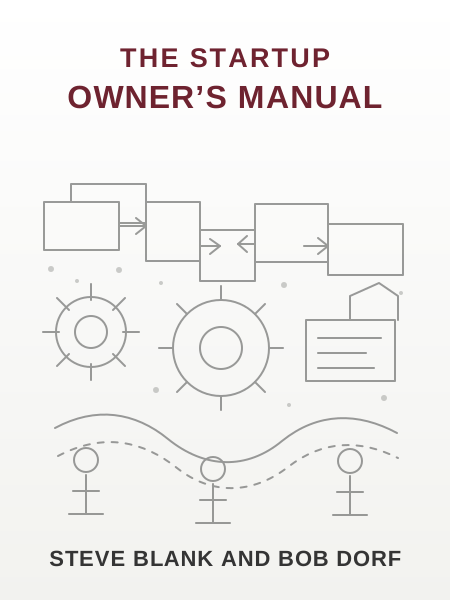
The Startup Owner's Manual
Steve Blank & Bob Dorf · 2012
Editorial rating
- Evidence
- 8/10
- Actionability
- 9/10
- Originality
- 9/10
The thesis
Startups aren't smaller versions of large companies - they're temporary organizations searching for a repeatable, scalable business model. The fatal mistake is executing a plan before validating it. Customer Development provides a systematic process for turning hypotheses into facts through direct customer contact before you run out of money.
Who this is for
First-time founders building technology startups, product managers launching new ventures within established companies, and anyone responsible for validating business models. Especially valuable for those who've read Lean Startup and want the detailed how-to manual.
My favorite quote
No business plan survives first contact with customers.
Why it matters
This reframes the startup journey from executing a vision to discovering what customers actually want - and will pay for.
Do this
Write down your three biggest assumptions about your customers. Plan how to test one this week.
Start here
Use Customer Development to test your business model before scaling. Four steps: Customer Discovery (find problem-solution fit), Customer Validation (find product-market fit), Customer Creation (scale demand), Company Building (transition to execution). Most startups fail because they skip to step three or four before completing steps one and two.
Critical summary
Steve Blank, serial entrepreneur and Stanford/Berkeley professor, wrote the book that catalyzed the Lean Startup movement. This 608-page manual, co-authored with Bob Dorf, is the comprehensive implementation guide for Customer Development methodology.
The framework uses the Business Model Canvas as an organizing principle, with tailored guidance for both web/mobile and physical products. Over 100 charts, graphs, and diagrams, plus 77 checklists make this a genuine operating manual.
What it gets right
- Treats startup creation as a rigorous process, not inspired guessing
- Customer Development methodology is now taught at Stanford, Berkeley, Columbia, and 100+ universities
- National Science Foundation pays startup teams to follow this process
- Distinguishes between different channel types (web/mobile vs. physical) with specific guidance for each
- Painstakingly detailed step-by-step roadmap
What it misses
- Dense and procedural - more reference manual than casual read
- Dry tone; Steve writes more like a blogger than a book author
- Organization confusing - follows two tracks simultaneously (Web/Mobile and Physical Channels)
- Frequently uses financial terms without explaining them
- May feel overwhelming; rigid validation process could limit creative exploration
- Not all startups fit the model - Airbnb and Uber emerged with approaches this book wouldn't have predicted
Evidence is strong: methodology refined over decades, validated by thousands of startups, institutionalized in academic and government programs.
Key concepts
Customer Development
Four-step process to validate business model before scaling. Map your current stage; execute that stage's activities.
Business Model Canvas
Nine building blocks capturing your business hypotheses. Fill it out; treat each cell as an assumption to test.
Get Out of the Building
Hypotheses are validated by talking to customers, not by internal meetings. Schedule five customer conversations this week.
Pivot
Changing one or more business model components based on validated learning. Define what evidence would trigger a pivot.
Minimum Viable Product (MVP)
Smallest feature set to test your value hypothesis. Build less than you think you need.
Core insights
-
Search vs. Execute modes require different behaviors
Startups search for business models; established companies execute them. Applying execution behaviors to search mode is fatal.
-
There are no facts inside your building
Everything you believe about customers, pricing, and channels is hypothesis until validated externally.
-
Earlyvangelists are your first customers
Find customers who have the problem, know they have it, have budget to solve it, and have already tried solutions. They'll forgive your MVP's flaws.
-
Failure to pivot is the leading cause of startup death
Most successful startups pivoted at least once. Build pivot triggers into your process.
-
Web/mobile and physical channels require different approaches
The book provides separate tracks because customer discovery in e-commerce differs fundamentally from enterprise sales.
Implementation steps
Today
- Complete a Business Model Canvas for your venture (or idea)
- List your three riskiest assumptions - the ones that would kill you if wrong
This week
- Schedule five customer discovery conversations
- Prepare a hypothesis testing plan: What question does each conversation answer?
This month
- Build an MVP to test your value proposition
- Document learnings; update your Business Model Canvas based on evidence
Ongoing
- Maintain a weekly cadence of customer conversations
- Hold regular pivot-or-persevere reviews based on accumulated evidence
- Graduate to next Customer Development phase only when current phase criteria are met
Suggested 30-day practice plan
An editorial application plan created by Monolithic Vault - an interpretation of the book's ideas, not part of the original book.
- Day 1
Complete Business Model Canvas; identify three riskiest assumptions
- Day 2
Define your target customer segment and earlyvangelist profile
- Day 3
Draft customer interview questions focusing on problems, not solutions
- Day 7
Complete five customer discovery interviews; document findings
- Day 14
Build and deploy MVP to test highest-risk assumption
- Day 21
Analyze MVP results; decide pivot or persevere on key assumptions
- Day 30
Update Business Model Canvas; present validated learnings to stakeholders
Free PDF summary
Take this analysis with you: a designed two-page field-notes sheet with the thesis, my favorite quote, the key concepts and core insights, and the full 30-day checklist. Print it or keep it - free, no signup.
Go deeper
If this analysis earned your attention, the full book goes further than any summary can. The original is always the primary source.