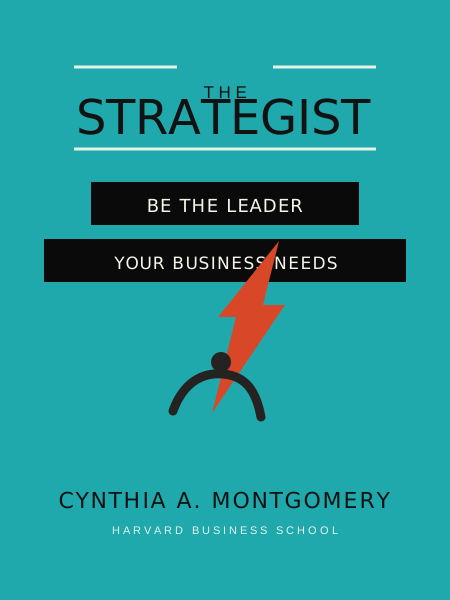
The Strategist
Cynthia Montgomery · 2012
Editorial rating
- Evidence
- 6/10
- Actionability
- 7/10
- Originality
- 6/10
The thesis
Strategy has been outsourced to specialists and consultants, but it belongs at the center of leadership. The strategist's job is not to craft a plan once and execute it forever - it's to continuously answer the question: "Why does this company matter?" Strategy is leadership; leadership is strategy.
Who this is for
CEOs and business owners who feel disconnected from their company's strategy, leaders who've delegated strategy to consultants, and anyone who senses that their "strategic plan" isn't actually guiding decisions.
My favorite quote
Strategy is not a destination or a solution. It's not a problem to be solved and settled. It's a journey.
Why it matters
Most leaders treat strategy as a document to be written once. Real strategy is ongoing, requiring continuous attention and adjustment.
Do this
Stop asking "What's our strategy?" and start asking "Why do we matter - today?"
Start here
Ask the fundamental question: Does your company matter? Not "are you profitable" or "are you growing" - but does your existence create value that wouldn't exist otherwise? A company matters when it drives a wider wedge between what customers are willing to pay and what suppliers are willing to accept. If you disappeared tomorrow, would anyone besides employees and shareholders care?
Critical summary
Cynthia Montgomery, Harvard Business School professor who taught strategy to executives for twenty years, wrote this book after realizing something had gone wrong. Strategy had become the domain of specialists - consultants with frameworks and MBAs with analytics - while leaders focused on "execution." She calls for reuniting strategy and leadership.
The book draws on her Executive Education program at HBS, where she forces seasoned executives to confront uncomfortable questions about their companies. Her central argument: the strategist's role is not to analyze and plan, but to continuously shape what the company is and why it matters.
What it gets right
- Powerful reframe: strategy is leadership's job, not a specialist function
- "Why do you matter?" is a genuinely useful question that most leaders avoid
- Strong on the ongoing, dynamic nature of strategy vs. static plans
- Draws on resource-based view of strategy (competing on unique capabilities)
What it misses
- Light on practical frameworks compared to Rumelt or Lafley/Martin
- More inspirational than instructional - you'll feel motivated but want more tools
- Case studies (IKEA, Gucci, Masco) are well-known and well-worn
- The "myth of the super-manager" section is underdeveloped
Evidence is primarily case-based and draws on the resource-based view of strategy from academic research. The book is more philosophical than empirical - a call to leadership rather than a methodology.
Key concepts
The Strategist
The leader who takes personal responsibility for why the company exists and continuously shapes its direction. Be one.
Purpose
Not mission statements - the concrete reason your company creates value. Define yours in terms customers would recognize.
Value Creation
The wedge between customers' willingness to pay and suppliers' willingness to supply. Expand this wedge.
The Myth of the Super-Manager
The belief that great managers can succeed in any industry. Industry structure matters; pick your battles.
Competitive Advantage as System
Not a single feature, but an integrated set of choices that reinforce each other. Think IKEA.
Strategy as Journey
Not a plan to be executed, but an ongoing process of shaping the company. Never "done."
Core insights
-
Strategy got separated from leadership - reunite them
When you outsource strategy to consultants, you outsource leadership. Take it back.
-
"Why do we matter?" is the essential question
Most companies can't answer this clearly. If you can't, you don't have a strategy.
-
Competitive advantage is temporary
The forces that made you successful yesterday are eroding today. Strategists must continuously adapt.
-
Industry structure constrains you
No amount of brilliant management can overcome a structurally unattractive industry. Choose wisely.
-
Strategy is about choosing what you won't do
Every addition to your strategy is also a distraction. Saying no is strategic.
Implementation steps
Today
- Answer honestly: Why does your company matter? What value do you create that wouldn't exist without you?
- Identify when you last personally engaged with strategic questions (not just approved a plan)
This week
- Review your "strategic plan" - does it actually guide decisions, or does it sit in a drawer?
- Ask your leadership team the "why do we matter?" question. Listen to the confusion.
This month
- Map your value creation system: What's the wedge between customer willingness to pay and supplier willingness to accept? How do you expand it?
- Identify one strategic question you've been avoiding. Confront it.
Ongoing
- Make strategy a regular leadership activity, not an annual planning exercise
- Continuously ask: "Does this still matter? Are we still creating unique value?"
Suggested 30-day practice plan
An editorial application plan created by Monolithic Vault - an interpretation of the book's ideas, not part of the original book.
- Day 1
Read Chapters 1-3 on the strategist's role
- Day 2
Write your answer to "Why does our company matter?" in one paragraph
- Day 3
Share that paragraph with trusted colleagues. Collect their reactions.
- Day 7
Analyze your industry structure - what forces constrain your success?
- Day 14
Map your value creation system - how do all the pieces fit together?
- Day 21
Identify the strategic question you've been avoiding. Schedule time to address it.
- Day 30
Establish a rhythm for strategic reflection - weekly, monthly, quarterly
Free PDF summary
Take this analysis with you: a designed two-page field-notes sheet with the thesis, my favorite quote, the key concepts and core insights, and the full 30-day checklist. Print it or keep it - free, no signup.
Go deeper
If this analysis earned your attention, the full book goes further than any summary can. The original is always the primary source.