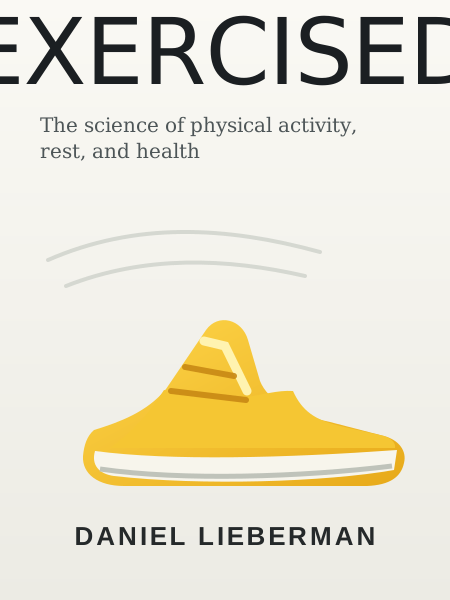
Exercised
Daniel Lieberman · 2020
Editorial rating
- Evidence
- 9/10
- Actionability
- 7/10
- Originality
- 8/10
The thesis
Humans evolved to conserve energy and move when movement was necessary or rewarding, not to perform voluntary workouts for distant health benefits. Lasting exercise habits therefore depend less on guilt and more on making activity social, enjoyable, and difficult to avoid.
Who this is for
People who understand that exercise matters but repeatedly fail to sustain it, fitness professionals who rely too heavily on discipline, and older adults deciding what kind of movement is worth prioritizing.
My favorite quote
Make exercise necessary and fun. Do mostly cardio, but also some weights. Some is better than none. Keep it up as you age.
Why it matters
Lieberman reduces hundreds of pages of evolutionary biology to a realistic prescription that favors consistency over athletic identity.
Do this
Add one ten-minute walk to an existing obligation today, such as lunch, commuting, or a phone call.
Start here
Stop treating reluctance to exercise as a character flaw. Your body is doing what natural selection trained it to do: avoid unnecessary energy expenditure, so build movement into situations where it becomes useful, social, or immediately rewarding.
Critical summary
Daniel Lieberman, a Harvard professor of human evolutionary biology, approaches exercise through anatomy, anthropology, and field research rather than modern fitness culture. His central distinction is between physical activity, which humans evolved to perform for work, travel, play, and survival, and exercise, which is voluntary activity undertaken mainly for health. Natural selection prepared humans for substantial movement, but it also rewarded energy conservation whenever effort produced no immediate benefit. That tension explains why sedentary modern environments are so attractive even though prolonged inactivity raises disease risk. Lieberman tests common claims about sitting, sleeping, speed, strength, endurance, aging, and extreme training, repeatedly replacing simple slogans with dose, context, and tradeoffs. His practical conclusion is modest: regular aerobic activity matters, strength work becomes increasingly valuable with age, and almost any movement is better than none.
What it gets right
- Replaces moral judgment about laziness with a plausible evolutionary explanation for why exercise often feels optional and unpleasant
- Separates ordinary health-promoting movement from elite performance, making the recommendations useful to normal people
- Uses cross-cultural evidence to challenge myths such as the idea that nonindustrial people never rest or sit for long periods
What it overstates or misses
- Evolutionary explanations can sound cleaner than the messy behavioral, economic, environmental, and medical causes of inactivity
- The long myth-by-myth tour occasionally buries the few recommendations most readers actually need
- Readers with disability, chronic pain, unsafe neighborhoods, or punishing work schedules receive less practical attention than motivated but sedentary professionals
The evidence base is unusually broad for a popular health book, combining Lieberman's own research with physiology, epidemiology, and observations of hunter-gatherer and subsistence communities. Observational comparisons cannot prove that ancestral patterns are automatically optimal today, but Lieberman is generally careful about uncertainty and avoids promising that exercise prevents every illness. The verdict: excellent science and humane motivation, with more detail than most readers need.
Key concepts
Exercise Paradox
Humans are built for physical activity but inclined to avoid needless effort. Design movement around immediate rewards instead of relying on abstract health warnings.
Physical Activity Versus Exercise
Work, transport, play, and caregiving all count as movement even when they do not resemble a workout. Expand your options beyond the gym.
Energy Conservation
Rest was adaptive when calories were scarce and work was unavoidable. Expect resistance to optional exertion and remove daily choices that favor inactivity.
Repair and Maintenance
Activity triggers cellular processes that help maintain tissues, especially as the body ages. Keep both aerobic and resistance work in your routine.
Dose and Context
Sitting, running, lifting, and sleeping are not simply good or bad. Judge each behavior by duration, intensity, recovery, age, and individual capacity.
Core insights
-
Reluctance Is Normal
You are not uniquely weak for preferring the sofa. Remove shame, then change the environment that keeps making rest the easiest option.
-
Movement Needs a Present Reward
Future disease prevention is a poor daily motivator. Pair activity with friends, play, transport, music, or a task that already matters.
-
Some Beats None
Health benefits begin below the level promoted by fitness culture. A short walk completed consistently is more useful than an ambitious program abandoned quickly.
-
Cardio and Strength Solve Different Problems
Aerobic work supports endurance and metabolic health, while resistance training protects muscle and function. Do not let preference erase either category.
-
Aging Raises the Stakes
Physical decline is not caused by age alone; inactivity accelerates it. Continue challenging the heart, muscles, and balance with sensible progression.
Implementation steps
Today
- Choose one ten-minute activity you can complete without changing clothes, traveling, or buying equipment.
- Identify one daily situation where walking, stairs, cycling, or standing can replace a passive default.
This week
- Complete three moderate aerobic sessions and one short full-body resistance session at a manageable intensity.
- Make one session social by walking with someone, joining a class, or calling a friend while moving.
This month
- Build a repeatable weekly pattern containing aerobic activity, resistance work, and at least one genuinely enjoyable form of movement.
- Track completed sessions and minutes moved, but ignore calories burned and performance comparisons for thirty days.
Ongoing
- Increase volume gradually while protecting sleep, recovery, and joints rather than treating exhaustion as proof of effectiveness.
- Review your routine every season and replace activities that have become inconvenient, painful, or boring.
Suggested 30-day practice plan
An editorial application plan created by Monolithic Vault - an interpretation of the book's ideas, not part of the original book.
- Day 1
Take a ten-minute walk and write down what made starting easy or difficult.
- Day 3
Complete a basic resistance circuit using squats to a chair, wall push-ups, rows, and carries.
- Day 7
Review your week and schedule three movement appointments for the next seven days.
- Day 14
Add a social or playful element to one session and compare your motivation afterward.
- Day 21
Increase one session slightly in duration or difficulty without changing the entire routine.
- Day 30
Set a sustainable weekly minimum for aerobic activity and strength work that you can maintain during a busy month.
Free PDF summary
Take this analysis with you: a designed two-page field-notes sheet with the thesis, my favorite quote, the key concepts and core insights, and the full 30-day checklist. Print it or keep it - free, no signup.
Go deeper
If this analysis earned your attention, the full book goes further than any summary can. The original is always the primary source.