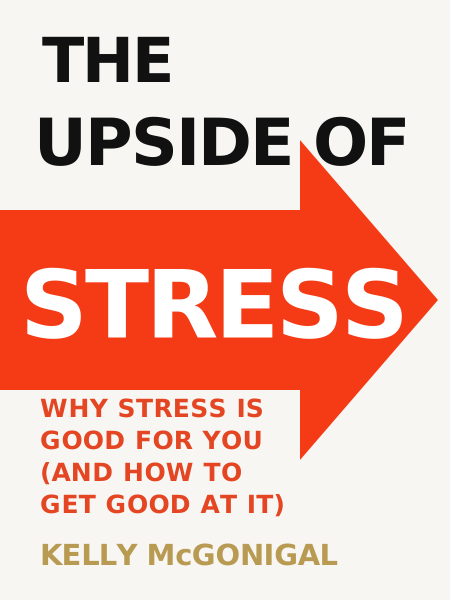
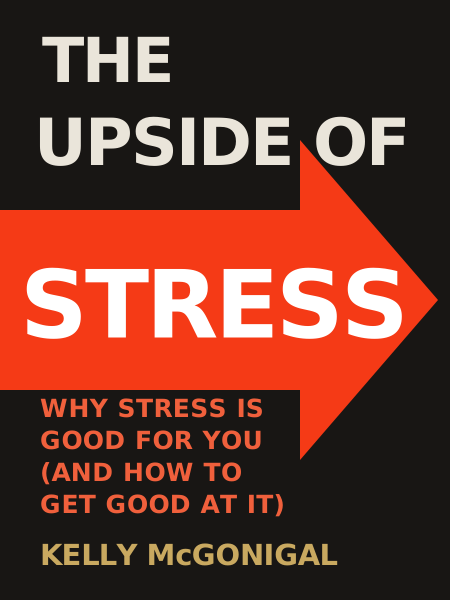
The Upside of Stress
Kelly McGonigal · 2015
Editorial rating
- Evidence
- 9/10
- Actionability
- 8/10
- Originality
- 8/10
The thesis
Stress isn't inherently harmful - your belief about stress determines whether it helps or harms you. When you view stress as enhancing (not debilitating), your body responds differently: you perform better, recover faster, and grow stronger. The goal isn't to eliminate stress but to get better at it.
Who this is for
High-performers drowning in stress who've been told to "just relax," people who feel guilty about being stressed, and anyone who wants to transform anxiety into courage and adversity into growth.
My favorite quote
Stress is what arises when something you care about is at stake.
Why it matters
This reframe changes everything. Stress isn't random suffering - it's a signal that you're engaged with something meaningful. No stress = no stakes = no meaning.
Do this
Next time you feel stressed, say out loud: "This is my body helping me rise to the challenge." Notice how the feeling shifts from threat to resource.
Start here
Your stress mindset matters more than the stress itself: A 1998 study tracked 30,000 Americans for 8 years. High stress increased risk of death by 43% - but only for those who believed stress was harmful. People with high stress who believed stress was enhancing had the lowest death risk in the study, even lower than those with minimal stress. Your belief literally changes the biology. When you view stress as helpful (not harmful), your cardiovascular system responds like it does during moments of joy and courage, not fear and threat. Same stressor, different outcome - all based on mindset.
Critical summary
Kelly McGonigal is a Stanford health psychologist who spent a decade teaching people to avoid and reduce stress. Then she encountered research that made her question everything: maybe stress isn't the enemy. Maybe our relationship with stress is the problem.
The book is built on two core findings: (1) Stress mindset determines outcomes - people who believe stress is enhancing perform better, stay healthier, and live longer than those who believe stress is harmful, even when experiencing identical stressors. (2) Stress responses are adaptive - your racing heart, sweating, anxiety aren't signs of weakness. They're your body mobilizing resources to meet a challenge. Reframe them as helpful, and they become helpful.
McGonigal introduces the Challenge Response vs. Threat Response: Both involve stress, but they're biologically different. Threat response (stress is bad): blood vessels constrict, heart works harder, cortisol spikes, inflammation increases, cognitive function narrows (tunnel vision). Challenge response (stress is good): blood vessels dilate, oxygen flows freely, heart is efficient, you feel focused and energized. Athletes in "the zone" are experiencing a challenge response. Same stress, different biology - triggered by your mindset.
The book offers three stress mindset interventions: (1) Rethink your stress response (acknowledge stress, welcome it as helpful, use its energy). (2) Stress makes you social (under stress, oxytocin increases, motivating you to seek support and help others). (3) Stress helps you learn and grow (post-traumatic growth is more common than post-traumatic stress disorder - most people emerge stronger from adversity).
What it gets right
- The research is solid: University of Wisconsin study (30,000 participants, 8 years), Harvard stress reappraisal study, Yale-UBS corporate study. Peer-reviewed, replicated, rigorous.
- The mindset interventions work: Small shifts (viewing stress as helpful, connecting under stress) have measurable, lasting effects on performance, health, and wellbeing.
- It's not toxic positivity: McGonigal doesn't say "stress is always good" or "just think positive." She says stress is a normal response to meaningful challenges, and how you interpret it matters.
- Practical exercises throughout: Three-question stress rethink, values affirmation, stress inoculation, growth mindset journaling. Actionable, not just conceptual.
What it misses
- Privilege blind spot: "Choose to see stress as enhancing" is easier when you have resources, stability, and control. Chronic poverty, discrimination, trauma - these create different stress than a work deadline. McGonigal acknowledges this briefly but doesn't dwell on it.
- Corporate co-option risk: The UBS study is cited heavily (mindset training made bankers more productive). This can feel like "be less stressed so your employer can extract more labor." McGonigal isn't promoting exploitation, but the framing invites it.
- Doesn't replace therapy/medication: Severe anxiety disorders, PTSD, major depression - mindset shifts help but aren't sufficient alone. McGonigal says this, but it's easy to miss in the enthusiasm.
- Growth mindset cult: The emphasis on "stress makes you stronger" can morph into "if you're not stronger, you didn't have the right mindset," which is victim-blaming. McGonigal is careful, but readers may not be.
Evidence quality
Very strong. McGonigal has a PhD from Stanford, published research in peer-reviewed journals, taught "The Science of Willpower" at Stanford for years. Her TED talk (15+ million views) introduced this research to mainstream. She cites neuroscience, endocrinology, social psychology, longitudinal health studies. Not just self-help anecdotes - real science.
Critics (rightly) note that "stress mindset" research is relatively new (2010s) and long-term effects aren't fully understood. Also, some studies are small or correlational. But the pattern is consistent across multiple research groups and contexts.
Key concepts
Stress Mindset
Your core belief about stress - either "stress is harmful and should be avoided" or "stress is enhancing and should be utilized." This belief becomes self-fulfilling: harmful mindset → avoidance, poor coping, worse outcomes. Enhancing mindset → engagement, active coping, better outcomes.
Challenge Response vs. Threat Response
Two physiologically distinct stress states. Challenge: blood vessels dilate, heart pumps efficiently, feel energized and focused (think athletes, performers "in the zone"). Threat: blood vessels constrict, heart strains, feel anxious and overwhelmed (think panic attack). Same stressor can trigger either - depends on your interpretation.
Three-Part Mindset Intervention
(1) Acknowledge the stress ("I'm stressed about this presentation"). (2) Welcome it ("This is my body helping me perform - my racing heart is getting oxygen to my brain"). (3) Use the energy ("I'll channel this into preparation"). Takes 30 seconds, measurably changes physiology.
Oxytocin as Stress Hormone
We think of oxytocin as the "cuddle hormone." It's actually a stress hormone that motivates social connection. Under stress, oxytocin increases, making you want to seek support and help others. This is why disasters bring communities together. Embrace it - don't isolate.
Stress Inoculation
Moderate stress makes you more resilient to future stress (like a vaccine). Kids who experience daily manageable challenges (sports, responsibilities) develop better stress tolerance than overprotected kids. Avoiding all stress makes you fragile.
Post-Traumatic Growth
75% of trauma survivors report positive changes afterward - greater appreciation for life, stronger relationships, increased personal strength, new possibilities, spiritual growth. PTSD is real, but PTG is more common. Adversity often catalyzes meaning and growth.
Core insights
-
Stress and meaning are inseparable
The things you care most about create the most stress. If you want a stress-free life, you must want a meaningless life. Embrace the connection.
-
Your stress response is trying to help you
Racing heart? It's delivering oxygen to your brain. Sweating? It's cooling you down for sustained effort. Butterflies? Your gut-brain axis mobilizing energy. These aren't signs of weakness - they're signs of readiness.
-
How you think about stress changes its effects
1998 study: high stress + "stress is harmful" belief = 43% increased death risk. High stress + "stress is enhancing" belief = lowest death risk in the study. Your belief literally changes biology.
-
Connecting under stress is a superpower
Don't isolate when stressed - that's the threat response talking. Reach out, help others, build community. Oxytocin is flooding your system to enable exactly this. Use it.
-
Growth requires stress
Muscles grow when stressed (exercise). Brains grow when stressed (learning). Relationships grow when stressed (overcoming challenges together). You don't grow in your comfort zone.
Implementation steps
Today
- Identify one current stressor and complete the three-part intervention: (1) "I'm stressed about [X]," (2) "This means I care about [X], and my body is helping me," (3) "I'll use this energy to [specific action]."
- Notice your stress response today (heart racing, butterflies). Say out loud: "This is my body preparing me to succeed." Notice the shift.
- Reach out to one person you trust and share what you're stressed about. Don't isolate.
This week
- Practice the mindset intervention daily: acknowledge, welcome, use. Make it automatic.
- Reframe one stress response per day as helpful (not harmful). Track how it changes your experience.
- Help someone else under stress. Caring for others during stress reduces your own stress (oxytocin effect).
This month
- Journal on past adversity: What difficult experience made you stronger? How? This builds a growth mindset narrative.
- Identify one fear you've been avoiding because "it's too stressful." Reframe it as a challenge. Take one step toward it.
- Teach this concept to someone else (explaining = retention). Share the 1998 study statistic - it's mind-blowing.
Ongoing
- When stress arises, default to "challenge" framing, not "threat." This becomes automatic with practice.
- Monthly stress reflection: What was hard this month? How did I grow? What did I learn? (Post-traumatic growth practice)
- Use stress as a compass: If you're not stressed, you might not be challenging yourself enough. Stress = engagement with meaningful goals.
Suggested 30-day practice plan
An editorial application plan created by Monolithic Vault - an interpretation of the book's ideas, not part of the original book.
- Day 1
Read Part 1, practice first mindset intervention. Write down current biggest stressor and complete three steps.
- Day 2
Notice every stress response today. Reframe each as "body helping me." Track count.
- Day 3
Reach out to someone under stress. Offer support. Notice your own stress reduces (oxytocin).
- Day 7
Week 1 checkpoint - did you reframe stress daily? If not, set a phone reminder: "This stress is helping me."
- Day 14
Journal on past adversity. Write 1 page: "A hard time that made me stronger." Read it when stressed.
- Day 21
Habits forming. Test yourself: next time stressed, do you automatically reframe, or default to "stress is bad"? Adjust.
- Day 30
Full review. Compare stress level Day 1 vs. Day 30. Probably similar, but your relationship with it should feel different. Celebrate.
Free PDF summary
Take this analysis with you: a designed two-page field-notes sheet with the thesis, my favorite quote, the key concepts and core insights, and the full 30-day checklist. Print it or keep it - free, no signup.
Go deeper
If this analysis earned your attention, the full book goes further than any summary can. The original is always the primary source.