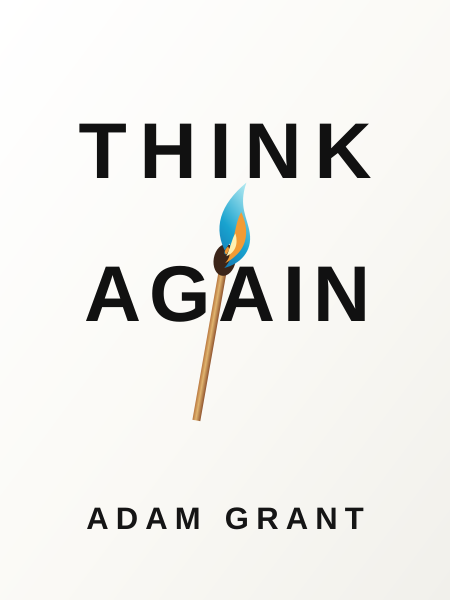
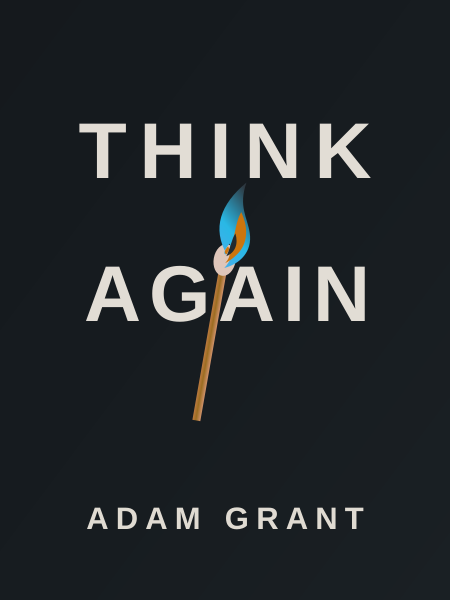
Think Again
Adam Grant · 2021
Editorial rating
- Evidence
- 7/10
- Actionability
- 7/10
- Originality
- 5/10
The thesis
Intelligence isn't just the ability to think and learn - it's the ability to rethink and unlearn. In a rapidly changing world, the willingness to question your own opinions, update your beliefs based on evidence, and change your mind isn't weakness; it's a critical skill. Think like a scientist: favor humility over pride, doubt over certainty, curiosity over closure.
Who this is for
Leaders creating learning cultures, professionals whose expertise risks becoming a trap, anyone who finds themselves in unproductive debates, and people who want to help others change their minds. Especially valuable for those who pride themselves on being right - that pride may be the problem.
My favorite quote
The goal is not to be wrong more often. It's to recognize that we're all wrong more often than we'd like to admit, and the more we deny it, the deeper the hole we dig for ourselves.
Why it matters
This reframes intellectual humility from weakness to wisdom - acknowledging uncertainty is the path to getting closer to truth.
Do this
Identify one strong opinion you hold. Ask yourself: What evidence would change my mind?
Start here
Adopt the Scientist Mindset: Treat your opinions as hypotheses to be tested, not conclusions to be defended. When you encounter conflicting information, get curious rather than defensive. Ask "What would have to be true for this to be correct?" before dismissing it. The smarter you are, the more vulnerable you are to overconfidence - intelligence becomes a weapon against truth when used to defend rather than discover.
Critical summary
Adam Grant, Wharton's top-rated professor for seven consecutive years, argues that rethinking is a learnable skill as important as thinking itself. The book covers three domains: individual rethinking, changing others' minds, and creating collective environments that encourage rethinking.
Grant's strength is explaining psychology in accessible terms through engaging stories - from the BlackBerry's failure to adapt, to how a hostage negotiator approaches disagreement.
What it gets right
- Makes time-tested concepts feel fresh through well-chosen stories
- Practical techniques for productive disagreement
- Emphasizes asking questions over making arguments
- Challenges readers to see from different perspectives
- Strong research foundation with accessible presentation
What it misses
- Breaks little new ground - synthesizes existing psychology without deep innovation
- Some examples feel dated or controversial (Cuomo praised; FDR's depression policies contested)
- Can feel long; some readers skim stories rather than engage fully
- Doesn't fully address deeply-held beliefs tied to identity or values
- Grant sometimes criticized for popularizing others' research without sufficient credit
Daniel Kahneman praised it: "No one could teach this hugely valuable skill better than he does." The book has 12,000 Amazon reviews averaging 4.6/5.
Key concepts
Scientist Mindset
Treating beliefs as hypotheses requiring evidence rather than positions requiring defense. Default to "I might be wrong about this."
Confident Humility
Being secure enough to acknowledge uncertainty. High confidence in your ability to learn, low confidence in your current conclusions.
Challenge Network
People who actively push back on your ideas - more valuable than support networks for intellectual growth.
Motivational Interviewing
Helping others find their own reasons to change rather than arguing your reasons. Ask questions; don't lecture.
Binary Bias
Tendency to see issues as two-sided when reality is more nuanced. Resist oversimplification.
Core insights
-
The smarter you are, the more vulnerable you are to overconfidence
Intelligence helps you rationalize; it doesn't guarantee you're right. Actively seek disconfirming evidence.
-
Argue like you're right, listen like you're wrong
Passion for your ideas combined with openness to being wrong is more effective than either alone.
-
Fewer arguments win more debates
The best case for your position is one strong point, not twelve weak ones. Concentrate on what matters.
-
Ask "how" instead of "why"
When people explain how their extreme views would work in practice, they often temper their opinions. Why intensifies; how moderates.
-
Unlearning is as important as learning
What made you successful in the past may be exactly wrong for the future. Regularly audit beliefs for continued relevance.
Implementation steps
Today
- Identify one belief you've held for years without recent examination
- Find one piece of evidence that challenges your view on a current issue
This week
- Have a conversation with someone who disagrees with you; practice asking questions instead of making points
- Identify one person who could be part of your "challenge network"
This month
- Conduct a "belief audit": List five opinions; for each, write what evidence would change your mind
- Practice motivational interviewing: Help someone find their own reason to change
Ongoing
- Celebrate changing your mind - reframe it as progress, not weakness
- Ask "What would have to be true?" before dismissing opposing views
- Regular unlearning reviews: What do you believe that's no longer true?
Suggested 30-day practice plan
An editorial application plan created by Monolithic Vault - an interpretation of the book's ideas, not part of the original book.
- Day 1
List three strong opinions; for each, write what evidence would change your mind
- Day 2
Identify someone who disagrees with you on something important; schedule a conversation
- Day 3
Practice asking questions in that conversation; track ratio of questions to statements
- Day 7
Ask a trusted colleague for honest feedback on a blind spot
- Day 14
Find someone in your field who changed their mind on a major issue; learn their process
- Day 21
Conduct a "belief audit" on your professional assumptions - which are outdated?
- Day 30
Teach one rethinking technique to a colleague or team
Free PDF summary
Take this analysis with you: a designed two-page field-notes sheet with the thesis, my favorite quote, the key concepts and core insights, and the full 30-day checklist. Print it or keep it - free, no signup.
Go deeper
If this analysis earned your attention, the full book goes further than any summary can. The original is always the primary source.