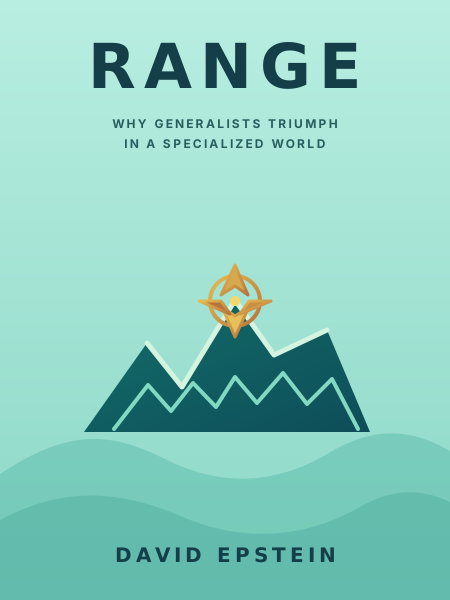
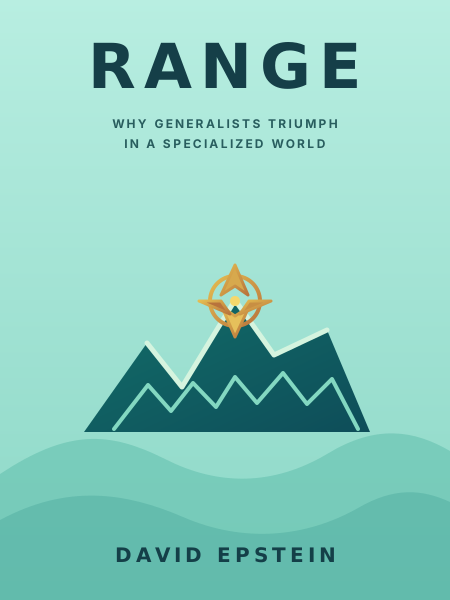
Range
David Epstein · 2019
Editorial rating
- Evidence
- 7/10
- Actionability
- 6/10
- Originality
- 8/10
The thesis
Early specialization is overrated. In most complex, unpredictable fields, generalists - people who sample widely, experiment broadly, and specialize late - outperform specialists who narrowed early. The "Tiger Woods model" (intense focus from childhood) is the exception, not the rule. The "Roger Federer model" (diverse experiences, late specialization) produces more top performers and more adaptable thinkers.
Who this is for
Career-changers feeling behind, parents agonizing over their children's "head start," professionals in rapidly changing fields, and anyone who's ever felt guilty about having too many interests.
My favorite quote
Compared to other scientists, Nobel laureates are at least twenty-two times more likely to partake as an amateur actor, dancer, magician, or other type of performer.
Why it matters
The highest achievers aren't the most specialized - they're often the most well-rounded. Breadth feeds creativity.
Do this
Identify one skill or interest outside your main domain. Schedule time to explore it this week - not as a hobby, but as fuel for your primary work.
Start here
Kind vs. wicked learning environments: In "kind" environments (chess, golf), patterns repeat, feedback is clear, and deliberate practice works. In "wicked" environments (most real-world problems), patterns don't repeat, feedback is delayed or misleading, and experience can actually make you worse. Most of life is wicked - which is why range beats specialization.
Critical summary
Epstein, a science journalist, challenges the 10,000-hour rule and early specialization gospel. Using research and stories from sports, music, science, and business, he argues that breadth of experience and late specialization produce more innovation, better problem-solving, and more fulfilling careers.
What it gets right
- Tiger Woods vs. Roger Federer framing is memorable
- "Kind" vs. "wicked" learning environments is genuinely useful
- Challenges the early specialization panic in parenting and education
- Strong on the benefits of analogical thinking across domains
- Well-researched with diverse examples
What it misses
- Can feel like a series of anecdotes rather than a tight argument
- Some critics note selection bias in examples
- Less guidance on HOW to develop range strategically
- Conflates several different arguments (late specialization, analogical thinking, sampling periods)
- The Malcolm Gladwell-style storytelling obscures the actual evidence quality
Evidence is mixed - some solid research studies, some cherry-picked anecdotes. Better than most pop science, but not meta-analysis level rigor.
Key concepts
Kind Learning Environments
Patterns repeat, rules are clear, feedback is immediate. Specialization and deliberate practice excel here.
Wicked Learning Environments
Patterns don't repeat, rules change, feedback is unclear. Range and adaptability excel here.
Sampling Period
A time of trying many things before committing. More successful people often had longer sampling periods.
Analogical Thinking
Drawing insights from distant domains. Generalists do this better than specialists.
Outside View
Looking at a problem from outside your specialty. Often produces better predictions than the "inside view."
Lateral Thinking
The ability to make connections across fields that specialists miss.
Core insights
-
Head starts often fade
Early specializers may lead initially, but late specializers catch up and often surpass them.
-
Match quality matters more than early commitment
Finding the right fit (between your abilities and your work) matters more than starting early.
-
Specialists become prisoners of their tools
When you're a hammer, everything looks like a nail. Generalists see more options.
-
Struggle and failure are features, not bugs
The "desirable difficulties" of varied learning create more durable knowledge.
-
Forecasters with range beat experts
In prediction tournaments, "foxes" (who know many things) beat "hedgehogs" (who know one big thing).
-
The most innovative teams are cognitively diverse
Breakthroughs often come from outsiders applying knowledge from distant fields.
Implementation steps
Today
- List 3 interests you've abandoned because they weren't "practical." Pick one to revisit.
- Ask: Is my current work environment "kind" or "wicked"? What does that imply?
This week
- Solve a current problem by asking: "What would someone from a completely different field try?"
- Read one article or book outside your domain
This month
- Interview or shadow someone in a different field
- Identify one "desirable difficulty" to add to your learning (variation, spacing, testing)
Ongoing
- Resist premature specialization - both in your career and in developing your team
- When stuck, seek the "outside view" from people with different expertise
Suggested 30-day practice plan
An editorial application plan created by Monolithic Vault - an interpretation of the book's ideas, not part of the original book.
- Day 1
Map your career path. How much sampling did you do? How much do you wish you'd done?
- Day 2
Identify a "wicked" problem you're facing. Who outside your field might have useful perspective?
- Day 3
Read something completely outside your domain
- Day 7
Apply one insight from an unrelated field to a current challenge
- Day 14
Have a conversation with someone whose expertise is far from yours
- Day 21
Identify one area where you've over-specialized. How could you broaden?
- Day 30
Reflect: What connections have you made across domains this month?
Free PDF summary
Take this analysis with you: a designed two-page field-notes sheet with the thesis, my favorite quote, the key concepts and core insights, and the full 30-day checklist. Print it or keep it - free, no signup.
Go deeper
If this analysis earned your attention, the full book goes further than any summary can. The original is always the primary source.