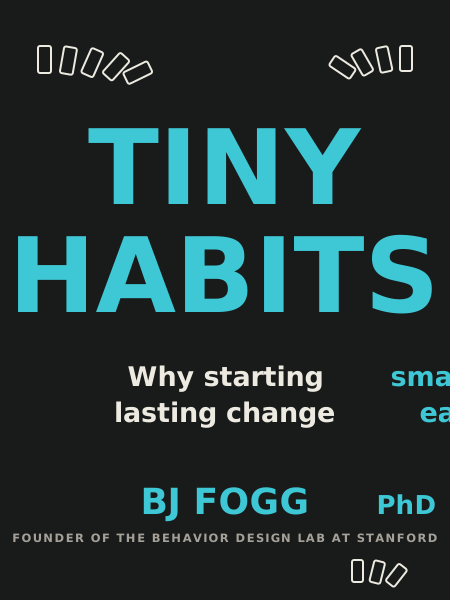
Tiny Habits
BJ Fogg · 2019
Editorial rating
- Evidence
- 10/10
- Actionability
- 10/10
- Originality
- 9/10
The thesis
Motivation is a fickle friend that disappears when you need it most. To build lasting change, you must stop relying on willpower and instead focus on "Ability" (making the behavior ridiculously small) and "Prompts" (anchoring it to an existing routine). Behavior happens when Motivation, Ability, and a Prompt converge (B=MAP).
Who this is for
People who have failed at New Year's resolutions for years, perfectionists who beat themselves up for "falling off the wagon," and anyone who wants to design behavior change scientifically rather than emotionally.
My favorite quote
People change best by feeling good, not by feeling bad.
Why it matters
It challenges the cultural myth that discipline requires suffering. Positive emotion (celebration) wires habits into the brain; guilt destroys them.
Do this
Immediately after doing a new habit today, say "Victory!" or do a fist pump. Force the feeling of success.
Start here
Master the ABC Recipe: Anchor + Behavior + Celebration. 1. Anchor: An existing routine (e.g., flushing the toilet). 2. Behavior: The tiny version of the new habit (e.g., do two push-ups). 3. Celebration: An immediate emotional reward (e.g., a smile or mental "Good job"). Without the Anchor, you forget. Without the Celebration, the brain doesn't learn to repeat it.
Critical summary
BJ Fogg is the Stanford researcher who literally established the science of "Behavior Design." While books like Atomic Habits (written by his student, James Clear) popularized these ideas, Tiny Habits is the source code.
The book is built on the Fogg Behavior Model (B=MAP): Behavior occurs only when Motivation, Ability, and a Prompt happen at the same moment. If a behavior doesn't happen, one of these is missing. Since Motivation is unreliable, Fogg argues you must focus entirely on Ability (making it easy) and Prompts.
What it gets right
- Simplicity as the driver: Fogg proves mathematically that if a behavior is hard, you need high motivation (which is rare). If it's easy, you need almost zero motivation.
- The "Shine" (Celebration): This is Fogg's unique contribution. He argues that emotions create habits, not repetition. You can wire a habit in one day if the emotional signal is strong enough.
- Troubleshooting: Unlike other books that say "try harder," Fogg gives a diagnostic checklist: Check the Prompt -> Check the Ability -> Check the Motivation (in that order).
What it misses
- The "Scaling" Problem: The book is excellent at starting habits (flossing one tooth) but spends less time on how to transition from "tiny" to "intense" (running a marathon).
- Cheesiness: The "Celebration" techniques (doing a little dance, saying "I'm awesome") feel awkward and uncool to many serious professionals, leading them to skip the most important step.
- Repetition: Like many business books, the core B=MAP model is explained in the first 50 pages, and the rest is case studies.
Key concepts
B=MAP
The universal formula for behavior. To stop a bad habit, remove the prompt or make it hard (decrease ability). To start a good one, make it tiny (increase ability) and design a prompt.
The Ability Chain
Five factors that make things hard: Time, Money, Physical Effort, Mental Effort, Routine Deviation.
Pearl Habits
turning an annoyance (like a noisy neighbor or a spam call) into a prompt for a relaxation response.
The "Maui Habit"
A starter habit Fogg does every morning: putting feet on the floor and saying, "It's going to be a great day."
De-motivation
Motivation is not a character trait; it is a wave. You must "surf" the wave (do hard things when motivation is high) and survive the trough (do tiny things when motivation is low).
Core insights
-
Simplicity changes behavior
If you want to read more, put a book on your pillow. If you want to eat better, put apples on the counter. Reduce the friction to zero.
-
You are not the problem; your design is
If a plant dies, you don't blame the plant; you blame the soil/light. If you fail a habit, don't blame your character; blame your prompt or ability setting.
-
Celebration is non-negotiable
The brain releases dopamine when it feels successful. You must hack this by artificially celebrating small wins to speed up habit formation.
-
Prompts must be precise
"I will work out after work" is a bad prompt. "After I close my laptop, I will put on my running shoes" is a good prompt. Action leads to action.
-
Focus on the "Starter Step"
Don't worry about the 30-minute run. Worry about the 10-second action of putting on your shoes. If you do that, the run usually happens.
Implementation steps
Today
- Design one ABC: Pick one habit you've failed at. Write it as: "After I [Anchor], I will [Tiny Behavior], and then I will [Celebrate]."
- The "One Tooth" Test: Floss only one tooth tonight. Celebrate it. See if you stop there.
This week
- Map your environment: Identify the "Ability Blockers" in your home (e.g., guitar is in the closet, fruit is in the drawer). Move them to visible, easy-to-reach spots.
- Rehearse Celebrations: Find a celebration that doesn't feel cringe. Maybe a deep breath and a smile, or a mental "Yes." Use it 5 times.
This month
- The "Pearl Habit": Pick one person who annoys you. Decide: "After [Name] complains, I will take one deep relaxing breath."
- Focus Mapping: List 20 behaviors that could achieve your goal. Plot them on a grid of "High Impact" vs. "Easy to Do." Only do the ones in the "High Impact/Easy" corner.
Ongoing
- Troubleshoot fails: When you miss a habit, ask: "Did I forget? (Prompt issue)" or "Was it too hard? (Ability issue)." Never ask "What is wrong with me?"
- Batching: Group tiny habits into routines (Morning Routine, After-Work Routine).
Suggested 30-day practice plan
An editorial application plan created by Monolithic Vault - an interpretation of the book's ideas, not part of the original book.
- Day 1
Learn the "Maui Habit" (Say "It's going to be a great day" when feet hit floor).
- Day 2
Create 3 Tiny Habits for your morning routine using the ABC formula.
- Day 3
Audit your kitchen: Make bad foods hard to reach (high shelf), good foods easy (counter).
- Day 7
Review your "Celebrations." Are they working? If not, switch to a physical movement (snap fingers).
- Day 14
"Scale up" day. Let your tiny habits grow naturally (e.g., do 5 pushups instead of 2) but keep the requirement at 2.
- Day 21
Teach the B=MAP model to a partner or colleague.
- Day 30
Look at your "Success list." How many tiny habits have grown into full routines?
Free PDF summary
Take this analysis with you: a designed two-page field-notes sheet with the thesis, my favorite quote, the key concepts and core insights, and the full 30-day checklist. Print it or keep it - free, no signup.
Go deeper
If this analysis earned your attention, the full book goes further than any summary can. The original is always the primary source.