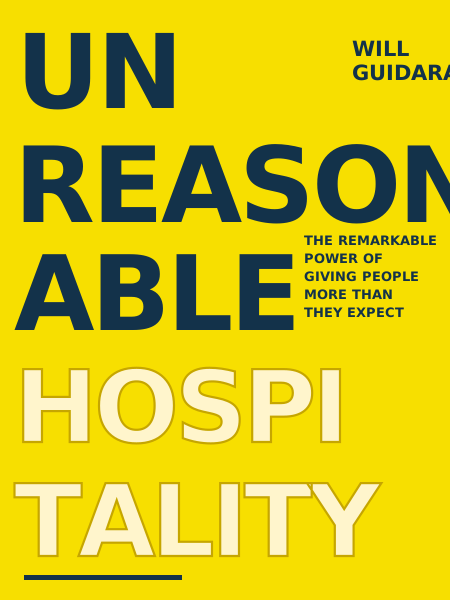
Unreasonable Hospitality
Will Guidara · 2022
Editorial rating
- Evidence
- 6/10
- Actionability
- 8/10
- Originality
- 8/10
The thesis
Operational excellence earns trust, but memorable hospitality earns loyalty by making people feel individually seen. The best gestures are not the most expensive; they are the most attentive and specific.
Who this is for
Service leaders, consultants, customer-experience teams, and managers trying to turn competent delivery into an experience people remember and talk about.
My favorite quote
No one who ever changed the game did so by being reasonable.
Why it matters
Distinctive experiences require choices that a spreadsheet alone would usually reject.
Do this
Add one personal, low-cost gesture to a customer interaction already scheduled today.
Start here
Separate service from hospitality. Service is completing the transaction accurately and efficiently; hospitality is how the person feels while and after you do it. First make the basics reliable, then use attention and creativity to add one detail that could only have been chosen for that person.
Critical summary
Will Guidara was twenty-six when he became general manager of Eleven Madison Park, then a respected but underperforming New York restaurant. Working with chef Daniel Humm, he helped turn it into the top-ranked restaurant on the World's 50 Best Restaurants list. His argument is that every organization can behave like a hospitality business by combining exacting operations with generous, personalized human connection. The signature story is a table of tourists regretting that they had not eaten a New York hot dog. Guidara bought a two-dollar street-cart dog, persuaded the kitchen to plate it, and created the most memorable course of an expensive meal. From there, the book moves between memoir and operating philosophy: define nonnegotiable standards, hire slowly, treat staff with the care expected for guests, give ownership to frontline employees, praise emotionally, criticize calmly, and create systems that make bespoke gestures possible without leaving everything to improvisation.
What it gets right
- Shows that personalization begins with listening closely rather than spending lavishly
- Connects customer experience to employee experience instead of treating frontline warmth as a script
- Balances creative gestures with the less glamorous discipline of standards, feedback, preparation, and repetition
What it overstates or misses
- Draws broad business lessons from an elite restaurant with staffing, pricing, and margins unlike most service operations
- Gives limited attention to labor intensity, burnout, boundaries, and the customers who exploit generosity
- Makes memorable exceptions more vivid than the economics required to sustain them at scale
The evidence is a detailed leadership case study rather than comparative research. Eleven Madison Park's rise gives Guidara credibility, but rankings and anecdotes cannot isolate hospitality from cuisine, location, capital, timing, or partnership with Humm. The philosophy travels best when translated into small, repeatable gestures supported by operational slack, not copied as theatrical excess. Its lasting insight is that human attention can differentiate a competent commodity. The verdict: steal the attentiveness, not the extravagance.
Key concepts
Service Versus Hospitality
Service is what you deliver; hospitality is how the recipient feels about the delivery, so measure emotional memory alongside accuracy and speed.
Unreasonable Hospitality
A deliberate choice to exceed expectations through creativity and generosity; apply it selectively where a personal gesture can matter most.
Dreamweaving
Listening for personal details that can become a tailored surprise; create a simple process for capturing and acting on those signals.
One Size Fits One
Personalization beats generic luxury because relevance creates the memory; choose details tied to the person rather than the price tag.
Black and White Plus Color
Competence and efficiency are the black and white foundation, while warmth and personality add color; never use charm to excuse unreliable basics.
Core insights
-
Attention is the scarce ingredient
The hot dog worked because Guidara heard an unspoken desire and acted before the moment disappeared.
-
Systems enable spontaneity
Personalized gestures become repeatable only when staff have authority, information, time, and a modest budget.
-
Employees receive the first experience
A team cannot sustainably make customers feel valued while feeling ignored, distrusted, or disposable themselves.
-
Standards create creative freedom
Reliable basics free people to personalize the edges without causing errors in the core service.
-
Memories outperform transactions
Customers forget competent delivery quickly but retell moments that made them feel known, giving hospitality commercial reach beyond the visit.
Implementation steps
Today
- Review one upcoming customer interaction and note a personal detail that could shape the experience.
- Distinguish one service standard from one hospitality behavior in your current process.
This week
- Give frontline staff a small discretionary budget and clear boundaries for personalized gestures.
- Map five customer touchpoints and add one low-cost opportunity to reduce friction or create recognition.
This month
- Build a simple system for recording preferences, milestones, and useful context with appropriate consent.
- Audit whether employees receive the same clarity, appreciation, and care expected in customer interactions.
Ongoing
- Protect operational standards before adding theatrical extras.
- Collect stories of effective gestures and convert repeatable patterns into team practice.
Suggested 30-day practice plan
An editorial application plan created by Monolithic Vault - an interpretation of the book's ideas, not part of the original book.
- Day 1
Identify where your customer journey is merely efficient and where it already feels personal.
- Day 3
Perform one specific gesture based on something a customer actually said.
- Day 7
Ask frontline staff which rules block sensible acts of hospitality.
- Day 14
Test a small discretionary budget with clear approval and documentation rules.
- Day 21
Review the gestures for cost, effort, customer response, and employee strain.
- Day 30
Standardize two sustainable practices and retire anything expensive, forced, or difficult to scale.
Free PDF summary
Take this analysis with you: a designed two-page field-notes sheet with the thesis, my favorite quote, the key concepts and core insights, and the full 30-day checklist. Print it or keep it - free, no signup.
Go deeper
If this analysis earned your attention, the full book goes further than any summary can. The original is always the primary source.