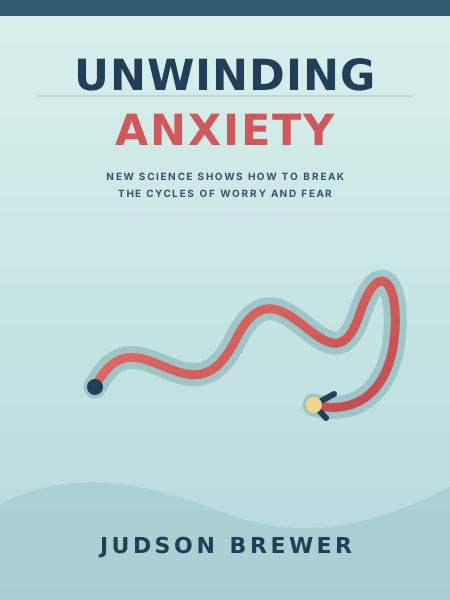
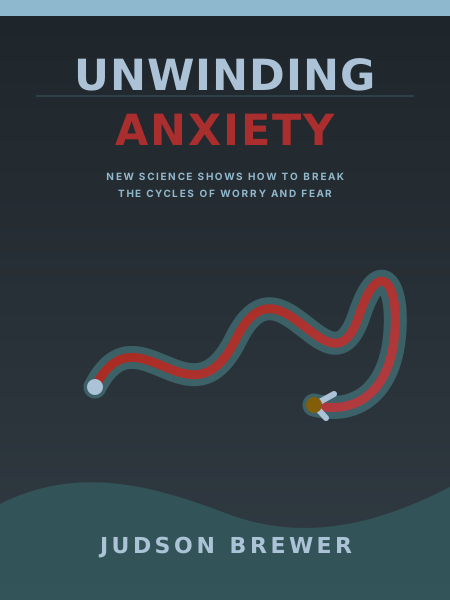
Unwinding Anxiety
Judson Brewer · 2021
Editorial rating
- Evidence
- 7/10
- Actionability
- 7/10
- Originality
- 6/10
The thesis
Anxiety is a habit, not a character trait. Like any habit, it follows a loop: trigger → behavior (worry) → reward (false sense of control). By mapping these loops and replacing worry with curiosity, you can break the anxiety cycle without fighting it directly.
Who this is for
Professionals whose anxiety manifests as overthinking, rumination, or compulsive planning. Anyone who has tried willpower-based approaches and failed. People curious about mindfulness but skeptical of spiritual frameworks.
My favorite quote
Curiosity is the key that opens the lock of the worry habit.
Why it matters
This provides a concrete alternative to "stop worrying" - advice that never works. Curiosity gives your brain something to do instead.
Do this
Next time you catch yourself worrying, ask: "What does this anxiety actually feel like in my body right now?" Describe it without judgment.
Start here
Replace worry with curiosity: When anxiety arises, don't fight it or try to solve the imagined problem. Instead, get genuinely curious about the physical sensation: Where do you feel it? What's its texture? Does it move? This interrupts the habit loop by substituting a different behavior for the same trigger - and curiosity actually feels better than worry.
Critical summary
Judson Brewer is a psychiatrist and neuroscientist who runs Brown University's Mindfulness Center. His framework treats anxiety as a learned habit rather than a pathology, applying the same trigger-behavior-reward model he used successfully for addiction in his previous work.
The three-gear system is elegant:
- Gear 1: Map your anxiety loops (trigger → behavior → reward)
- Gear 2: Become disenchanted with worry (recognize it doesn't actually help)
- Gear 3: Offer a "bigger, better offer" (curiosity, which feels better than anxiety)
What it gets right
- Habit-loop framework makes anxiety tractable and less mysterious
- Curiosity as intervention is genuinely useful and backed by research
- Non-pathologizing approach reduces shame around anxiety
- Practical exercises throughout
- Brewer's research has real clinical backing
What it misses
- Repetitive - the same concepts appear in multiple chapters
- Elementary for anyone with prior mindfulness experience
- "Unwinding anxiety" title is somewhat misleading - it's really about breaking the worry habit
- Reads partly as promotion for Brewer's app
- Doesn't address anxiety disorders that may require professional treatment
- Can feel slow-paced; core framework could be conveyed in 50 pages
The book is most useful for people new to both mindfulness and habit science. Experienced practitioners will find it basic but may appreciate the anxiety-specific framing.
Key concepts
Habit Loop
Trigger → Behavior → Reward. Anxiety follows this pattern just like any habit.
Gear 1 (Mapping)
Identify your specific anxiety triggers and the behaviors they prompt.
Gear 2 (Disenchantment)
Recognize that worry doesn't deliver on its promise of control or safety.
Gear 3 (Bigger Better Offer)
Replace worry with curiosity - a behavior that feels better.
RAIN
Recognize, Allow, Investigate, Note - a mindfulness framework for processing difficult emotions.
Reward-Based Learning
The brain repeats behaviors that feel rewarding. Update what feels rewarding.
Core insights
-
Worry feels productive but isn't
The "reward" of worry is an illusion of control. Recognizing this breaks its power.
-
You can't think your way out of anxiety
Analyzing anxious thoughts feeds them. Drop into body sensation instead.
-
Curiosity is incompatible with anxiety
The brain can't be curious and anxious simultaneously. Curiosity wins.
-
Avoidance reinforces anxiety
Every time you avoid something anxiety-provoking, you teach your brain it was dangerous.
-
Kindness beats judgment
Self-criticism about being anxious creates a second layer of suffering. Notice without judging.
Implementation steps
Today
- Map one anxiety loop: What triggered it? What did you do? What reward did it promise?
- When anxious, locate the sensation in your body and describe its qualities
This week
- Practice RAIN once daily: Recognize anxiety, Allow it, Investigate the sensation, Note what you observe
- Notice when worry promises control - and whether it delivers
This month
- Identify your top 3 anxiety triggers and map complete loops for each
- Practice "noting" throughout the day: silently label mental states ("worrying," "planning," "ruminating")
Ongoing
- Default to curiosity when anxiety arises - ask "What does this feel like?" before trying to solve
- Regular mindfulness practice (10 minutes daily) to strengthen curiosity muscle
Suggested 30-day practice plan
An editorial application plan created by Monolithic Vault - an interpretation of the book's ideas, not part of the original book.
- Day 1
List your top 5 anxiety triggers; choose one to map completely
- Day 2
Practice locating anxiety in your body; describe sensations without judgment
- Day 3
Begin 10-minute daily mindfulness practice (app or guided)
- Day 7
Map loops for remaining triggers; identify common patterns
- Day 14
Focus on Gear 2 - notice when worry fails to deliver promised relief
- Day 21
Practice curiosity as active intervention; note what happens to anxiety intensity
- Day 30
Assess: Which triggers have weakened? Which need continued attention?
Free PDF summary
Take this analysis with you: a designed two-page field-notes sheet with the thesis, my favorite quote, the key concepts and core insights, and the full 30-day checklist. Print it or keep it - free, no signup.
Go deeper
If this analysis earned your attention, the full book goes further than any summary can. The original is always the primary source.