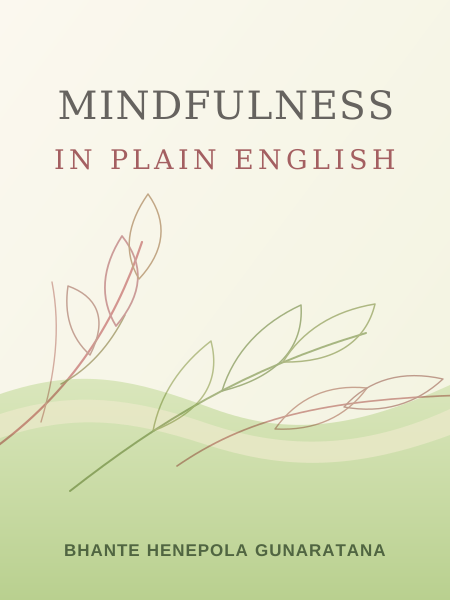
Mindfulness in Plain English
Bhante Henepola Gunaratana · 1994
Editorial rating
- Evidence
- 7/10
- Actionability
- 9/10
- Originality
- 7/10
The thesis
Mindfulness is pure, non-judgmental awareness of the present moment - observing what is without adding or subtracting. Through Vipassana meditation (insight meditation), you can train this capacity systematically, reducing suffering and gaining clarity about reality.
Who this is for
Meditation beginners who want practical instruction without mysticism, skeptics curious about mindfulness but put off by spiritual jargon, and experienced meditators seeking to deepen their foundational understanding.
My favorite quote
Somewhere in this process, you will come face to face with the sudden and shocking realization that you are completely crazy.
Why it matters
This disarming honesty captures what meditators actually experience - seeing the mind's chaos clearly for the first time. It's reassuring, not discouraging.
Do this
Sit for 5 minutes today, watching your breath. When your mind wanders (it will), gently return to the breath without judgment.
Start here
Start with breath awareness: Sit comfortably, focus attention on the sensation of breathing at the nostrils - the subtle feeling of air entering and leaving. When attention wanders (constantly at first), notice where it went, then gently return. This simple practice, done consistently, builds the foundation for all mindfulness.
Critical summary
Bhante Gunaratana, a Sri Lankan Buddhist monk ordained at age 12, distills Vipassana meditation into clear, practical English. The book has become the gold standard introduction - Jon Kabat-Zinn calls it "a masterpiece." It succeeds by avoiding both New Age fluff and academic dryness.
The book's greatest strength is accessibility. Gunaratana anticipates every beginner obstacle - restlessness, sleepiness, doubt, physical discomfort - and provides specific solutions. The chapter on dealing with distractions is worth the book alone.
What it gets right
- Jargon-free explanations of meditation mechanics
- Honest about difficulty - meditation is hard work, not blissful escape
- Distinction between concentration and mindfulness clearly explained
- Practical guidance on posture, timing, handling thoughts
What it misses
- Rooted in Buddhist framework - secular readers may want even less tradition
- Occasionally overpromises benefits or slips into mystical language
- More focused on sitting meditation than everyday mindfulness practice
- Some claims about "reality" and "insight" require faith commitments
Evidence is experiential and traditional - millennia of contemplative practice, not randomized controlled trials. However, modern research (MBSR studies) supports many of the book's claims about stress reduction and emotional regulation.
Key concepts
Vipassana
Insight meditation - seeing things as they really are through direct observation. The book's core method.
Mindfulness (Sati)
Non-judgmental awareness of present experience. Not thinking about experience - observing it.
Concentration (Samatha)
One-pointed focus that calms the mind. Develops alongside mindfulness but is distinct.
Impermanence (Anicca)
Everything changes - sensations, thoughts, emotions arise and pass. Observing this reduces attachment.
Meta-awareness
The capacity to notice where attention is. You can be lost in thought or aware that you're thinking.
Equanimity
Balanced response to pleasant and unpleasant experiences. Neither grasping nor pushing away.
Core insights
-
Mindfulness is observation, not thinking
When you label an experience ("I'm anxious"), you've moved from observing to conceptualizing. Pure mindfulness happens before words.
-
The breath is always available
Unlike complicated techniques, breath awareness can be practiced anywhere, anytime. It's the universal anchor.
-
Distraction is the practice
You don't fail when your mind wanders - returning from distraction is the actual training. More wandering = more reps.
-
Consistency beats intensity
15 minutes daily matters more than occasional 2-hour sessions. The mind responds to regularity.
-
Meditation changes daily life
The real benefit isn't in sitting sessions but in the mindfulness that spills into conversations, decisions, and emotional reactions.
Implementation steps
Today
- Sit for 5 minutes, observing breath at nostrils
- When distracted, note "thinking" and return (no judgment)
This week
- Increase to 10-15 minutes daily
- Try one session with eyes open, soft gaze downward
This month
- Build to 20-30 minutes daily
- Practice one "informal" session: mindful walking, eating, or showering
Ongoing
- Morning sitting practice (non-negotiable)
- Regular "checking in" throughout day - where is attention right now?
Suggested 30-day practice plan
An editorial application plan created by Monolithic Vault - an interpretation of the book's ideas, not part of the original book.
- Day 1
5 minutes sitting, breath awareness at nostrils
- Day 2
Same practice, notice where mind goes when it wanders
- Day 3
10 minutes; experiment with noting "thinking" or "planning"
- Day 7
15 minutes; review chapter on dealing with distractions
- Day 14
20 minutes; add one informal mindfulness practice (walking or eating)
- Day 21
25 minutes; practice noting sensations in the body
- Day 30
30-minute session; reflect on changes noticed over the month
Free PDF summary
Take this analysis with you: a designed two-page field-notes sheet with the thesis, my favorite quote, the key concepts and core insights, and the full 30-day checklist. Print it or keep it - free, no signup.
Go deeper
If this analysis earned your attention, the full book goes further than any summary can. The original is always the primary source.