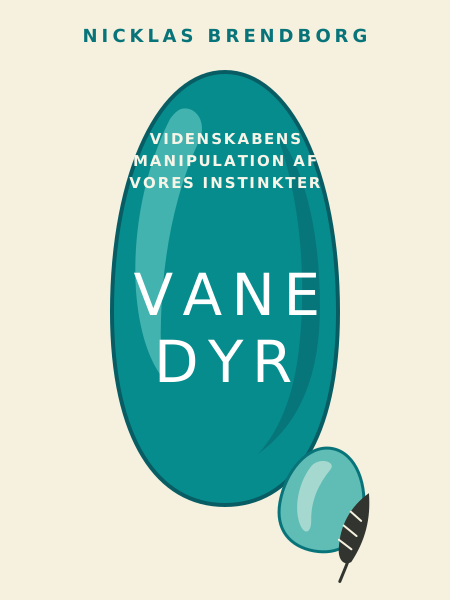
Vanedyr
Nicklas Brendborg · 2023
Editorial rating
- Evidence
- 8/10
- Actionability
- 7/10
- Originality
- 8/10
The thesis
Many bad habits are not failures of character but predictable responses to superstimuli engineered to overpower normal appetite, attention, and social instincts. Regaining control requires redesigning exposure, not merely demanding more willpower.
Who this is for
People losing evenings to scrolling or streaming, professionals struggling with distracting products, parents worried about digital habits, and readers who want the biology behind overeating, addiction, comparison, and compulsive consumption.
My favorite quote
It is not weakness. It is biology being exploited.
Why it matters
Shame keeps the individual fighting a commercial system with the weakest available tool: self-criticism.
Do this
Remove one engineered trigger from your immediate environment instead of promising to resist it later.
Start here
Identify the superstimulus, then reduce contact before trying to moderate your response. Make the product less vivid, less available, less varied, or less frictionless, because an environment designed by specialists will usually beat a tired person's intention.
Critical summary
Nicklas Brendborg trained in molecular biomedicine and biotechnology before turning dense research into popular science, and Vanedyr applies that skill to modern habit formation. His organizing idea is the superstimulus, an exaggerated version of something evolution taught animals to seek. A shorebird may abandon its own eggs to sit on an artificial egg that is larger and bluer; humans face industrial versions of the same trap. Ultra-processed food concentrates taste, texture, variety, and convenience beyond ordinary food. Drugs refine natural compounds into faster and stronger rewards. Streaming services remove stopping cues, while social platforms combine variable rewards, social approval, personalized feeds, and infinite scrolling. The consumer does not meet these products on equal terms. Companies employ researchers, designers, data systems, and algorithms to improve engagement, while the individual meets the finished system with finite attention and willpower. Brendborg connects food, drugs, pornography, gaming, gambling, social media, status, beauty, and comparison through this common mechanism. The practical implication is less glamorous than a motivation speech: notice engineered exaggeration, reduce exposure, restore friction, limit variety, choose smaller comparison groups, and make healthier alternatives easier to reach.
What it gets right
- Reframes bad habits as an interaction between evolved preferences and deliberately intensified commercial environments
- Connects apparently separate problems through a memorable scientific concept without reducing everything to dopamine
- Uses animal behavior, biology, psychology, and industry design to make invisible manipulation easier to recognize
What it overstates or misses
- The superstimulus concept can become so broad that very different mechanisms begin to look more unified than they are
- Industry incentives receive heavy emphasis while poverty, stress, trauma, culture, and individual psychiatric vulnerability receive less
- Awareness and environmental changes help, but severe addiction and eating disorders may require professional treatment rather than habit tactics
The book draws from a wide range of scientific fields and is strongest when explaining mechanisms and experiments, not when turning them into universal prescriptions. Its stories are exceptionally sticky, but readers should distinguish evidence that a product captures attention from evidence about the best intervention for a particular person. The central argument remains persuasive: a market can systematically improve products at exploiting instincts faster than biology can adapt. The verdict: a sharp field guide to the traps around you, not a complete treatment manual for what they have already done.
Key concepts
Superstimulus
An exaggerated artificial version of a natural reward that provokes a stronger response than the original stimulus evolved to produce.
Evolutionary Mismatch
Ancient preferences for calories, novelty, sex, status, and belonging now operate inside environments that supply them at industrial scale.
Variable Reward
Unpredictable rewards such as likes, wins, messages, or new content sustain checking because the next attempt might pay off.
Frictionless Consumption
Autoplay, infinite scroll, delivery, and constant availability remove the pauses that once allowed desire to fade or choices to reset.
Comparison Environment
Expanding the social reference group exposes people to extreme bodies, wealth, talent, and lifestyles that distort what feels normal.
Core insights
-
Willpower Is Outnumbered
A single consumer cannot reliably outthink teams paid to test which trigger keeps attention or consumption alive.
-
Intensity Changes Behavior
Concentrating speed, novelty, taste, or social reward can turn a normal preference into repeated overconsumption.
-
Stopping Cues Matter
Episodes, package sizes, daylight, distance, and social rituals once ended behavior; modern products deliberately erase those boundaries.
-
Your Reference Group Shapes Satisfaction
Comparing yourself with a curated global extreme can make an objectively good life feel inadequate.
-
Environment Beats Shame
Removing cues and adding friction is more reliable than treating every lapse as evidence of weak character.
Implementation steps
Today
- Turn off autoplay and nonessential notifications on the device that consumes most of your attention.
- Move the most tempting food, app, or device out of sight and put a useful alternative in its previous place.
This week
- Track one habit for seven days, recording the cue, product feature, emotional state, and missing stopping signal each time it begins.
- Create a fixed stopping rule such as one episode, one portion, or one scheduled social-media window per day.
This month
- Redesign one room or device so desirable actions are visible and immediate while superstimuli require extra steps, distance, or waiting.
- Replace one global comparison feed with a smaller real community built around participation rather than performance display.
Ongoing
- Treat new convenience features as behavior changes that deserve deliberate evaluation, not automatic upgrades.
- Seek professional support when a habit produces withdrawal, medical risk, lost relationships, or repeated failure despite serious consequences.
Suggested 30-day practice plan
An editorial application plan created by Monolithic Vault - an interpretation of the book's ideas, not part of the original book.
- Day 1
Choose one superstimulus and document exactly how it gains access to your attention or appetite.
- Day 3
Disable its easiest entry point by removing notifications, autoplay, stored payment, delivery access, or bedroom placement.
- Day 7
Review the week's triggers and identify the emotional or situational pattern behind the strongest episodes.
- Day 14
Add a physical stopping cue and a healthier substitute that satisfies part of the same underlying need.
- Day 21
Reduce exposure to one comparison-heavy feed and increase time with a smaller offline reference group.
- Day 30
Keep the environmental change that worked best and escalate to professional help if the behavior remains harmful and uncontrolled.
Free PDF summary
Take this analysis with you: a designed two-page field-notes sheet with the thesis, my favorite quote, the key concepts and core insights, and the full 30-day checklist. Print it or keep it - free, no signup.
Go deeper
If this analysis earned your attention, the full book goes further than any summary can. The original is always the primary source.