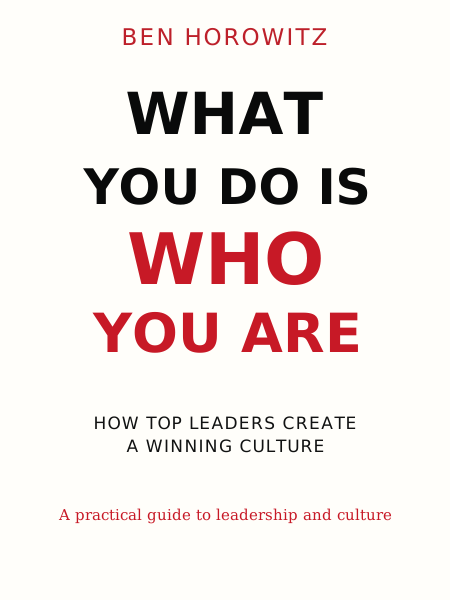
What You Do Is Who You Are
Ben Horowitz · 2019
Editorial rating
- Evidence
- 6/10
- Actionability
- 8/10
- Originality
- 8/10
The thesis
Culture is not what you believe or what you say - it's what you do. It's how your company makes decisions when you're not there, how people behave when no one is watching. Leaders build culture through specific, often counterintuitive actions, not mission statements. The book draws on unlikely sources - a slave revolutionary, samurai warriors, Genghis Khan, and a prison gang leader - to show how culture is forged.
Who this is for
CEOs and founders who sense their culture has drifted from their intentions. Leaders taking over teams with problematic cultures. Anyone who's written core values on a wall and wondered why nothing changed. Executives who need to transform culture during crisis or rapid growth.
My favorite quote
Your culture is how your company makes decisions when you're not there. It's how they behave when no one is looking.
Why it matters
This cuts through aspirational culture talk to the operational reality - culture is revealed in ungoverned moments.
Do this
Identify one decision your team made recently without your input. Does it reflect the culture you want? If not, what signal did you send that led there?
Start here
Create shocking rules - practices so counterintuitive they force people to ask why, embedding the cultural lesson in the question. Toussaint Louverture forbade married officers from having concubines (shocking in that era) to signal that the revolution's army was different. Your rules should be so unusual that people must understand the underlying value to make sense of them.
Critical summary
Ben Horowitz, author of The Hard Thing About Hard Things and co-founder of a16z, tackles the question every leader asks: How do you create and sustain the culture you want? His answer: through actions, not words - and often through actions that seem unusual or extreme.
The book profiles four unlikely cultural architects: Toussaint Louverture (leader of the only successful slave revolution), the samurai (whose bushido code shaped Japan for 700 years), Genghis Khan (who built history's largest empire partly through cultural inclusion), and Shaka Senghor (who transformed prison gang culture from within).
What it gets right
- Actions > words is genuinely practical and measurable
- Historical examples are fresh and illuminating (not the usual business case studies)
- "Shocking rules" concept is immediately actionable
- Honest about culture's limitations - won't save a bad product
- Travis Kalanick/Uber analysis shows how culture fails
What it misses
- Historical accuracy of some examples is debatable (Louverture, Khan)
- Less "raw" and personal than The Hard Thing About Hard Things
- Some readers find historical examples hard to translate to modern contexts
- Culture is described as mostly top-down; less attention to emergent culture
- Limited guidance on changing an existing culture vs. building from scratch
Evidence is primarily historical analysis and Horowitz's experience with portfolio companies. The lessons are derived from observation and pattern-matching rather than formal research.
Key concepts
Culture as Decision-Making
Culture is how employees make decisions when leadership isn't present. Audit ungoverned decisions to assess your actual culture.
Shocking Rules
Counterintuitive practices that force people to ask "why?" embedding the cultural value in the explanation. Create one this week.
Keep What Works
When transforming culture, preserve strengths from the old culture to give people continuity and reduce resistance.
Walk the Talk
Leaders must be the most rigorous practitioners of cultural values, especially when it's costly. Your exceptions become their permissions.
Make Ethics Explicit
Implicit ethical standards are insufficient. Define bright-line rules that can't be crossed.
Object Lessons
Dramatic actions that demonstrate values more powerfully than words. What you do to high performers who violate values is especially visible.
Core insights
-
Virtues must be actionable
"Integrity" means nothing. "We always ship on time even if features are cut" is actionable. Make values specific enough to guide decisions.
-
The most important cultural decisions are the hardest
How you handle a top performer who violates values defines your culture more than any speech. Fire the brilliant jerk.
-
Culture doesn't guarantee success
Great culture won't save a bad product or wrong market. Culture is necessary but not sufficient.
-
Culture must match strategy
A culture built for one strategy can sabotage another. When strategy changes, culture must adapt.
-
Everyone is watching
Leaders are on stage constantly. Your worst moments - not your best - define what's permitted.
Implementation steps
Today
- Write down three decisions your team made recently without you - do they reflect your intended culture?
- Identify one value you espouse but haven't enforced when it was costly
- Think of one "shocking rule" that could encode an important cultural value
This week
- Have a conversation with your team about one cultural value - explain the "why" behind it
- Identify one behavior you've tolerated that contradicts your stated values
- Create one new ritual or practice that reinforces desired culture
This month
- Audit your core values - are they actionable? Would they help someone make a hard decision?
- Address one visible violation of cultural values (even if the person is high-performing)
- Document the "why" behind your culture for onboarding new employees
Ongoing
- Model cultural values visibly, especially when costly
- Tell stories of cultural heroes and cautionary tales
- Refresh culture practices as company evolves - what worked at 20 people may fail at 200
Suggested 30-day practice plan
An editorial application plan created by Monolithic Vault - an interpretation of the book's ideas, not part of the original book.
- Day 1
Read chapters 1-3, note which historical examples resonate with your challenges
- Day 2
Audit current culture by examining recent ungoverned decisions
- Day 3
Draft one "shocking rule" that encodes your most important value
- Day 7
Discuss shocking rule with leadership team, refine and implement
- Day 14
Identify one cultural violation you've tolerated - plan how to address it
- Day 21
Create onboarding content explaining the "why" behind key cultural practices
- Day 30
Assess - have decisions changed? Are people asking different questions?
Free PDF summary
Take this analysis with you: a designed two-page field-notes sheet with the thesis, my favorite quote, the key concepts and core insights, and the full 30-day checklist. Print it or keep it - free, no signup.
Go deeper
If this analysis earned your attention, the full book goes further than any summary can. The original is always the primary source.