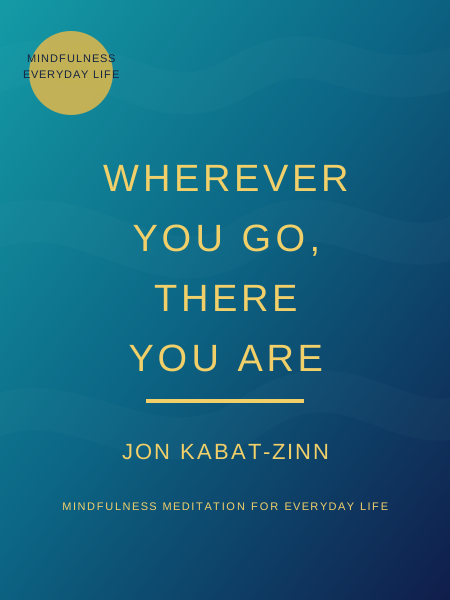
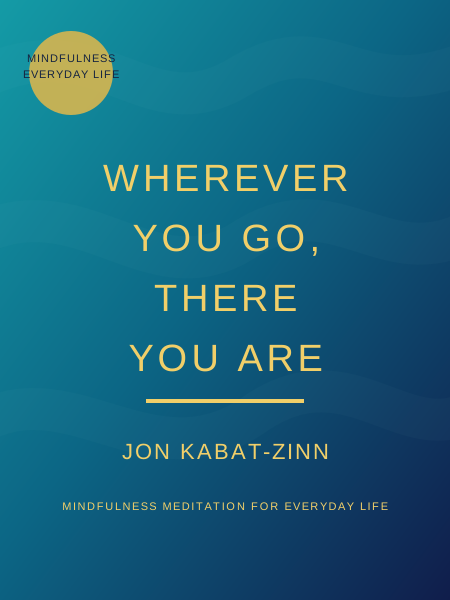
Wherever You Go, There You Are
Jon Kabat-Zinn · 1994
Editorial rating
- Evidence
- 7/10
- Actionability
- 6/10
- Originality
- 5/10
The thesis
Mindfulness isn't about becoming someone different or achieving some future state - it's about being fully present with whatever is happening right now. You can't escape yourself by changing locations or circumstances. The practice is always here, always now.
Who this is for
Stressed professionals seeking a non-religious meditation practice, people new to mindfulness who want scientific credibility, and anyone who needs reminding that presence is available in every moment.
My favorite quote
You can't stop the waves, but you can learn to surf.
Why it matters
Life will always bring challenges. Mindfulness doesn't eliminate difficulties - it changes your relationship to them.
Do this
Next time something goes wrong today, pause and observe: "I'm having the thought that this is a problem." Notice the gap between event and reaction.
Start here
Meditation is not about becoming someone different. It's about realizing where you already are and accepting it fully. Most people come to meditation trying to "fix" themselves, achieve peace, or become enlightened. This is just more striving - the opposite of presence. Instead, try this: For the next 60 seconds, simply be exactly as you are. Don't try to calm your mind, don't chase good feelings. Just be. That's it. That's the practice.
Critical summary
Kabat-Zinn, the founder of Mindfulness-Based Stress Reduction (MBSR) at UMass Medical School, brings Buddhist meditation to secular medicine and Western science. This book, written as a series of short reflective essays, aims to make mindfulness meditation accessible to anyone regardless of religious background.
Core message: Mindfulness = paying attention on purpose, in the present moment, non-judgmentally. It's not about emptying your mind or achieving special states. It's about waking up to your actual life as it unfolds.
What it gets right
- Demystifies meditation - presents it as a natural human capacity, not mystical achievement
- Scientific credibility: Kabat-Zinn's research on MBSR has been validated by decades of peer-reviewed studies
- Emphasis on "non-doing" - being rather than constantly striving
- Accessible to beginners while containing depth for experienced practitioners
- Integration of mindfulness into everyday activities (eating, walking, waiting)
What it misses
- Heavy on philosophy, light on practice: The book tells you ABOUT mindfulness more than HOW to practice it. Compared to Thich Nhat Hanh's "Peace Is Every Step," this feels more abstract.
- Excessive quotation reliance: Kabat-Zinn leans heavily on Thoreau, Whitman, Tao Te Ching, and others. Critics note it feels like filler - quoting other people's wisdom rather than offering his own.
- Thoreau obsession borders on pretentious: Multiple reviewers found the constant Walden references alienating if you're not a 19th-century American literature fan.
- Formal practice requirements are unrealistic: Recommends 45-minute daily sitting meditations. Most people can't sustain this, leading to discouragement.
- Vague on the "How": Walking meditation chapter describes the formal technique (slow, deliberate steps) but doesn't explain how to actually be mindful while walking naturally to your car.
- "Hero's journey" language feels grandiose: Kabat-Zinn describes mindfulness practice as your "personal hero's mythic journey." Some find this inspiring; others find it pretentious.
Evidence quality: Strong. Kabat-Zinn is a legitimate researcher with published studies showing MBSR reduces stress, anxiety, chronic pain, and improves immune function. The book references this research lightly but the science is solid. However, the book itself is primarily philosophical reflection, not a research summary.
Multiple Goodreads reviewers who love mindfulness gave this 2-3 stars, noting they preferred Thich Nhat Hanh's simpler, more practical approach. Common criticism: "More talk about meditation than actual meditation guidance."
Key concepts
Beginner's Mind
Approach each moment as if for the first time, without preconceptions. Your "expertise" often blocks fresh perception.
Non-Striving
Most of life is about achieving, improving, getting somewhere. Meditation is the opposite - being fully where you are without trying to change anything.
Non-Judging
Notice when you label experiences as "good" or "bad." These judgments create suffering. Practice observing without evaluating.
Acceptance
Doesn't mean passivity or resignation. Means seeing clearly what IS before deciding what to do about it.
Letting Go
Not suppression, but releasing your grip on thoughts, emotions, outcomes. Hold experiences lightly.
Trust
Trust your own basic wisdom and intuition. Mindfulness reveals what you already know but have been too busy to hear.
Patience
Things unfold in their own time. Impatience is resistance to the present moment.
Core insights
-
You already are where you're going
Constantly planning the next thing prevents experiencing this thing. Enlightenment isn't elsewhere.
-
The present moment is the only time you're actually alive
Past is memory, future is fantasy. Life happens now.
-
Meditation practice is not self-improvement
It's self-acceptance. You don't meditate to become a better person - you meditate to be who you already are.
-
Formal practice feeds informal practice
Sitting meditation trains the mind. Then you bring that awareness to washing dishes, waiting in line, driving.
-
Mindfulness doesn't require stillness
You can be mindful while moving, talking, working. Presence is available in action, not just on the cushion.
-
Your life IS your practice
You don't need to go on a retreat or join a monastery. Every moment is an opportunity to wake up.
-
Suffering comes from wanting things to be different than they are
Mindfulness is radical acceptance of what is - before deciding how to respond.
Implementation steps
Today
- Do one ordinary activity (brushing teeth, eating lunch) with full attention. Notice every sensation, movement, sound.
- When stress arises, take three conscious breaths before reacting. Just three. That's mindfulness.
This week
- Set a daily reminder: 3x per day, stop whatever you're doing and take three mindful breaths.
- Practice "STOP": Stop, Take a breath, Observe (body, thoughts, emotions), Proceed with awareness.
This month
- Establish a daily sitting practice - even 5 minutes counts. Same time, same place, daily consistency matters more than duration.
- Pick one routine activity (commute, morning coffee, walking dog) and make it your "mindfulness anchor" - always done with full presence.
Ongoing
- Body scan before bed: Lie down, mentally scan from head to toes, noticing sensations without judgment. 10 minutes.
- Mindful eating once per day: One meal without screens, conversation, or distraction. Just food, taste, chewing.
Suggested 30-day practice plan
An editorial application plan created by Monolithic Vault - an interpretation of the book's ideas, not part of the original book.
- Day 1
Read the book. Commit to trying mindfulness as an experiment, not a self-improvement project.
- Day 3
Sit for 5 minutes. Just sit. Watch your breath. When mind wanders, gently return.
- Day 7
Reflection: What patterns do you notice in your mind? Does it future-trip? Past-ruminate? Judge?
- Day 10
Introduce walking meditation: 10 minutes of slow, deliberate walking with full attention to each step.
- Day 14
Midpoint check: Have you been consistent? If not, what gets in the way? (Hint: It's usually "I'm too busy" - which is exactly when you need it most.)
- Day 21
Expand to 15-minute sits. Notice resistance. That's mindfulness - watching yourself not want to sit.
- Day 30
Write down what changed. Subtleties count - maybe you snapped less, noticed beauty more, felt slightly less hijacked by thoughts.
Free PDF summary
Take this analysis with you: a designed two-page field-notes sheet with the thesis, my favorite quote, the key concepts and core insights, and the full 30-day checklist. Print it or keep it - free, no signup.
Go deeper
If this analysis earned your attention, the full book goes further than any summary can. The original is always the primary source.