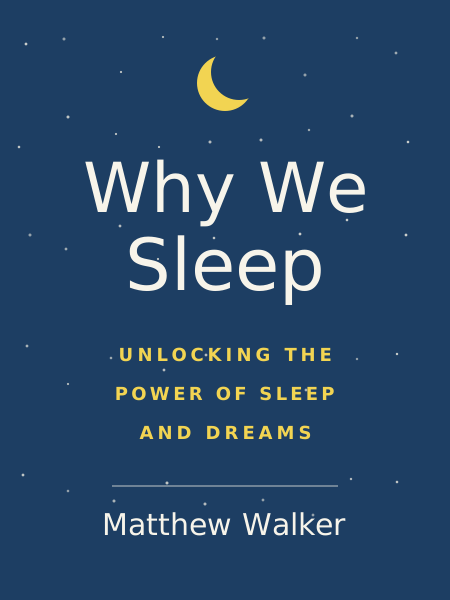
Why We Sleep
Matthew Walker · 2017
Editorial rating
- Evidence
- 5/10
- Actionability
- 8/10
- Originality
- 6/10
The thesis
Sleep is non-negotiable for health. Chronic sleep deprivation (< 7 hours) causes cognitive decline, weakens immune system, increases dementia/cancer/heart disease risk, and shortens lifespan. Modern society has a sleep epidemic. Solution: prioritize 8 hours nightly.
Who this is for
People who sleep <7 hours regularly, anyone convinced they "don't need that much sleep," shift workers, parents of teenagers, and executives who brag about 4-hour nights.
My favorite quote
The shorter your sleep, the shorter your life.
Why it matters
This encapsulates Walker's central warning - sleep deprivation isn't badge of honor, it's slow suicide.
Do this
Track sleep for 7 days. If averaging <7 hours, add 30 minutes by setting earlier bedtime. Repeat until hitting 7-8 hours.
Start here
Sleep 7-9 hours. Period. Walker argues anything less causes cumulative damage that recovery sleep can't fix. The book's biggest strength: motivating people to take sleep seriously. The biggest weakness: wildly exaggerated claims, cherry-picked studies, and factual errors exposed by critics. The core message (sleep more) is sound, but Walker overstates the evidence to create alarm. Treat this as motivational wake-up call, not gospel truth.
Critical summary
Walker, a UC Berkeley neuroscience professor, wrote a bestselling polemic that sleep deprivation is killing us. The book became cultural phenomenon - Bill Gates called it one of his favorite books, TED talk has millions of views, Walker became Google's sleep scientist. The problem: multiple researchers (most notably Alexey Guzey) documented serious factual errors, misrepresented studies, and cherry-picked evidence.
Walker presents sleep as non-negotiable: < 7 hours = cognitive impairment, cancer, dementia, diabetes, obesity. He claims WHO declared "sleep loss epidemic" (they didn't), that one week of 6-hour nights causes brain damage (study doesn't show this), that sleep deprivation causes death (no documented human cases). Even sympathetic critics note he removed data from graphs to support claims (possible research misconduct).
What it gets right
- Sleep is important (uncontroversial)
- Modern society undervalues sleep (true)
- Sleep deprivation impairs cognition, mood, performance (well-established)
- REM sleep critical for memory consolidation, learning (solid science)
- Chronic sleep restriction has health consequences (generally supported)
- 12 tips for better sleep (practical, evidence-based)
CRITICAL PROBLEMS - MAJOR FRAUD CONCERNS
- Factual errors: "200% reduction" appears multiple times (impossible). WHO never declared sleep epidemic. Misrepresented sleep deprivation therapy (it actually helps some depression patients, contradicts his thesis).
- Cherry-picking: Presents studies supporting plant-based narrative while ignoring contradictory evidence. Removed bars from graphs to make data look more supportive.
- Exaggerated claims: "The shorter your sleep, the shorter your life" ignores that long sleep (>9 hours) also correlates with mortality (U-shaped curve). Correlation ≠ causation - sick people sleep more/less, doesn't mean sleep caused illness.
- Alarmism causes harm: Sleep coach Martin Reed reports patients who slept fine on 6-7 hours developed insomnia after reading Walker's book due to anxiety about not hitting 8 hours. The book creates sleep anxiety that worsens sleep.
- Misrepresented evidence: Andrew Gelman (Columbia statistician) called Walker's data manipulation "research misconduct." UC Berkeley investigated, found "minor errors" but no misconduct (many disagree with this conclusion).
- Depression misrepresentation: Walker claims sleep deprivation makes depression worse. Large literature shows sleep deprivation therapy helps 30-40% of depression patients. He acknowledges this in Chapter 7 but contradicts himself earlier.
Evidence quality: Highly questionable. Walker is UC Berkeley professor with legitimate research background, but this book is advocacy, not science. The exaggerations, omissions, and errors undermine credibility. Core insights about sleep importance are sound, but don't trust specific claims without verification.
Key concepts
7-9 hours non-negotiable
Anything less causes damage Walker claims is irreversible (critics dispute irreversibility).
REM vs. Deep Sleep
REM (dreaming) for memory, creativity. Deep sleep (slow-wave) for physical restoration, immune function.
Sleep Debt
Can't "catch up" on weekends. Chronic restriction causes cumulative damage (this claim is disputed - some recovery is possible).
Circadian Rhythm
Internal 24-hour clock. Disruption (shift work, jet lag) increases disease risk.
Adenosine
Chemical that builds during waking, creating sleep pressure. Caffeine blocks adenosine receptors (doesn't remove it).
Blue Light
Screens suppress melatonin, delay sleep. Use blue-light filters or avoid screens 1-2 hours before bed.
Core insights
-
Sleep is more important than diet or exercise
Walker claims (critics say this is overstatement - all three matter).
-
6 hours for 10 nights = cognitive impairment
Volunteers showed brain damage equivalent to pulling all-nighter (critics question "brain damage" interpretation).
-
Naps are beneficial
20-minute naps boost performance without grogginess. 90-minute naps include full sleep cycle.
-
Alcohol destroys sleep quality
Even though it makes you fall asleep faster, it suppresses REM and fragments sleep.
-
Sleeping pills don't produce real sleep
They sedate but don't deliver restorative sleep architecture.
-
Teenagers need more sleep
Biological shift delays circadian rhythm. Early school start times are harmful (this is well-supported).
-
If you need alarm clock, you're not getting enough sleep
Truly rested people wake naturally (critics say this is simplistic - some people have irregular schedules).
Implementation steps
Today
- Set consistent sleep/wake time (even weekends). Circadian rhythm thrives on consistency.
- Calculate bedtime: if waking at 6am, need to be in bed by 10pm for 8 hours.
This week
- Remove screens 1 hour before bed. Use blue-light filters if necessary.
- Make bedroom cool (65-68°F / 18-20°C). Warm rooms disrupt sleep.
This month
- Cut caffeine after 2pm. Adenosine continues building even though caffeine blocks receptors.
- Exercise regularly but not within 3 hours of bedtime
Ongoing
- Track sleep (Apple Watch, Oura Ring, etc.). Are you actually getting 7+ hours?
- Prioritize sleep over work/entertainment. This is countercultural but necessary.
- If chronic insomnia, see sleep specialist. Don't self-treat with pills or alcohol.
Suggested 30-day practice plan
An editorial application plan created by Monolithic Vault - an interpretation of the book's ideas, not part of the original book.
- Day 1
Track baseline - how many hours are you sleeping currently?
- Day 3
Set consistent bedtime. Calculate 8 hours before wake time.
- Day 7
Remove screens from bedroom. Use alarm clock, not phone.
- Day 10
Install blackout curtains or use eye mask. Complete darkness helps melatonin.
- Day 14
Cut caffeine after 2pm. Monitor if sleep improves.
- Day 21
Review sleep tracking - are you hitting 7+ hours? If not, move bedtime earlier.
- Day 30
Assess improvements - better mood? Energy? Cognitive function?
Free PDF summary
Take this analysis with you: a designed two-page field-notes sheet with the thesis, my favorite quote, the key concepts and core insights, and the full 30-day checklist. Print it or keep it - free, no signup.
Go deeper
If this analysis earned your attention, the full book goes further than any summary can. The original is always the primary source.