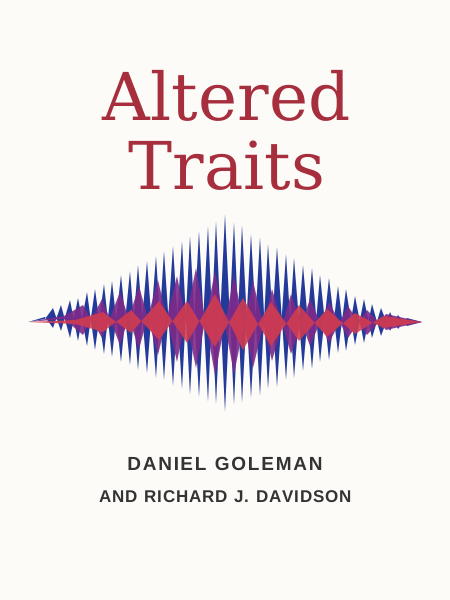

Altered Traits
Daniel Goleman & Richard J. Davidson · 2017
Editorial rating
- Evidence
- 8/10
- Actionability
- 5/10
- Originality
- 7/10
The thesis
Beyond the pleasant states meditation produces, the real payoffs are lasting personality traits - permanent changes to brain function, behavior, and well-being that persist outside meditation sessions. The distinction between temporary "altered states" and permanent "altered traits" is everything.
Who this is for
Skeptics wanting evidence-based claims about meditation, practitioners curious about the neuroscience behind their practice, and anyone tired of meditation hype wanting to know what actually works. Not for those seeking a practical how-to guide.
My favorite quote
The after is the before for the next during.
Why it matters
This captures the core insight: you're not chasing temporary calm during sessions - you're building a new baseline state that becomes your starting point for the next session.
Do this
After your next meditation, notice your state 2 hours later. That "after" is what you're actually training.
Start here
The Dose-Response Curve determines everything: Beginner (<1,000 hours), Long-term (1,000-10,000 hours), World-class (12,000-62,000 hours). Benefits are real but slow - not the 10 minutes daily that apps promise. Know where you stand on the curve and adjust expectations accordingly. 30 hours of MBSR produces measurable stress reduction; 7 hours of loving-kindness increases actual helping behavior.
Critical summary
Goleman and Davidson reviewed 6,000+ scientific studies on meditation and selected only 60 that met rigorous methodological standards - a tacit admission that most meditation research is garbage (small samples, poor controls, publication bias toward positive findings).
The core framework distinguishes the "deep path" (intensive, lifelong practice aimed at total self-transformation) from the "wide path" (secular adaptations like MBSR that reach more people but produce shallower effects). Both authors are lifelong meditators reviewing primarily their own lab's work, which raises objectivity questions.
What it gets right
- Ruthless honesty about weak methodology plaguing meditation research
- Clear evidence thresholds: 30 hours MBSR for stress reduction, 7 hours loving-kindness for compassion behavior
- Fascinating data on advanced practitioners showing genuinely different brains at rest - 700-800% increases in EEG empathy signatures
What it misses
- Author bias: lifelong meditators reviewing their own research
- Neglected downsides: meditation can trigger anxiety, depression, and dissociation in some - barely addressed
- Heavy on methodology, light on application - reads like a research report
- Replicability crisis: many cited studies haven't been replicated
- Expectation effects: early benefits might partly stem from participant hopes
Evidence quality is high for neuroscience findings but the practical "how" is largely absent. This is the science behind meditation, not instruction for practice.
Key concepts
Altered Traits
Lasting changes to brain function and behavior persisting outside meditation. Set this as your actual goal - not just feeling calm during practice.
Altered States
Temporary experiences during meditation sessions. Recognize these as pleasant but insufficient for lasting change.
Dose-Response Curve
Benefits scale with hours - <1K beginner, 1-10K long-term, 12-62K elite. Track your hours; know where you stand.
Default Mode Network
Brain circuitry active during mind-wandering and self-referential thought. Progressively quiets with long-term practice.
Deep Path vs. Wide Path
Intensive traditional practice (deep) vs. secular mass adaptations (wide). Decide which you're pursuing; adjust expectations.
Gamma Waves
High-frequency brain waves associated with heightened awareness. Dramatically elevated in advanced practitioners at rest.
Core insights
-
Most meditation research is methodologically weak
Of 6,000+ studies reviewed, only 60 met rigorous standards. Be skeptical of bold claims from apps and influencers.
-
States ≠ Traits
Feeling calm during meditation isn't the goal - permanent changes to your baseline neural function are. The "after" becomes the "before."
-
Hours matter, but so does practice quality
Short daily sessions won't reach deep transformation without retreats and quality instruction. "Smart practice" beats raw hours.
-
Different meditations train different skills
Loving-kindness builds compassion; focused attention improves concentration; open awareness reduces default-mode activity. Choose based on goals.
-
Retreats accelerate progress disproportionately
Number of retreats correlated more strongly with certain altered traits than total hours alone. Intensity matters.
Implementation steps
Today
- Create a meditation hour log (spreadsheet or note). Record date, duration, type after each session.
- Choose one meditation type and commit: MBSR-style mindfulness, loving-kindness, focused attention, or open awareness. Stick with it for 8 weeks.
This week
- Establish minimum viable practice: 10 minutes daily, same time, same place. Attach to existing habit.
- Research MBSR courses (Palouse Mindfulness, UMass Center for Mindfulness) and enroll within 2 weeks.
This month
- Schedule and complete a half-day sit (4-8 hours). Plan structure: sitting periods, walking meditation, meals.
- Research local meditation teachers with established lineages. Schedule initial meeting.
Ongoing
- Reach 100-hour milestone (6-12 months depending on daily commitment)
- Book a multi-day retreat within 6 months - research shows intensity correlates with trait development more than equivalent hours of daily sitting
Suggested 30-day practice plan
An editorial application plan created by Monolithic Vault - an interpretation of the book's ideas, not part of the original book.
- Day 1
Create meditation log; choose one technique type; practice 10 minutes
- Day 2
Practice 10 minutes; research MBSR courses
- Day 3
Practice 10 minutes; enroll in 8-week MBSR program
- Day 7
Review first week - 5+ sessions logged? Technique chosen? Course enrolled?
- Day 14
Increase to 15 minutes daily; contact one qualified teacher for instruction
- Day 21
Complete half-day sit (4-8 hours); start stress-recovery tracking
- Day 30
Calculate total hours; project 100-hour milestone date; book retreat deposit
Free PDF summary
Take this analysis with you: a designed two-page field-notes sheet with the thesis, my favorite quote, the key concepts and core insights, and the full 30-day checklist. Print it or keep it - free, no signup.
Go deeper
If this analysis earned your attention, the full book goes further than any summary can. The original is always the primary source.