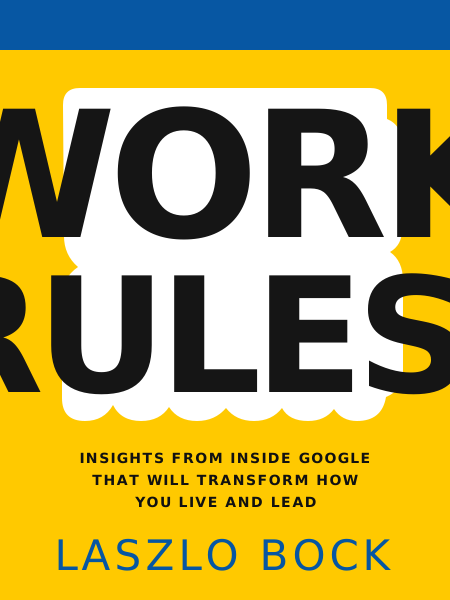
Work Rules!
Laszlo Bock · 2015
Editorial rating
- Evidence
- 8/10
- Actionability
- 7/10
- Originality
- 7/10
The thesis
Work doesn't have to be demotivating and dehumanizing. By giving people freedom, using data over intuition, and treating employees like owners rather than resources, companies can attract exceptional talent and achieve exceptional results. Google's "People Operations" approach - essentially HR reinvented through behavioral science - demonstrates that what seems expensive (transparency, autonomy, generous benefits) is actually the path to competitive advantage.
Who this is for
HR leaders seeking to move beyond compliance to strategic impact, executives questioning traditional management approaches, startup founders building culture from scratch, and anyone who manages people and suspects there's a better way than command-and-control hierarchy.
My favorite quote
If you give people freedom, they will amaze you.
Why it matters
This captures Bock's philosophy: most management is about control because managers fear what people will do with autonomy. But freedom - thoughtfully designed - produces better outcomes than constraint.
Do this
Identify one area where you're managing through control. Experiment with giving your team more autonomy and observe what happens.
Start here
Hire only people who are better than you in some meaningful way. Raise your hiring bar above average - every hire should improve your team's average. This requires patience (Google interviews extensively and turns away most candidates) but creates compounding returns: great people attract great people, and a team of A-players doesn't need micromanagement.
Critical summary
Bock led Google's People Operations for over a decade, during which the company won "Best Place to Work" awards over 100 times. This book explains the philosophy and tactics behind that success - written accessibly enough for any manager, with enough rigor to satisfy HR professionals.
The core insight: Google treats people management as a science. They run controlled experiments, measure outcomes, and iterate. When intuition conflicts with data, data wins. This approach led to counterintuitive findings: interviews beyond four are wasteful, GPAs don't predict performance, and "pay unfairly" (top performers get disproportionate rewards) is more equitable than equal pay.
What it gets right
- Data-driven HR is genuinely different - testing hypotheses rather than following best practices
- The "hiring better than yourself" principle is actionable and transformative
- Specific tactics are shared with unusual transparency (interview questions, evaluation criteria, feedback structures)
- Addresses the "one size fits all" problem - acknowledges that context matters
- Project Oxygen (manager effectiveness research) led to actionable, specific coaching
What it misses or overstates
- Google-specific context: a company that attracts two million applicants annually can be pickier than most
- Many practices require scale or resources that smaller companies lack
- The book starts slowly with self-congratulation and name-dropping before delivering substance
- Some critics find it reads like a marketing document for Google
- Limited discussion of failures or practices that didn't work
- "High-freedom" works best with high-talent populations; less clear how it scales to average performers
The book is part Google recruitment marketing, part genuine management innovation. Extract the principles; adapt the practices to your context.
Key concepts
Hire Only the Best
Never compromise on hiring standards. A mediocre hire is worse than no hire. Four interviews are enough - more doesn't improve prediction.
Give People Freedom
Default to trust and transparency. Managers who share information and grant autonomy get better results than those who hoard and control.
Use Data, Not Intuition
Test HR practices like product features. Measure outcomes. Kill practices that don't work, even popular ones.
Pay Unfairly
Top performers deliver exponentially more value. Pay them exponentially more. Equal pay for unequal contribution is actually unfair.
Nudge, Don't Mandate
Design environments that make good choices easy. Healthier food at eye level beats banning junk food.
Project Oxygen
Google's research identifying eight behaviors of effective managers. Used for training and feedback, not screening.
Core insights
-
Hiring is the most important thing you do
A great hire raises everyone's game; a bad hire costs exponentially more than their salary. Invest accordingly.
-
Remove the power from managers
At Google, managers can't unilaterally hire, fire, or rate their own team. This prevents cronyism and reduces bias.
-
Transparency is cheaper than you think
Sharing information (including salary data, company strategy, and problems) builds trust faster than any team-building exercise.
-
Most benefits are free or cheap
Flexibility, transparency, and treating people with respect cost nothing but generate enormous return on employee engagement.
-
The best training is peer-to-peer
Google has top performers teach classes. It's more effective than outside experts and develops leadership simultaneously.
Implementation steps
Today
- Define "better than me in some meaningful way" for your next hire
- Identify one piece of information you're hoarding that you could share with your team
This week
- Audit your hiring process: how many interviews? What do you actually measure?
- Pick one management practice and design an experiment to test its effectiveness
This month
- Implement structured interviewing: same questions for all candidates, rubric-based scoring
- Survey your team anonymously on what they wish you did differently as a manager
Ongoing
- Before any HR policy, ask: "What data would tell us this works?"
- Default to freedom; add control only when necessary and with evidence
- Treat every hire as the most important decision you'll make that quarter
Suggested 30-day practice plan
An editorial application plan created by Monolithic Vault - an interpretation of the book's ideas, not part of the original book.
- Day 1
Read Part 1 (Culture and Hiring); audit your current hiring standards
- Day 2
List the attributes that predict success in your context (not generic "smart")
- Day 3
Review recent hires: did they meet your bar? Would you hire them again?
- Day 7
Design structured interview questions aligned with success attributes
- Day 14
Share one piece of information with your team you previously kept private; observe reaction
- Day 21
Run a mini-experiment on one management practice; measure before/after
- Day 30
Review: what's one Google practice you can adapt? What won't work in your context?
Free PDF summary
Take this analysis with you: a designed two-page field-notes sheet with the thesis, my favorite quote, the key concepts and core insights, and the full 30-day checklist. Print it or keep it - free, no signup.
Go deeper
If this analysis earned your attention, the full book goes further than any summary can. The original is always the primary source.