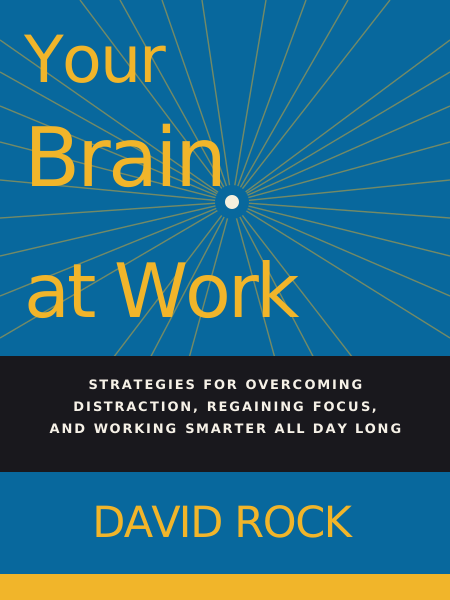
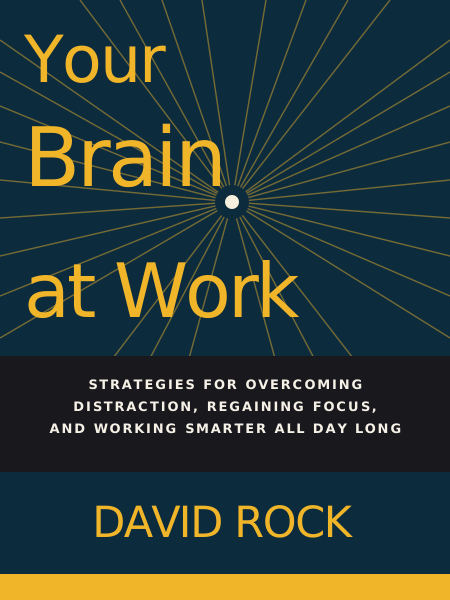
Your Brain at Work
David Rock · 2009
Editorial rating
- Evidence
- 7/10
- Actionability
- 8/10
- Originality
- 7/10
The thesis
Your brain is not a computer - it's a biological organ with specific limitations. Thinking consumes enormous energy, multitasking is a myth, and social threats trigger the same response as physical danger. Work with your brain's constraints, not against them.
Who this is for
Knowledge workers who feel mentally exhausted by day's end, managers who want to give feedback without triggering defensive reactions, and anyone whose job requires sustained focus in a distracting environment.
My favorite quote
No matter how much effort you put in, you can't sit there and make brilliant decisions all day the way a truck driver can stay on the road.
Why it matters
This reframes productivity as resource management rather than willpower. Your brain has a daily budget - spend it wisely.
Do this
Identify your most cognitively demanding task tomorrow and schedule it for your first 90 minutes of work, before email.
Start here
Protect your prefrontal cortex by doing your most important thinking when your brain is freshest (usually morning), eliminating distractions completely during focus work, and externalizing information (write it down rather than holding it in mind). Your brain's capacity for conscious thought is far more limited than you realize.
Critical summary
Rock, a leadership consultant who coined the term "NeuroLeadership," applies neuroscience findings to workplace challenges. The book follows fictional characters Emily and Paul through a typical workday, illustrating how brain science explains common productivity failures.
What it gets right
- Practical applications of neuroscience research for daily work life
- SCARF model (Status, Certainty, Autonomy, Relatedness, Fairness) for understanding social threats is genuinely useful
- Story format makes abstract brain science accessible
- Reframing feedback as threat management changes how you approach difficult conversations
What it misses
- Some claims may oversimplify complex neuroscience
- Emily and Paul's story can feel contrived
- Neuroleadership critics argue the science-to-practice bridge is sometimes shaky
- Written in 2009; some research may have been updated or nuanced since
Evidence quality is mixed - Rock cites real research but sometimes extrapolates broadly. Still, the core insights about cognitive limits, social threats, and attention management remain practically useful. For knowledge workers, this is one of the more accessible bridges between brain science and daily work.
Key concepts
The Stage
A metaphor for conscious attention - your mental "stage" can only hold a few actors (ideas) at once. Most thinking happens offstage.
Prefrontal Cortex Limitations
Complex thinking drains energy rapidly. Schedule demanding cognitive work for peak energy times.
SCARF Model
Five domains of social experience that trigger threat or reward responses - Status, Certainty, Autonomy, Relatedness, Fairness.
Toward and Away States
Positive emotions pull you "toward" engagement; negative emotions push you "away." Threat states impair complex thinking.
Reappraisal
Consciously reframing a situation to change its emotional impact. More effective than suppression.
Labeling
Naming an emotion ("I'm feeling anxious") reduces its intensity by engaging the prefrontal cortex.
Core insights
-
Thinking is expensive
Complex cognitive work uses more energy than almost any other brain activity. Plan your thinking like a budget.
-
Multitasking doesn't work
Task-switching costs 10+ IQ points and leaves you exhausted. Do one thing at a time.
-
Social pain is physical pain
Being excluded, criticized, or treated unfairly activates the same brain regions as physical injury.
-
Certainty is addictive
The brain craves predictability. Uncertainty - even about minor things - creates stress that impairs performance.
-
Self-awareness is a superpower
Simply noticing your mental state creates distance from it, allowing better regulation.
Implementation steps
Today
- Schedule tomorrow's hardest thinking for your first 90 minutes; protect that block from meetings and email
- When stressed, label the emotion: "I'm feeling X." Notice if intensity decreases
This week
- Track your energy: note when you feel sharpest and when drained. Align task types accordingly
- Practice reappraisal: when something frustrates you, find an alternative interpretation
This month
- Apply SCARF to feedback: before giving feedback, consider how it might threaten Status, Certainty, or Fairness - and frame to minimize threat
- Build breaks into demanding cognitive work (every 52-90 minutes)
Ongoing
- Default to externalizing: write things down rather than holding them in working memory
- Treat focus time as non-negotiable; schedule it and defend it
Suggested 30-day practice plan
An editorial application plan created by Monolithic Vault - an interpretation of the book's ideas, not part of the original book.
- Day 1
Track energy levels at 9am, 12pm, 3pm, 6pm; identify peak and trough
- Day 2
Schedule hardest task for peak energy; compare output to normal
- Day 3
Practice labeling emotions three times; note effects
- Day 7
Review week - when did you violate brain constraints? Plan adjustments
- Day 14
Apply SCARF to one feedback conversation; frame to reduce threat
- Day 21
Implement 90-minute focus blocks with breaks; compare to previous work pattern
- Day 30
Document your brain's patterns; create personal "user's guide"
Free PDF summary
Take this analysis with you: a designed two-page field-notes sheet with the thesis, my favorite quote, the key concepts and core insights, and the full 30-day checklist. Print it or keep it - free, no signup.
Go deeper
If this analysis earned your attention, the full book goes further than any summary can. The original is always the primary source.