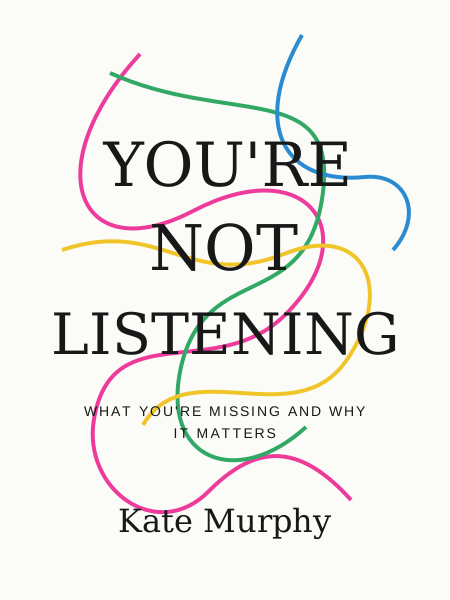
You're Not Listening
Kate Murphy · 2020
Editorial rating
- Evidence
- 6/10
- Actionability
- 6/10
- Originality
- 7/10
The thesis
We've forgotten how to listen - and the cost is loneliness, misunderstanding, and shallow relationships. True listening isn't passive reception but active curiosity that requires silencing our inner narrator long enough to genuinely absorb what someone else is saying.
Who this is for
Professionals who realize conversations often go nowhere despite talking a lot, managers who want to understand what their teams aren't saying, and anyone who suspects they're better at talking than listening and wants to fix it.
My favorite quote
Listening is not about what you hear, but what you understand.
Why it matters
This cuts through the illusion that being present equals listening. You can hear every word and still miss the meaning entirely.
Do this
In your next important conversation, after the other person finishes, summarize what you understood in one sentence before responding.
Start here
Give support responses, not shift responses. When someone tells you about their trip to a gallery, resist redirecting to your gallery visit. Instead, lay more track for their story: "Which gallery? What exhibition? What struck you most?" The goal is making them feel heard, not making yourself interesting.
Critical summary
Murphy, a New York Times contributor, argues that we've become terrible listeners in an age of constant distraction and self-promotion. The book reads like extended journalism - interviews with CIA interrogators, focus group moderators, bartenders, and priests weave together research on what listening actually is and why we've lost it.
The central diagnostic is the shift-versus-support response distinction. Shift responses redirect attention to yourself ("That reminds me of when I..."). Support responses encourage elaboration ("What was that like?"). Most of us default to shifting without realizing it.
What it gets right
- The observation that even close relationships suffer from a "closeness communication bias" - we assume we understand loved ones better than we actually do
- CIA interrogator insight: genuine curiosity, not technique, extracts information
- "Negative capability" concept from Keats - the ability to hold uncertainty and contradictory ideas without reaching for resolution
What it misses
- The book has a narrow neurotypical focus. People with ADHD or autism may listen differently (looking away to focus, for instance) without listening poorly
- Some advice approaches platitude ("be curious," "be present")
- Structure is loose - more essay collection than systematic framework
- Light on concrete techniques; heavy on "why you should care"
Evidence draws from interviews, psychological research, and the author's journalism experience, though sources are often unnamed or generalized.
Key concepts
Shift vs. Support Responses
Shifting redirects to you; supporting encourages their story to continue. Default to support.
Closeness Communication Bias
We understand spouses, close friends, and longtime colleagues less accurately than we assume. Familiarity breeds presumption.
Negative Capability
The ability to sit with ambiguity, contradiction, and uncertainty without forcing premature resolution. Let confusion exist.
The Field Hospital Effect
People are desperate to be heard - confession lines are long because listening is that rare.
Conversational Narcissism
The tendency to steer every exchange back to ourselves. We do it unconsciously and constantly.
Improvisational Listening
Approaching conversation like improv - "yes, and" rather than "no, but." Building on what others offer.
Core insights
-
Listening is the foundation, not the filler
We treat speaking as the action and listening as the waiting. It's backward - listening creates the space where connection happens.
-
Curiosity is the master skill
The CIA interrogator's secret weapon wasn't technique - it was genuine interest in the person across the table.
-
We overestimate how well we know people
After years together, couples often understand each other's preferences less accurately than strangers would with fresh curiosity.
-
Silence is productive
The urge to fill pauses robs conversations of depth. Let quiet exist; people often share more when given space.
-
Distractions aren't neutral
Every phone check, every internal monologue, signals that something else matters more. People feel it.
-
Good listeners don't prepare responses
When you're formulating your next point, you've stopped listening. Trust that you'll have something to say.
Implementation steps
Today
- Notice when you give a shift response vs. a support response. Just observe.
- Put your phone completely out of sight in one conversation.
This week
- Ask three follow-up questions in a row before sharing anything about yourself
- Practice sitting with 5 seconds of silence before responding
This month
- Identify one relationship where you've stopped being curious. Approach them as if meeting for the first time.
- Track how often you mention yourself in conversations - reduce by 30%
Ongoing
- Build the habit of asking "What was that like?" rather than jumping to advice
- After important conversations, reflect: "What did they actually say?"
Suggested 30-day practice plan
An editorial application plan created by Monolithic Vault - an interpretation of the book's ideas, not part of the original book.
- Day 1
Track shift vs. support responses for one day - just notice the ratio
- Day 2
Give only support responses in one full conversation
- Day 3
Put your phone in another room during dinner or a meeting
- Day 7
Approach a familiar person with genuine curiosity - ask something you've never asked
- Day 14
Practice sitting with silence - count to five before responding
- Day 21
Review a week of conversations - when did you shift? When did you support?
- Day 30
Ask someone you're close to: "Do you feel like I listen to you?" Accept the answer without defending.
Free PDF summary
Take this analysis with you: a designed two-page field-notes sheet with the thesis, my favorite quote, the key concepts and core insights, and the full 30-day checklist. Print it or keep it - free, no signup.
Go deeper
If this analysis earned your attention, the full book goes further than any summary can. The original is always the primary source.