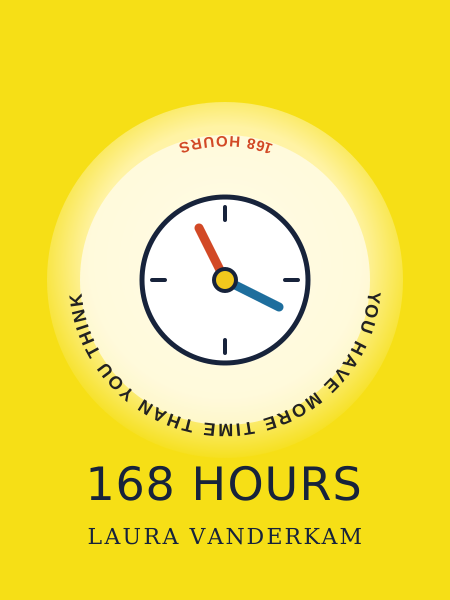
168 Hours
Laura Vanderkam · 2010
Editorial rating
- Evidence
- 6/10
- Actionability
- 8/10
- Originality
- 7/10
The thesis
Time scarcity is often a measurement problem before it is a scheduling problem. Plan across a full week, protect what matters, and stop treating every low-value obligation as fixed.
Who this is for
Professionals balancing demanding work, family, exercise, and neglected personal goals, especially those whose days feel packed but who have never tracked an entire week.
My favorite quote
You can choose how to spend your 168 hours, and you have more time than you think.
Why it matters
The line replaces vague busyness with ownership over a finite weekly budget.
Do this
Reserve one hour this week for something you repeatedly claim you lack time to do.
Start here
Track one normal week in half-hour blocks before changing anything. Memory exaggerates exhausting moments and overlooks recoverable gaps, so a time log gives you facts instead of a story about being busy. Then move hours toward work, relationships, health, and interests that only you can meaningfully perform.
Critical summary
Laura Vanderkam built 168 Hours around a simple shift in scale: stop treating each day as an isolated container and examine the full 168-hour week. A difficult Tuesday can coexist with a spacious Saturday, and weekly planning creates room that daily perfectionism hides. Her central exercise is a complete time log, followed by identifying core competencies at work and at home. These are activities where your strengths, responsibilities, and values overlap. Everything else should be minimized, ignored, simplified, or outsourced where practical. The List of 100 Dreams broadens the method beyond efficiency by forcing readers to name experiences and ambitions worth making time for.
What it gets right
- Replaces unreliable impressions of busyness with a concrete weekly record
- Treats meaningful work, exercise, relationships, and leisure as calendar commitments rather than leftovers
- Shows that reducing low-value standards can create more life than optimizing every task
What it overstates or misses
- Outsourcing laundry, cleaning, and errands assumes money, local services, and control that many readers do not have
- Core competencies can become a flattering excuse to avoid ordinary obligations that still need shared ownership
- The examples lean toward educated professionals with flexible schedules and underplay shift work, illness, and caregiving constraints
The evidence is mainly time-use statistics, interviews, and illustrative schedules rather than controlled research. That is enough to challenge distorted perceptions, but not enough to prove that most people can rearrange life as freely as the strongest examples suggest. The weekly frame remains valuable because it exposes tradeoffs without requiring a complicated productivity system. The book is less convincing when it turns structural constraints into personal choices, yet unusually effective when it asks one blunt question: where did the hours actually go? The verdict: use the time log and weekly frame, but ignore any advice that confuses privilege with discipline.
Key concepts
The 168-Hour Frame
Evaluate time across an entire week so uneven days can balance each other instead of demanding the same routine every day.
Time Log
Record activities in half-hour blocks for seven days to compare perceived busyness with actual allocation.
Core Competencies
Identify work and life activities that use your strengths and cannot be meaningfully delegated, then protect them first.
List of 100 Dreams
Write one hundred experiences, projects, and ambitions to reveal what deserves space beyond immediate obligations.
Minimize, Ignore, or Outsource
Reduce time spent on low-value tasks through lower standards, elimination, automation, delegation, or paid help where feasible.
Core insights
-
Weeks Are More Flexible Than Days
A missed workout on Monday matters less when three realistic exercise windows exist elsewhere in the week.
-
Busyness Is Often a Story
Track before optimizing because stressful fragments are more memorable than quiet gaps and routine leisure.
-
Priorities Need Appointments
Anything important but unscheduled will repeatedly lose to urgent requests and convenient entertainment.
-
Good Enough Creates Capacity
Lowering standards on low-stakes chores can protect time for relationships, health, and demanding creative work.
-
Leisure Should Be Chosen
Intentional recreation restores energy better than defaulting to whatever screen happens to be available.
Implementation steps
Today
- Download or draw a seven-day grid divided into half-hour blocks.
- Add one neglected personal priority to next week's calendar before filling optional commitments.
This week
- Track every hour for seven consecutive days without trying to make the record look productive.
- Write twenty-five items toward a List of 100 Dreams, including several that require less than one hour.
This month
- Review the time log and reclaim three weekly hours by deleting, simplifying, batching, or delegating low-value activities.
- Define three core competencies across work, relationships, and personal well-being and schedule recurring time for each.
Ongoing
- Plan the coming week before it begins, placing priorities before minor tasks and optional meetings.
- Repeat a full time audit twice a year to catch drift between stated values and actual hours.
Suggested 30-day practice plan
An editorial application plan created by Monolithic Vault - an interpretation of the book's ideas, not part of the original book.
- Day 1
Start a seven-day time log and record activities in half-hour blocks.
- Day 3
Mark the activities that create energy, meaning, income, or irreplaceable connection.
- Day 7
Total the week by category and identify the three largest avoidable drains.
- Day 14
Test one simplification, cancellation, automation, or delegation and measure the time recovered.
- Day 21
Schedule one work goal, one relationship goal, and one personal goal into the next seven days.
- Day 30
Build a reusable weekly template that protects core competencies while leaving several hours deliberately unassigned.
Free PDF summary
Take this analysis with you: a designed two-page field-notes sheet with the thesis, my favorite quote, the key concepts and core insights, and the full 30-day checklist. Print it or keep it - free, no signup.
Go deeper
If this analysis earned your attention, the full book goes further than any summary can. The original is always the primary source.