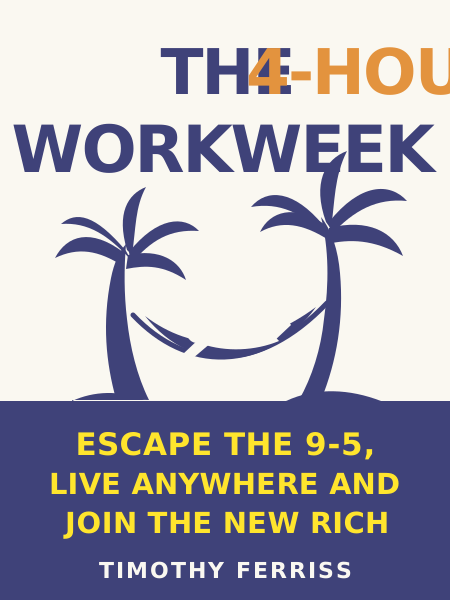
The 4-Hour Workweek
Tim Ferriss · 2007
Editorial rating
- Evidence
- 4/10
- Actionability
- 7/10
- Originality
- 8/10
The thesis
Traditional career paths are a trap - you don't need to defer life until retirement. By ruthlessly eliminating time-wasters, automating income streams, and outsourcing low-value tasks, you can design a lifestyle of freedom and mobility now, not in 40 years.
Who this is for
Employees burned out by corporate culture who dream of location independence, aspiring entrepreneurs seeking passive income models, and anyone questioning the "work hard for 40 years, then retire" script - but who have the privilege of existing skills, savings, or entrepreneurial runway.
My favorite quote
The fishing is best where the fewest go, and the collective insecurity of the world makes it easy for people to hit home runs while everyone else is aiming for base hits.
Why it matters
Most people compete for "realistic" goals, making them paradoxically harder. Ambitious goals often have less competition.
Do this
Identify one goal you've dismissed as "too ambitious" and research what it would actually take - you may find fewer barriers than expected.
Start here
Apply the 80/20 Principle ruthlessly to your work: identify the 20% of activities producing 80% of your results and eliminate or delegate the rest. Combine this with Parkinson's Law - work expands to fill available time - by imposing artificial deadlines that force focus. Most people can compress a 40-hour week into 8-12 hours of actual productive work.
Critical summary
Ferriss built a supplements company (BrainQUICKEN), burned out working 14-hour days, then restructured his business to run on minimal input while traveling the world. The book codifies his escape into the DEAL framework: Define goals, Eliminate distractions, Automate income, and Liberate yourself from location.
The book's greatest strength is permission-giving. It legitimizes questioning the default life script and provides specific tactics: batching email, using virtual assistants, creating "muse" businesses for passive income. The mini-retirement concept - taking extended breaks throughout life rather than deferring all leisure to retirement - remains genuinely innovative.
What it gets right
- Effectiveness over efficiency (doing the right things vs. doing things right)
- Challenging assumptions about what's "required" in work
- Specific scripts for negotiating remote work or reduced hours
What it misses or overstates
- The title is misleading clickbait. Ferriss himself works far more than 4 hours weekly on "evangelizing." The New York Times called this out directly.
- Assumes significant privilege: existing skills, capital to invest, no caregiving responsibilities
- "Muse" business advice is vague - affiliate marketing and dropshipping rarely work as described
- Ethical concerns about outsourcing to low-wage workers in developing countries
- Some advice is dated (2007 references to Palm readers, pre-smartphone tactics)
- The "become an expert in 4 weeks" section is irresponsible and has spawned an industry of fake gurus
Cal Newport's counter-argument is compelling: before the 4-hour workweek comes the 40-hour workweek of building valuable skills. Ferriss built actual expertise before escaping - but the book undersells this prerequisite.
Key concepts
DEAL Framework
Define dreams, Eliminate time-wasters, Automate income, Liberate from location. Use as a checklist for lifestyle redesign.
The New Rich (NR)
People who prioritize time and mobility over money accumulation. Reframe your goals around experiences, not net worth.
Dreamlining
Calculate the actual monthly cost of your dream lifestyle - often less than you think. Do this calculation today.
Selective Ignorance
Low-information diet. Stop reading news and checking email constantly. Batch information consumption to 2x daily maximum.
Outsourcing
Delegate tasks under your target hourly rate to virtual assistants. Test with one $5 task on Upwork this week.
Mini-Retirements
Take 1-6 month breaks throughout life rather than saving all leisure for traditional retirement. Start planning one.
Core insights
-
Fear-setting beats goal-setting
Define worst-case scenarios explicitly. Most fears are reversible and less catastrophic than the cost of inaction.
-
Being busy is a form of laziness
Endless tasks feel productive but avoid the hard work of prioritization. Ask "Am I being productive or just active?"
-
Asking for forgiveness beats asking for permission
Many restrictions exist only because no one has challenged them. Test boundaries before accepting them.
-
Relative income matters more than absolute income
$50K working 20 hours/week beats $100K working 80 hours. Calculate your effective hourly rate.
-
Retirement is worst-case insurance
The goal isn't to stop working forever - it's to do work you'd do for free, with time flexibility.
Implementation steps
Today
- Calculate your true hourly rate (annual income ÷ total hours worked including commute)
- List your top 5 time-wasting activities from the past week
This week
- Implement email batching: check only at 12pm and 4pm
- Identify one task to outsource and post it on Fiverr or Upwork (<$50 test)
- Create a "dreamline" spreadsheet: 6-month and 12-month dreams with costs
This month
- Have the remote work conversation with your employer (use scripts from Chapter 12)
- Conduct an 80/20 analysis: which 20% of clients/tasks generate 80% of income/results?
- Fire or reduce time with your bottom 20% of clients/commitments
Ongoing
- Weekly "fear-setting" exercise for major decisions
- Monthly review: "What would I eliminate if I had to cut my workday to 2 hours?"
- Quarterly mini-retirement planning (even if just a 1-week test)
Suggested 30-day practice plan
An editorial application plan created by Monolithic Vault - an interpretation of the book's ideas, not part of the original book.
- Day 1
Read Part 1 (Definition), calculate current hourly rate, complete fear-setting exercise
- Day 2
Begin email batching (2x daily only), set up auto-responder explaining new policy
- Day 3
Create dreamline spreadsheet with 6 dreams and their true monthly costs
- Day 7
Complete 80/20 analysis of clients, tasks, and income sources
- Day 14
Hire virtual assistant for one delegable task, evaluate results
- Day 21
Draft remote work proposal or "muse" business idea; research implementation
- Day 30
Review month - calculate hours saved, plan first mini-retirement (even if 3-day weekend)
Free PDF summary
Take this analysis with you: a designed two-page field-notes sheet with the thesis, my favorite quote, the key concepts and core insights, and the full 30-day checklist. Print it or keep it - free, no signup.
Go deeper
If this analysis earned your attention, the full book goes further than any summary can. The original is always the primary source.