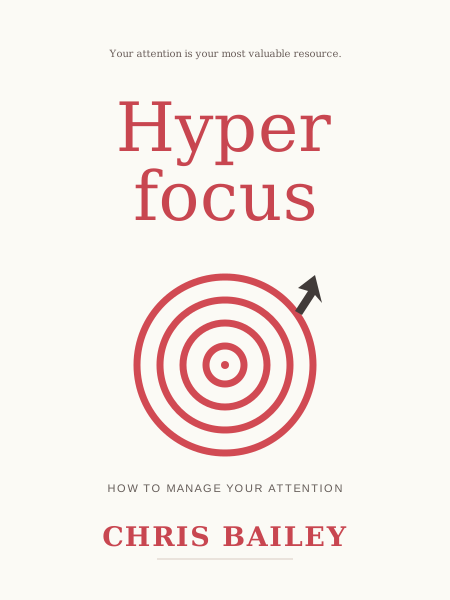
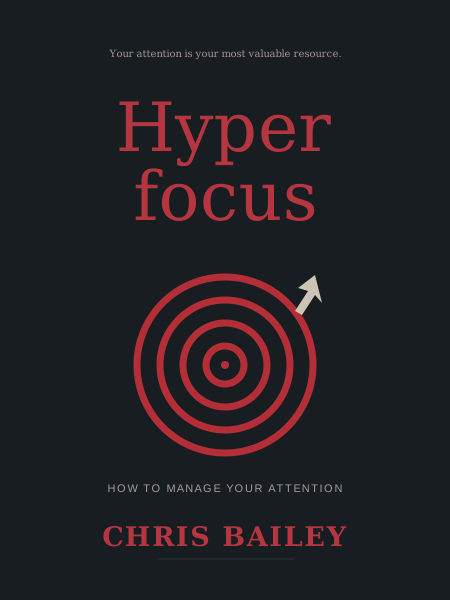
Hyperfocus
Chris Bailey · 2018
Editorial rating
- Evidence
- 7/10
- Actionability
- 8/10
- Originality
- 6/10
The thesis
Attention - not time - is your most limited resource. Mastering two complementary modes, hyperfocus (intense single-task concentration) and scatterfocus (intentional mind-wandering), allows you to accomplish more while simultaneously boosting creativity.
Who this is for
Knowledge workers drowning in distractions who want research-backed techniques for deep concentration. Particularly valuable for people who've tried productivity systems but still struggle with focus and creative blocks.
My favorite quote
Our attention has never been as overwhelmed as it is today. At the same time, our world has never had more things competing for it.
Why it matters
This frames the modern attention crisis as environmental, not personal failure - freeing you to engineer solutions rather than blame willpower.
Do this
Set a timer for 45 minutes right now and work on one thing. When your mind wanders, gently redirect without judgment.
Start here
Attentional Space is the mental capacity holding everything you're conscious of right now. It's limited to roughly 40 bits per second from 11 million bits your brain receives. Every notification, worry, or half-finished task consumes space. Clear it ruthlessly: close tabs, silence phone, write down worries. Then fill it with one meaningful task.
Critical summary
Bailey synthesizes attention research into a practical framework distinguishing between two cognitive modes. Hyperfocus involves deliberately filling your limited attentional space with a single task, while scatterfocus means intentionally letting your mind wander to connect ideas and recharge.
The book builds on Cal Newport's Deep Work but adds neuroscience backing and, crucially, legitimizes mind-wandering as productive rather than wasteful. Bailey's research synthesis is solid - he draws on Timothy Wilson's attention studies, working memory research, and creativity literature.
What it gets right
- Attentional space concept makes abstract "focus" tangible and measurable
- Scatterfocus reframes breaks as productive, not lazy
- Meta-awareness (noticing when you're distracted) is trainable and transformative
- Practical tactics like "Rule of 3" daily priorities are immediately usable
What it misses
- Much content feels familiar if you've read other productivity books - "yeah, I knew that" moments
- Term "hyperfocus" may confuse ADHD readers, for whom hyperfocus can be problematic, not beneficial
- Less novel than Deep Work or Indistractable in the same space
- Some advice is common sense (reduce notifications, take breaks)
- Limited discussion of systemic/workplace issues that prevent focus
Evidence quality is strong - Bailey cites research throughout and conducted personal experiments. The book is well-organized but not groundbreaking.
Key concepts
Attentional Space
Your limited working memory capacity. Before starting work, clear it of open loops and distractions.
Hyperfocus
Deliberately directing attention to one task while managing internal interruptions. Use for complex, important work requiring concentration.
Scatterfocus
Intentional mind-wandering that connects ideas and restores energy. Schedule for creative work and recovery.
Meta-Awareness
Noticing what you're paying attention to in real-time. Practice catching wandering thoughts without judgment.
The Rule of 3
Choose three daily intentions each morning. Review them at day's end.
Productivity/Attractiveness Matrix
Categorize tasks by productivity value and appeal to allocate focus appropriately.
Core insights
-
Complex tasks expand to fill attention
The more attentional space available, the deeper your engagement. Distractions don't just interrupt - they prevent depth.
-
Task-switching costs 50%
Studies show parallel tasks take 50% longer than sequential completion. Batch similar work to minimize switching.
-
Habitual tasks suffer from too much focus
Overthinking automated skills (like typing) degrades performance. Reserve hyperfocus for novel, complex work.
-
Mind-wandering is productive
Scatterfocus connects disparate ideas, processes emotions, and plans future. Don't feel guilty about breaks - structure them.
-
Caffeine and alcohol are attention tools
Use caffeine for focus tasks (30-minute lead time), alcohol for creative/associative thinking. Leverage strategically, not habitually.
Implementation steps
Today
- Write tomorrow's Rule of 3: your three most important tasks
- Clear your workspace and close unnecessary browser tabs
This week
- Track when your mind wanders and what triggered it
- Schedule two 15-minute scatterfocus breaks (walk without phone)
This month
- Build 45-minute hyperfocus blocks into your calendar daily
- Categorize recurring tasks using the productivity/attractiveness matrix
Ongoing
- Practice meta-awareness: set random timer reminders to check where attention is
- Protect scatterfocus time - it's not laziness, it's creativity infrastructure
Suggested 30-day practice plan
An editorial application plan created by Monolithic Vault - an interpretation of the book's ideas, not part of the original book.
- Day 1
Define Rule of 3 for tomorrow; audit current distractions
- Day 2
Try first 45-minute hyperfocus block; note interruptions
- Day 3
Take 15-minute phone-free walk; capture ideas that emerge
- Day 7
Complete productivity/attractiveness matrix for your typical tasks
- Day 14
Review which hyperfocus times worked best; adjust schedule
- Day 21
Track one week of meta-awareness moments; identify patterns
- Day 30
Design your ideal week balancing hyperfocus and scatterfocus periods
Free PDF summary
Take this analysis with you: a designed two-page field-notes sheet with the thesis, my favorite quote, the key concepts and core insights, and the full 30-day checklist. Print it or keep it - free, no signup.
Go deeper
If this analysis earned your attention, the full book goes further than any summary can. The original is always the primary source.